Reading I - Learning a Hard History in Class
Use this reading for questions 1 to 3.
In class, we learned that residential schools were part of a federal policy to assimilate Indigenous children. Children were taken from their families and sent to schools far from home, where they were often punished for speaking their languages. Our teacher said that this history is hard to hear, and that learning it matters because its effects are still felt today.
A community speaker visited our class and talked about language classes and cultural programs that help families rebuild what was harmed. The speaker did not ask us to feel sorry for Indigenous peoples. The speaker asked us to learn accurately, to listen, and to support work led by Indigenous communities.
- An invented account of a student in a British Columbia classroom
1
According to Reading I, what was the purpose of residential schools?
A a federal policy to assimilate Indigenous children B a program run only by families C schools that children chose freely D schools that taught only local languages
What looks wrong with Question 1?
Send anonymously
Cancel
2
According to Reading I, what often happened to children in residential schools who spoke their languages?
A rewarded for speaking their languages B punished for speaking their languages C allowed to speak any language freely D never separated from their families
What looks wrong with Question 2?
Send anonymously
Cancel
3
What does Reading I ask students to do as part of reconciliation?
A feel sorry and do nothing further B avoid hard history entirely C learn accurately and support Indigenous led work D learn only from official documents
What looks wrong with Question 3?
Send anonymously
Cancel
4
What did colonialism in Canada involve?
A only peaceful trade with no harm B a single event with no lasting effects C cooperation that left nations unchanged D taking land, spreading disease, and imposing disruptive policies
What looks wrong with Question 4?
Send anonymously
Cancel
5
Why is colonialism not only a past event?
A policies and systems that still affect people today B an event that ended with no trace C a story with no present meaning D something that affected only one generation
What looks wrong with Question 5?
Send anonymously
Cancel
6
How did residential schools aim to assimilate Indigenous children?
A strengthening family and language ties B removing them from families, languages, and cultures C providing free choice of schooling D teaching only in Indigenous languages
What looks wrong with Question 6?
Send anonymously
Cancel
7
Who ran residential schools, and where were children often sent?
A families in their own communities B provincial governments alone C churches under the federal government, far from home D children who stayed at home each night
What looks wrong with Question 7?
Send anonymously
Cancel
8
In what year did the last federally funded residential school in Canada close?
A 1876, before any other policy B 1950, with no schools after that C 2020, with schools still running today D 1996, in recent history
What looks wrong with Question 8?
Send anonymously
Cancel
9
What were the effects of residential schools, and how long have they been felt?
A language loss, family disruption, and trauma across generations B only the students who attended, with no wider effects C only school buildings D only one community for one year
What looks wrong with Question 9?
Send anonymously
Cancel
10
What did the Indian Act do?
A provincial control of all Indigenous lands B status, reserves, and imposed band councils C a treaty signed by all nations D a law that ended in 1876
What looks wrong with Question 10?
Send anonymously
Cancel
11
Between 1884 and 1951, what did the Indian Act ban?
A only European ceremonies B no ceremonies at all C the potlatch and other ceremonies, from 1884 to 1951 D ceremonies only after 1951
What looks wrong with Question 11?
Send anonymously
Cancel
12
How is status under the Indian Act different from membership in a nation?
A the same as nation membership in every case B a category created by nations themselves C a status that never affected anyone D a legal category, distinct from nation membership
What looks wrong with Question 12?
Send anonymously
Cancel
13
In what is called the Sixties Scoop, where were many Indigenous children removed to in the decades after the 1950s?
A foster and adoptive homes outside their communities B homes within their own communities only C schools chosen by their families D a program that strengthened family ties
What looks wrong with Question 13?
Send anonymously
Cancel
14
Who formally apologised for residential schools in 2008?
A no government ever B the federal government in 2008 C a single school in 2008 D a foreign government in 2008
What looks wrong with Question 14?
Send anonymously
Cancel
15
Besides an apology, what does repair also require?
A words alone with no further change B forgetting the history C action, funding, listening, and changes to policies D blaming survivors for the past
What looks wrong with Question 15?
Send anonymously
Cancel
16
What has happened to First Peoples languages, ceremonies, and governance despite bans and assimilation policies?
A disappeared entirely B survived only in museums C renewed only by outsiders D continued and are being renewed today
What looks wrong with Question 16?
Send anonymously
Cancel
17
What does cultural renewal today include?
A language nests, ceremonies, art, and land based programs B programs that ignore community leadership C renewal that ended in the past D art with no connection to culture
What looks wrong with Question 17?
Send anonymously
Cancel
18
What does truth telling about residential schools involve hearing?
A official documents alone B survivors, families, communities, and records together C ignoring community knowledge D a single source with no checking
What looks wrong with Question 18?
Send anonymously
Cancel
19
Where did residential schools operate in Canada?
A only in eastern Canada B only outside Canada C across Canada, including British Columbia D never in British Columbia
What looks wrong with Question 19?
Send anonymously
Cancel
20
The graph shows students in one school truth and reconciliation learning program. Between 2020 and 2023, enrolment
A fell by 45 students, from 75 to 30 B stayed at 30 students C rose by 200 students D rose by 45 students, from 30 to 75
What looks wrong with Question 20?
Send anonymously
Cancel
21
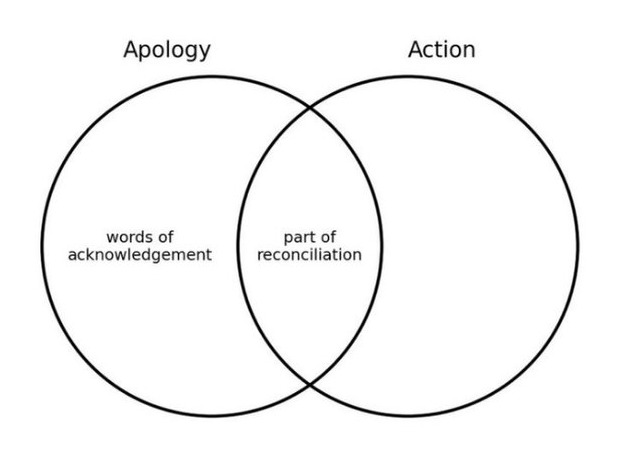
The Venn diagram compares apology and reconciliation action. The part belonging to action alone best represents
A changes to laws and funding B words of acknowledgement C words and action together D forgetting the past
What looks wrong with Question 21?
Send anonymously
Cancel
Reading II - A Language Nest Opens
Use this reading for questions 22 to 24.
In a small community hall, elders and young parents open a language nest for small children. Each morning, the adults speak only the language with the children as they play, eat, and sing. At first, some parents are shy about speaking, because they did not grow up hearing the language every day.
Over the months, the children begin to use greetings and songs on their own. Parents practise in the evenings and share new words with grandparents. One elder says that the nest does not erase the past, but it builds a future in which children grow up hearing the language from birth.
- An invented account of a community language program in British Columbia
22
What does Reading II mainly show?
A community led renewal through daily use B language learning imposed by outsiders C children learning with no adult help D a program that erases the past
What looks wrong with Question 22?
Send anonymously
Cancel
23
According to Reading II, how do children in the language nest learn each morning?
A studying grammar alone in silence B playing, eating, and singing in the language C speaking only English all day D listening to recordings with no people
What looks wrong with Question 23?
Send anonymously
Cancel
24
How does the community in Reading II show resilience?
A by giving up on the language entirely B by depending on outsiders for every lesson C by building a future for its language even after policies harmed transmission D by pretending the past caused no harm
What looks wrong with Question 24?
Send anonymously
Cancel
25
When a community opens a language nest led by elders, what is the best description of that step?
A assimilation imposed from outside B a return to a single past practice C a program with no connection to families D cultural renewal led by the community
What looks wrong with Question 25?
Send anonymously
Cancel