1
An atom has 11 protons and 12 neutrons. The element is
A sodium B magnesium C neon D aluminium
What looks wrong with Question 1?
Send anonymously
Cancel
2
A neutral atom has 17 protons. The number of electrons it has is
A 16 B 17 C 18 D 35
What looks wrong with Question 2?
Send anonymously
Cancel
3
Chlorine has atomic number 17 and mass number 37. The number of neutrons in this atom is ____
What looks wrong with Question 3?
Send anonymously
Cancel
4
Isotopes of an element have the same number of
A protons but different numbers of neutrons B neutrons but different numbers of protons C electrons but different numbers of protons D protons and neutrons in every case
What looks wrong with Question 4?
Send anonymously
Cancel
5
An atom loses two electrons to form an ion. The charge on the ion is
A 2- B 2+ C 0 D 1-
What looks wrong with Question 5?
Send anonymously
Cancel
6
Magnesium has atomic number 12. The number of electrons in Mg²⁺ is
A 10 B 12 C 14 D 8
What looks wrong with Question 6?
Send anonymously
Cancel
7
Oxygen has atomic number 8. The number of electrons in O²⁻ is ____
What looks wrong with Question 7?
Send anonymously
Cancel
8
Going down a group in the periodic table, atomic radius generally
A increases because a new energy level is added B decreases because nuclear charge increases C stays the same in every group D increases because protons are lost
What looks wrong with Question 8?
Send anonymously
Cancel
9
Going across a period from left to right, electronegativity generally
A increases B decreases C stays the same D falls to zero
What looks wrong with Question 9?
Send anonymously
Cancel
10
The element in group 17 and period 3 is
A fluorine B chlorine C bromine D sulfur
What looks wrong with Question 10?
Send anonymously
Cancel
11
Sulfur is in group 16. The number of valence electrons it has is ____
What looks wrong with Question 11?
Send anonymously
Cancel
12
An ionic bond forms when electrons are
A transferred from a metal to a nonmetal B shared equally between two metals C shared between two noble gases D destroyed by the metal atom
What looks wrong with Question 12?
Send anonymously
Cancel
13
Sodium forms Na⁺ and chlorine forms Cl⁻. The formula of the ionic compound formed is
A NaCl B NaCl₂ C Na₂Cl D Na₂Cl₂
What looks wrong with Question 13?
Send anonymously
Cancel
14
Magnesium forms Mg²⁺ and oxygen forms O²⁻. The formula of the compound formed is
A MgO₂ B Mg₂O C MgO D Mg₂O₂
What looks wrong with Question 14?
Send anonymously
Cancel
15
Aluminium forms Al³⁺ and oxygen forms O²⁻. The formula of the compound formed is
A AlO B Al₂O₃ C Al₃O₂ D AlO₂
What looks wrong with Question 15?
Send anonymously
Cancel
16
A covalent bond forms when atoms
A share pairs of electrons B transfer all their protons C lose all their neutrons D become positively charged only
What looks wrong with Question 16?
Send anonymously
Cancel
17
In a water molecule, the oxygen atom has this many lone pairs of electrons
A 0 B 1 C 2 D 3
What looks wrong with Question 17?
Send anonymously
Cancel
18
Carbon dioxide has a central carbon atom bonded to two oxygen atoms and no lone pairs. The shape of the molecule is
A bent B linear C trigonal planar D tetrahedral
What looks wrong with Question 18?
Send anonymously
Cancel
19
Ammonia has a central nitrogen atom bonded to three hydrogen atoms and one lone pair. The shape of the molecule is
A tetrahedral B trigonal pyramidal C linear D bent
What looks wrong with Question 19?
Send anonymously
Cancel
20
Methane has a central carbon atom bonded to four hydrogen atoms and no lone pairs. The shape of the molecule is
A tetrahedral B square planar C bent D linear
What looks wrong with Question 20?
Send anonymously
Cancel
21
Water has a central oxygen atom bonded to two hydrogen atoms and two lone pairs. The shape of the molecule is
A linear B trigonal planar C tetrahedral D bent
What looks wrong with Question 21?
Send anonymously
Cancel
22
Which of these molecules can form hydrogen bonds with other molecules of the same kind
A NH₃ B CH₄ C CO₂ D O₂
What looks wrong with Question 22?
Send anonymously
Cancel
23
London dispersion forces are present
A between all molecules, polar or nonpolar B only between ions in a crystal C only between metals and water D only inside a single atom
What looks wrong with Question 23?
Send anonymously
Cancel
24
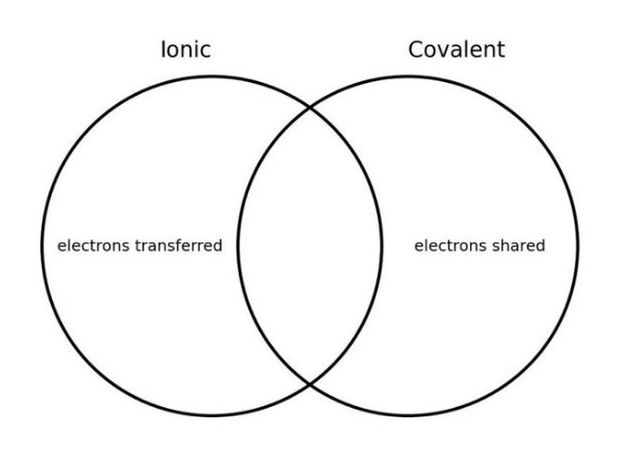
The diagram compares ionic and covalent bonding. Which statement belongs in the overlapping region
A atoms gain a stable electron arrangement B electrons are transferred C electrons are shared D a crystal lattice always forms
What looks wrong with Question 24?
Send anonymously
Cancel
25
The graph shows first ionization energy across period 2, from lithium at A to neon at H. The element with the highest value is at point
A A B C C F D H
What looks wrong with Question 25?
Send anonymously
Cancel