1
A solution contains 1 mole of solute in 2 litres of solution. Its concentration, in moles per litre, is ____
What looks wrong with Question 1?
Send anonymously
Cancel
2
A solution contains 2 moles of solute in 0.5 litre of solution. Its concentration, in moles per litre, is ____
What looks wrong with Question 2?
Send anonymously
Cancel
3
A solution has concentration 2 moles per litre. The amount of solute in 0.25 litre of it, in moles, is ____
What looks wrong with Question 3?
Send anonymously
Cancel
4
Sodium chloride has molar mass 58.5 g per mole. The mass needed to make 0.5 litre of a 2 mole per litre solution, in grams, is ____
What looks wrong with Question 4?
Send anonymously
Cancel
5
A solution is diluted from 100 mL at 6 moles per litre to a final volume of 600 mL. The final concentration, in moles per litre, is ____
What looks wrong with Question 5?
Send anonymously
Cancel
6
To make 500 mL of a 0.2 mole per litre solution from a 2 mole per litre stock solution, the volume of stock needed, in mL, is ____
What looks wrong with Question 6?
Send anonymously
Cancel
7
A saturated solution is one that contains
A no dissolved solute at all
B more solute than water
C the maximum amount of dissolved solute at that temperature
D only solid solute
What looks wrong with Question 7?
Send anonymously
Cancel
8
An unsaturated solution is one that
A has solid solute sitting on the bottom
B cannot dissolve any solute
C can still dissolve more solute at that temperature
D contains no solvent
What looks wrong with Question 8?
Send anonymously
Cancel
9
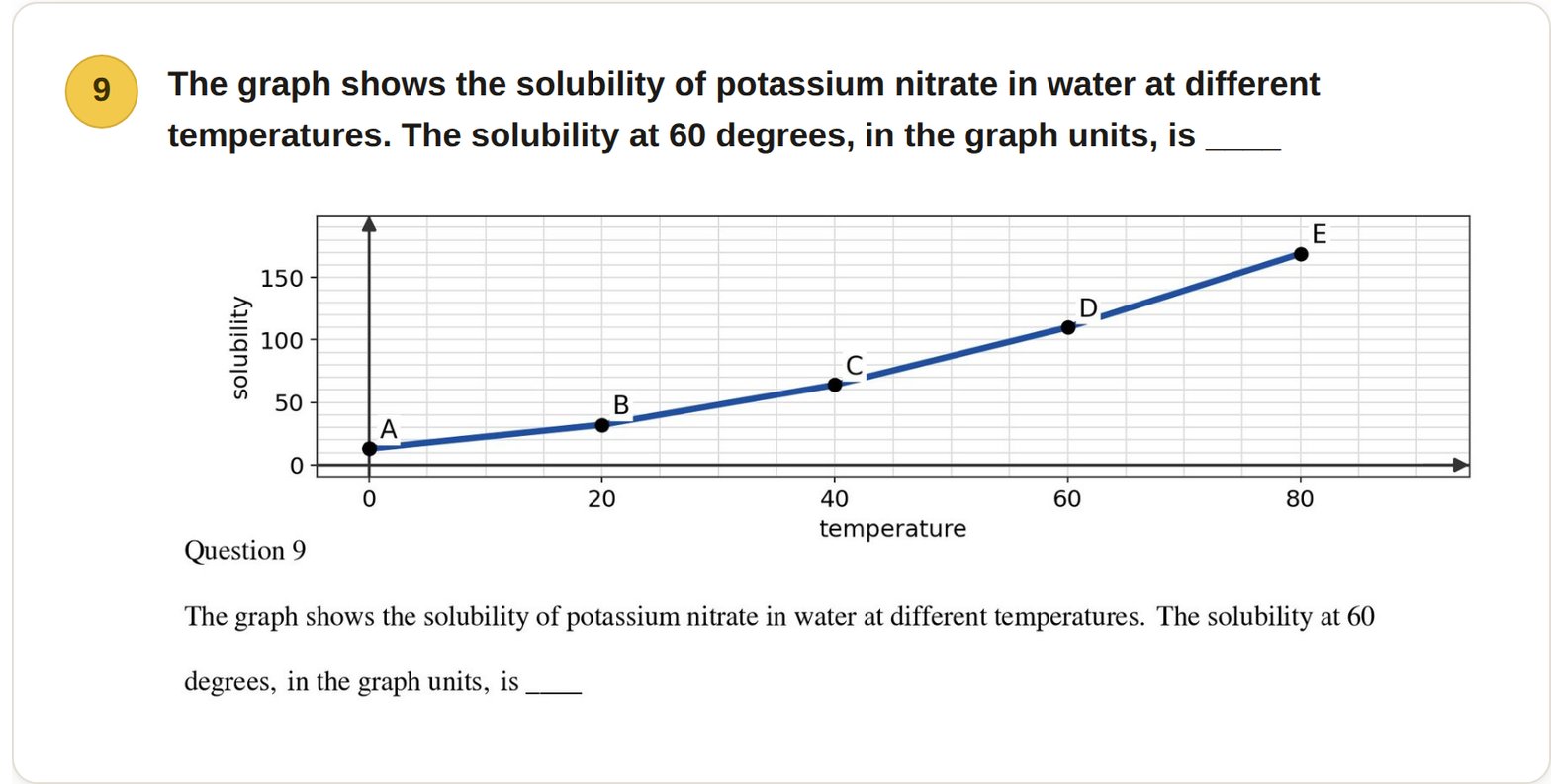
The graph shows the solubility of potassium nitrate in water at different temperatures. The solubility at 60 degrees, in the graph units, is ____
What looks wrong with Question 9?
Send anonymously
Cancel
10
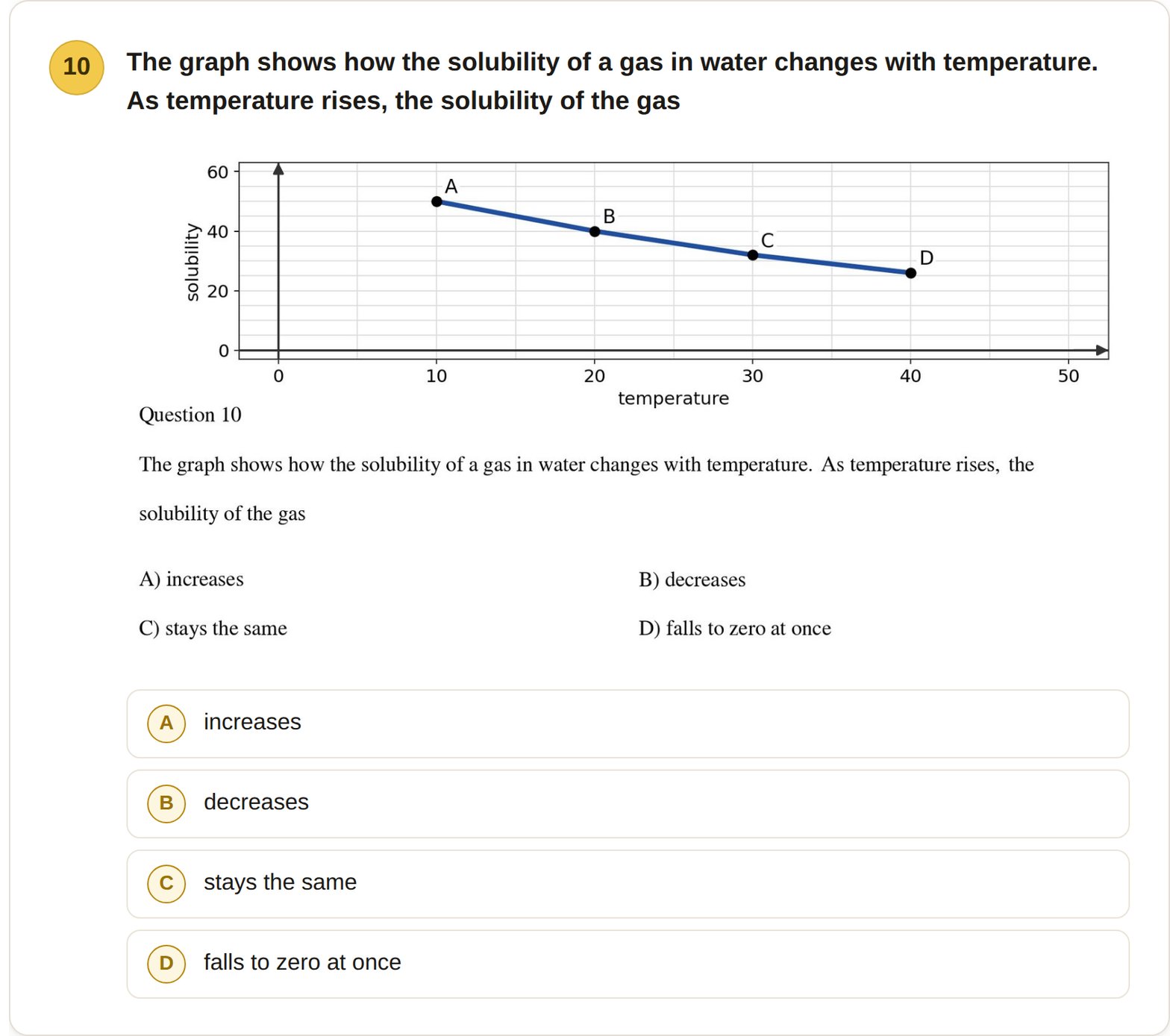
The graph shows how the solubility of a gas in water changes with temperature. As temperature rises, the solubility of the gas
A increases
B decreases
C stays the same
D falls to zero at once
What looks wrong with Question 10?
Send anonymously
Cancel
11
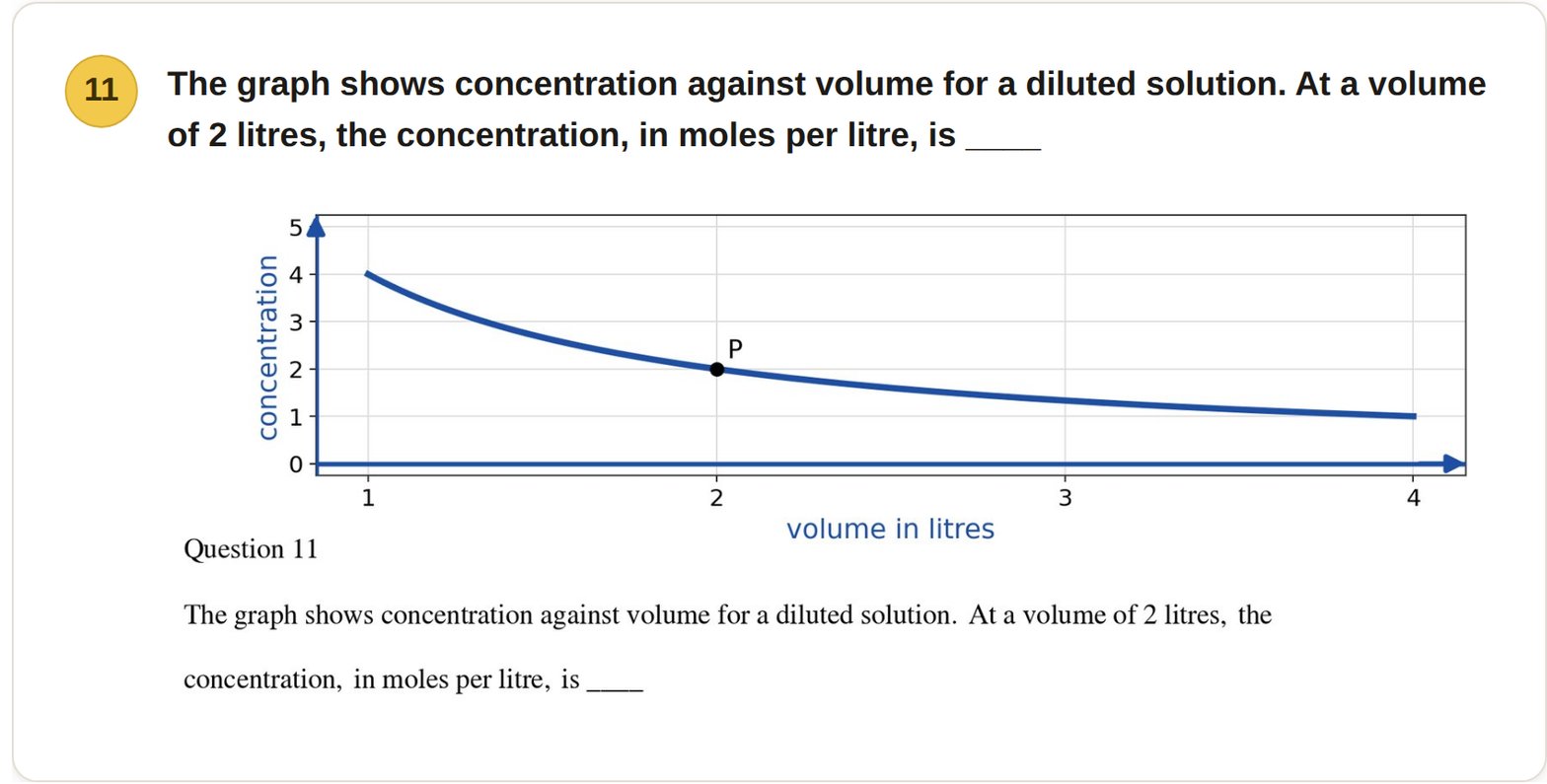
The graph shows concentration against volume for a diluted solution. At a volume of 2 litres, the concentration, in moles per litre, is ____
What looks wrong with Question 11?
Send anonymously
Cancel
12
Methane is a hydrocarbon with formula
A CH₄
B C₂H₆
C CH₃OH
D CO₂
What looks wrong with Question 12?
Send anonymously
Cancel
13
Propane is a hydrocarbon with formula
A C₃H₆
B C₂H₄
C C₄H₁₀
D C₃H₈
What looks wrong with Question 13?
Send anonymously
Cancel
14
Alkanes have the general formula
A CₙH₂ₙ
B CₙH₂ₙ₋₂
C CₙH₂ₙ₊₂
D CₙHₙ
What looks wrong with Question 14?
Send anonymously
Cancel
15
Ethene, C₂H₄, is an example of an
A alkane
B alkene
C alkyne
D alcohol
What looks wrong with Question 15?
Send anonymously
Cancel
16
An organic compound containing the hydroxyl group, OH, is an
A alkane
B alkene
C alcohol
D alkyne
What looks wrong with Question 16?
Send anonymously
Cancel
17
An organic compound containing the carboxyl group, COOH, is a
A ketone
B alkane
C ester
D carboxylic acid
What looks wrong with Question 17?
Send anonymously
Cancel
18
A two carbon alcohol with a hydroxyl group is named
A methanol
B ethanol
C ethane
D ethene
What looks wrong with Question 18?
Send anonymously
Cancel
19
A three carbon alkane is named
A propane
B propene
C butane
D pentane
What looks wrong with Question 19?
Send anonymously
Cancel
20
A four carbon alkane is named
A methane
B ethane
C butane
D propane
What looks wrong with Question 20?
Send anonymously
Cancel
21
In the lab, eye protection should be worn
A only when glass is broken
B whenever chemicals are handled
C only at the end of the lab
D only when water is used
What looks wrong with Question 21?
Send anonymously
Cancel
22
When diluting a concentrated acid, the safe practice is
A to add water to acid quickly
B to add acid to water, slowly and with stirring
C to pour acid down the sink
D to heat the acid first
What looks wrong with Question 22?
Send anonymously
Cancel
23
Broken glass in the lab should be put in
A the sharps container
B the regular garbage bin
C the sink
D a chemical waste bottle
What looks wrong with Question 23?
Send anonymously
Cancel
24
Chemicals in the lab should never be
A labelled before use
B tasted to identify them
C stored in closed containers
D measured with clean equipment
What looks wrong with Question 24?
Send anonymously
Cancel
25
A hydrocarbon is a compound made only of
A carbon and oxygen
B carbon and hydrogen
C hydrogen and oxygen
D carbon and nitrogen
What looks wrong with Question 25?
Send anonymously
Cancel