1
The rate of a reaction is best described as the
A change in concentration of a reactant or product per unit time B total mass of reactants used in the reaction C temperature at which the reaction starts D energy released when the reaction finishes
What looks wrong with Question 1?
Send anonymously
Cancel
2
At equilibrium, the concentrations of reactants and products
A remain constant, though not necessarily equal B are always equal to each other C keep changing until the reaction stops D are always zero for the reactants
What looks wrong with Question 2?
Send anonymously
Cancel
3
In a saturated solution with excess solid present, the solid is
A no longer dissolving at all B dissolving and precipitating at equal rates C only precipitating D only dissolving
What looks wrong with Question 3?
Send anonymously
Cancel
4
Reduction is the process in which a species
A loses electrons B gains electrons C loses protons D gains neutrons
What looks wrong with Question 4?
Send anonymously
Cancel
5
A powdered solid reacts faster than a single lump of the same solid because
A the powder has a larger surface area exposed to the other reactant B the powder has a lower activation energy C the lump has more total mass D the powder contains a catalyst
What looks wrong with Question 5?
Send anonymously
Cancel
6
For CaCO₃(s) ⇌ CaO(s)
A Kₑq = [CaO][CO₂] B Kₑq = [CaO][CO₂] [CaCO₃] C Kₑq = [CO₂] D Kₑq = 1 [CO₂]
What looks wrong with Question 6?
Send anonymously
Cancel
7
The Kₛₚ of AgCl is 1.8 × 10⁻¹⁰. Its molar solubility, in mol/L, is about
A 1.8 × 10⁻¹⁰ B 3.6 × 10⁻¹⁰ C 9.0 × 10⁻¹¹ D 1.3 × 10⁻⁵
What looks wrong with Question 7?
Send anonymously
Cancel
8
In a redox reaction, the oxidizing agent is the species that
A is oxidized and causes another species to be reduced B gains no electrons C is reduced and causes another species to be oxidized D loses no electrons
What looks wrong with Question 8?
Send anonymously
Cancel
9
The activation energy of a reaction is the
A total energy released by the reaction B energy of the products alone C average kinetic energy of all particles D minimum energy colliding particles need to react
What looks wrong with Question 9?
Send anonymously
Cancel
10
At equilibrium, [CO] = 0.20, [H₂O] = 0.20, [CO₂] = 0.40, and [H₂] = 0.40, all in mol/L, for CO
A 1 B 2 C 8 D 4
What looks wrong with Question 10?
Send anonymously
Cancel
11
The graph shows the amount of solid dissolved against time. Points are (0, 0), (1, 3), (2, 5), and (4, 5). The flat section shows the solution has become
A dilute B saturated C unsaturated D boiling
What looks wrong with Question 11?
Send anonymously
Cancel
12
In a galvanic cell, reduction occurs at the
A anode B cathode C salt bridge D wire
What looks wrong with Question 12?
Send anonymously
Cancel
13
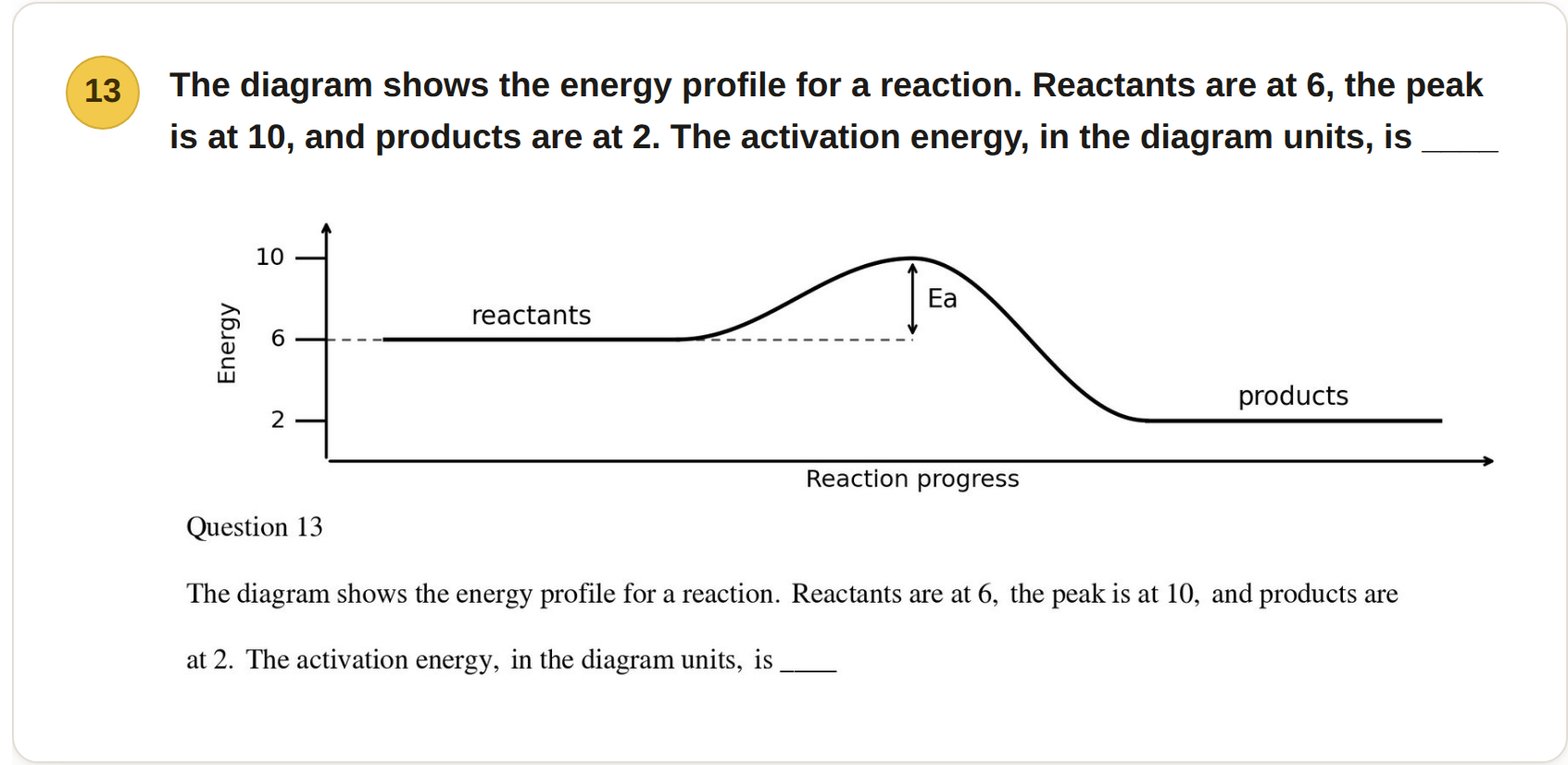
The diagram shows the energy profile for a reaction. Reactants are at 6, the peak is at 10, and products are at 2. The activation energy, in the diagram units, is ____
What looks wrong with Question 13?
Send anonymously
Cancel
14
For A ⇌ B, an
A 0.20 B 0.40 C 1.20 D 0.80
What looks wrong with Question 14?
Send anonymously
Cancel
15
A solution with [H₃O⁺] = 1.0 × 10⁻⁴ mol/L has a pH of
A 2 B 10 C 4 D 12
What looks wrong with Question 15?
Send anonymously
Cancel
16
A galvanic cell converts
A chemical energy into electrical energy B electrical energy into chemical energy C heat energy into light energy D mechanical energy into heat
What looks wrong with Question 16?
Send anonymously
Cancel
17
For the reaction A + B
A double the rate B quadruple the rate C halve the rate D leave the rate unchanged
What looks wrong with Question 17?
Send anonymously
Cancel
18
For the system in the previous type of ICE problem, with [H₂] = 0.20, [I₂] = 0.20, and [HI] = 0.60, all in mol/L, Kₑq is
A 3 B 6 C 9 D 15
What looks wrong with Question 18?
Send anonymously
Cancel
19
The pH of a 0.020 mol/L NaOH(aq) solution, to the nearest hundredth, is
A 12.30 B 11.30 C 12.70 D 13.30
What looks wrong with Question 19?
Send anonymously
Cancel
20
Standard reduction potentials are measured relative to the
A standard zinc electrode B standard copper electrode C standard silver electrode D standard hydrogen electrode
What looks wrong with Question 20?
Send anonymously
Cancel
21
A reaction is zero order with respect to B. Doubling [B] will
A leave the rate unchanged B double the rate C quadruple the rate D halve the rate
What looks wrong with Question 21?
Send anonymously
Cancel
22
For N₂ + 3H₂ ⇌ 2NH₃ + heat, adding more N₂ at equilibrium. In which direction does the equilibrium shift, and why?
A right, forming more NH₃ B left, forming more N₂ C right, forming more H₂ D left, with no change in NH₃
What looks wrong with Question 22?
Send anonymously
Cancel
23
A 0.10 mol/L solution of a weak acid, HX, has a pH of 3.00. The Kₐ of HX is approximately
A 1.0 × 10⁻³ B 1.0 × 10⁻⁷ C 1.0 × 10⁻² D 1.0 × 10⁻⁵
What looks wrong with Question 23?
Send anonymously
Cancel
24
Given E°(Mg²⁺/Mg) = -2.37 V
A 1.57 B 3.17 C 2.37 D 3.97
What looks wrong with Question 24?
Send anonymously
Cancel
25
Two identical reactions are run, one with a catalyst and one without. The catalyzed reaction has a
A higher activation energy and a larger enthalpy change B lower activation energy and more product at equilibrium C lower activation energy and the same enthalpy change D higher activation energy and less product
What looks wrong with Question 25?
Send anonymously
Cancel
26
For N₂ + 3H₂ ⇌
A more moles of gas, the reactant side B fewer moles of gas, the reactant side C fewer moles of gas, the product side D more moles of gas, the product side
What looks wrong with Question 26?
Send anonymously
Cancel
27
For a conjugate acid-base pair, Kₐ × Kb equals
A Kw = 1.0 × 10⁻⁷ B Kw = 1.0 × 10⁻¹⁴ C 14.00 D 7.00
What looks wrong with Question 27?
Send anonymously
Cancel
28
In electroplating a spoon with silver, the spoon is the
A anode B salt bridge C cathode D power supply
What looks wrong with Question 28?
Send anonymously
Cancel
29
As a reaction proceeds, its rate usually decreases because
A the activation energy rises steadily B the catalyst is consumed C reactant concentrations fall, so collisions become less frequent D the temperature always falls
What looks wrong with Question 29?
Send anonymously
Cancel
30
Which change alters the value of Kₑq for a reaction
A a change in concentration B a change in temperature C a change in pressure D adding a catalyst
What looks wrong with Question 30?
Send anonymously
Cancel
31
The graph shows the mass of solid dissolved against time. Points are (0, 0), (2, 4), (4, 6), and (6, 6). The solution first becomes saturated at about
A 2 minutes B 6 minutes C 0 minutes D 4 minutes
What looks wrong with Question 31?
Send anonymously
Cancel
32
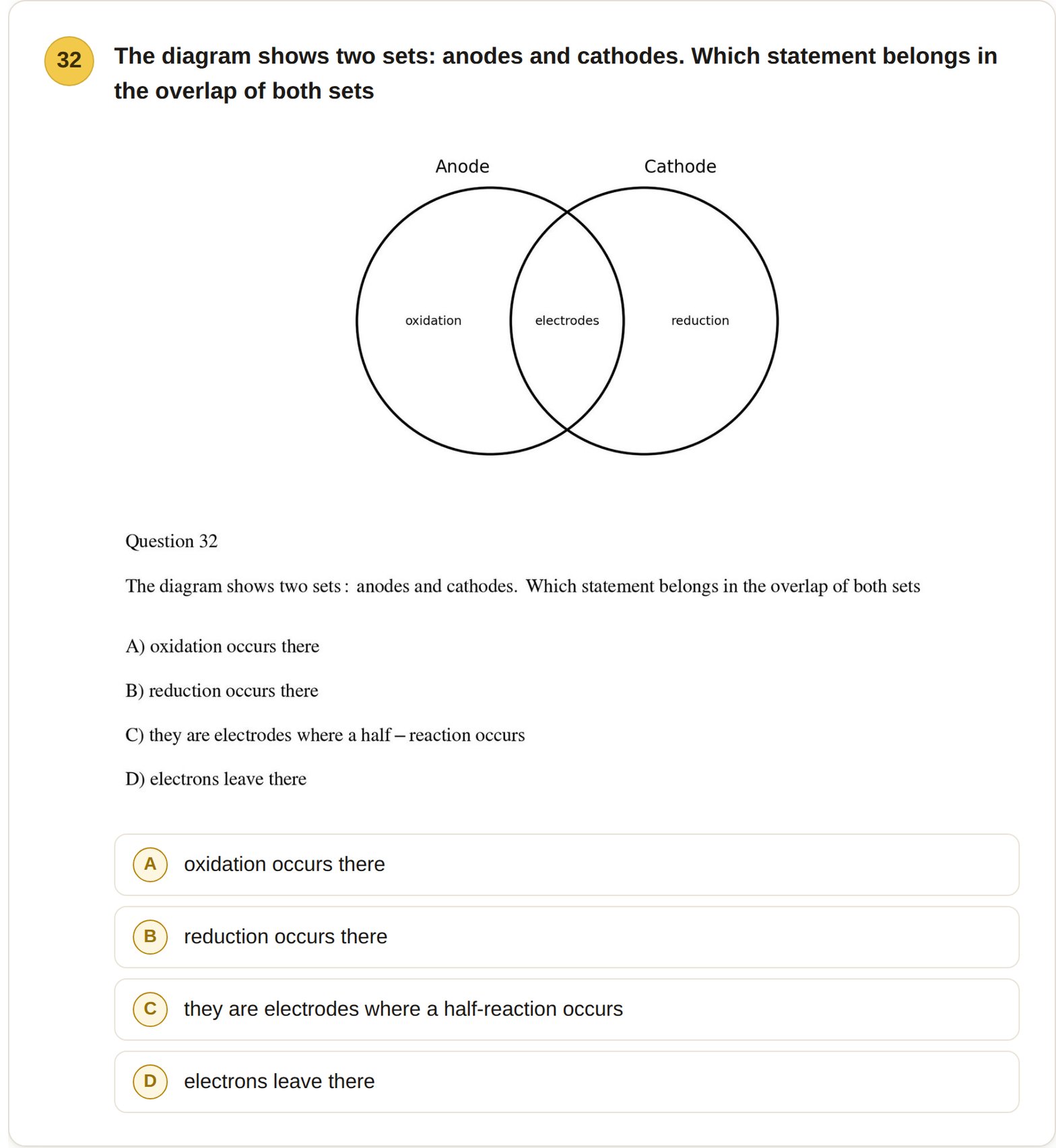
The diagram shows two sets: anodes and cathodes. Which statement belongs in the overlap of both sets
A oxidation occurs there B reduction occurs there C they are electrodes where a half-reaction occurs D electrons leave there
What looks wrong with Question 32?
Send anonymously
Cancel
33
The graph shows product concentration against time. Points are (0, 0), (1, 4), (2, 6), and (3, 7). During which time interval is product forming fastest
A 1 to 2 minutes B 0 to 1 minute C 2 to 3 minutes D The rate is constant
What looks wrong with Question 33?
Send anonymously
Cancel
34
The equilibrium law expression for CO(g) +
A Kₑq = [CO][H₂O] [CO₂][H₂] B Kₑq = [CO₂] [CO] C Kₑq = [CO₂][H₂] [CO][H₂O] D Kₑq = [CO₂][H₂]
What looks wrong with Question 34?
Send anonymously
Cancel
35
A larger Kₛₚ for salts of the same type generally means
A lower solubility B greater solubility C a higher pH D a lower temperature
What looks wrong with Question 35?
Send anonymously
Cancel
36
In the reaction Mg + 2Ag⁺ →
A Mg B Ag⁺ C Mg²⁺ D Ag
What looks wrong with Question 36?
Send anonymously
Cancel
37
Which condition gives the fastest reaction between magnesium and acid
A a magnesium block in cold, dilute acid B magnesium ribbon in cold, dilute acid C a magnesium block in warm, dilute acid D magnesium ribbon in warm, concentrated acid
What looks wrong with Question 37?
Send anonymously
Cancel
38
For X ⇌ Y, with
A 0.10 B 0.60 C 0.90 D 0.30
What looks wrong with Question 38?
Send anonymously
Cancel
39
A solution with pOH 3 has a pH of
A 3 B 7 C 14 D 11
What looks wrong with Question 39?
Send anonymously
Cancel
40
Given E°(Mg²⁺/Mg) = -2.37 V
A 1.61 B 2.37 C 3.13 D 0.76
What looks wrong with Question 40?
Send anonymously
Cancel
41
The concentration of a reactant falls from 0.60 mol/L to 0.30 mol/L in 15 seconds. The average rate of consumption, in mol/L/s, is
A 0.020 B 0.010 C 0.030 D 0.040
What looks wrong with Question 41?
Send anonymously
Cancel
42
For 2SO₂ + O₂ ⇌
A left, toward more moles of gas B right, toward fewer moles of gas C right, toward more moles of gas D left, toward fewer moles of gas
What looks wrong with Question 42?
Send anonymously
Cancel
43
Which 0.10 mol/L solution has the highest pH
A NaOH(aq) B HCl(aq) C NH₃(aq) D CH₃COOH(aq)
What looks wrong with Question 43?
Send anonymously
Cancel
44
In a zinc-copper galvanic cell, the copper electrode
A loses mass as copper metal is oxidized B gains mass as copper metal plates onto it C does not change in mass D gains mass as zinc plates onto it
What looks wrong with Question 44?
Send anonymously
Cancel
45
Which change increases both the frequency and the energy of collisions
A adding a catalyst B grinding a solid reactant C diluting a solution D raising the temperature
What looks wrong with Question 45?
Send anonymously
Cancel
46
When a stress is applied to a system at equilibrium, the system shifts to
A increase the stress further B stop both reactions C partially counteract the stress D change the temperature to zero
What looks wrong with Question 46?
Send anonymously
Cancel
47
The conjugate base of HF(aq) is
A F⁻(aq) B H₂F⁺(aq) C H₃O⁺(aq) D OH⁻(aq)
What looks wrong with Question 47?
Send anonymously
Cancel
48
Which equation is a balanced redox half-reaction for the oxidation of aluminium
A Al + 3e⁻ → Al³⁺ B Al → Al³⁺ + e⁻ C Al → Al³⁺ + 3e⁻ D Al³⁺ + 3e⁻ → Al
What looks wrong with Question 48?
Send anonymously
Cancel
49
Stirring a mixture can increase the reaction rate because
A it lowers the activation energy B it brings reactant particles into contact more often C it changes the enthalpy of reaction D it acts as a catalyst
What looks wrong with Question 49?
Send anonymously
Cancel
50
For A + B ⇌ C + D,
A 3 B 6 C 12 D 9
What looks wrong with Question 50?
Send anonymously
Cancel