1
For a reaction to occur, reactant particles must
A collide gently in any orientation B remain far apart and move slowly C collide with enough energy and the right orientation D break apart before they meet
What looks wrong with Question 1?
Send anonymously
Cancel
2
The rate of a reaction is best described as the
A change in concentration of a reactant or product per unit time B total mass of reactants used in the reaction C temperature at which the reaction starts D energy released when the reaction finishes
What looks wrong with Question 2?
Send anonymously
Cancel
3
Increasing the concentration of a reactant usually increases the rate because
A the activation energy of the reaction increases B the products become more stable C the catalyst is used up more slowly D there are more collisions per second between particles
What looks wrong with Question 3?
Send anonymously
Cancel
4
Raising the temperature of a reacting mixture increases the rate mainly because
A the reactants become less concentrated B a larger fraction of collisions have at least the activation energy C the activation energy becomes zero D the products stop reacting
What looks wrong with Question 4?
Send anonymously
Cancel
5
A powdered solid reacts faster than a single lump of the same solid because
A the powder has a larger surface area exposed to the other reactant B the powder has a lower activation energy C the lump has more total mass D the powder contains a catalyst
What looks wrong with Question 5?
Send anonymously
Cancel
6
A catalyst speeds up a reaction by
A increasing the energy of the products B being used up to form extra product C providing a pathway with a lower activation energy D raising the temperature of the mixture
What looks wrong with Question 6?
Send anonymously
Cancel
7
Which statement about a catalyst is true
A it is consumed in the reaction B it is not consumed in the overall reaction C it changes the overall enthalpy change of the reaction D it makes an endothermic reaction exothermic
What looks wrong with Question 7?
Send anonymously
Cancel
8
The activation energy of a reaction is the
A total energy released by the reaction B energy of the products alone C average kinetic energy of all particles D minimum energy colliding particles need to react
What looks wrong with Question 8?
Send anonymously
Cancel
9
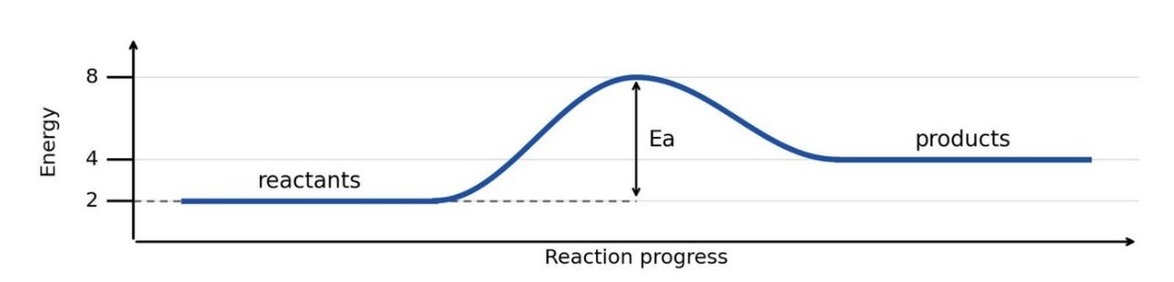
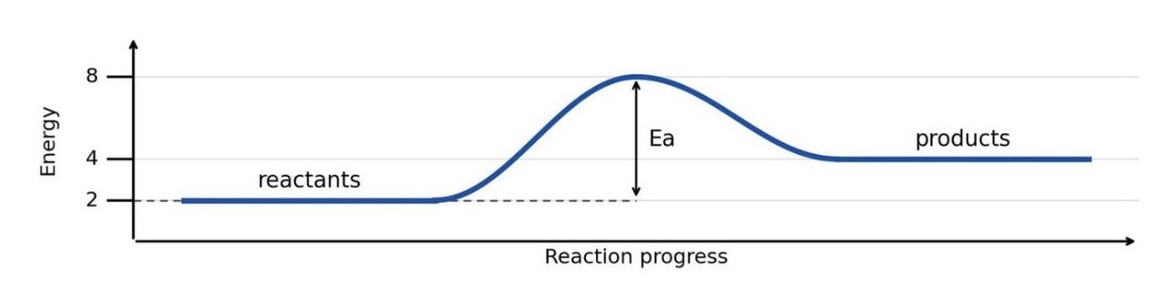
The diagram shows the energy profile for a reaction. Reactants are at 2, the peak is at 8, and products are at 4. The activation energy, in the diagram units, is ____
What looks wrong with Question 9?
Send anonymously
Cancel
10
The diagram shows the energy profile for a reaction. Reactants are at 2, the peak is at 8, and products are at 4. The enthalpy change of the reaction, in the diagram units, is
A -2 B +6 C -6 D +2
What looks wrong with Question 10?
Send anonymously
Cancel
11
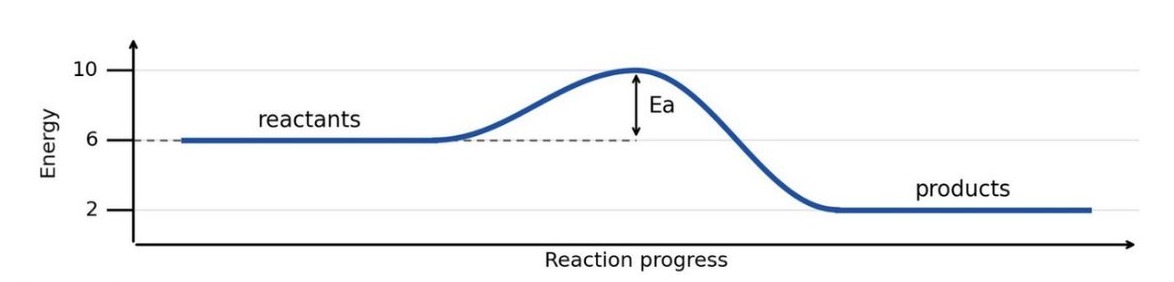
The diagram shows the energy profile for a reaction. Reactants are at 6, the peak is at 10, and products are at 2. The activation energy, in the diagram units, is ____
What looks wrong with Question 11?
Send anonymously
Cancel
12
The graph shows reactant concentration against time. Points are (0, 8), (2, 5), (4, 3), and (6, 2). During which time interval is the reaction fastest
A 2 to 4 minutes B 4 to 6 minutes C 0 to 2 minutes D The rate is constant
What looks wrong with Question 12?
Send anonymously
Cancel
13
For the reaction A + B
A double the rate B quadruple the rate C halve the rate D leave the rate unchanged
What looks wrong with Question 13?
Send anonymously
Cancel
14
For a reaction with rate law rate = k[A]²[B], doubling [A] while [B] is constant will
A double the rate B quadruple the rate C halve the rate D leave the rate unchanged
What looks wrong with Question 14?
Send anonymously
Cancel
15
For a reaction with rate law rate = k[A][B]², tripling [B] while [A] is constant will multiply the rate by
A 3 B 6 C 27 D 9
What looks wrong with Question 15?
Send anonymously
Cancel
16
In an experiment, doubling [A] doubles the initial rate, while doubling [B] has no effect on the rate. The rate law is
A rate = k[B] B rate = k[A][B] C rate = k[A] D rate = k[A]²
What looks wrong with Question 16?
Send anonymously
Cancel
17
In an experiment, doubling [A] quadruples the initial rate. The order of the reaction with respect to A is
A 0 B 2 C 1 D 3
What looks wrong with Question 17?
Send anonymously
Cancel
18
A reaction is zero order with respect to B. Doubling [B] will
A leave the rate unchanged B double the rate C quadruple the rate D halve the rate
What looks wrong with Question 18?
Send anonymously
Cancel
19
The rate constant k for a reaction increases when
A the concentration increases B the pressure decreases C more product is added D the temperature increases
What looks wrong with Question 19?
Send anonymously
Cancel
20
Which change would slow down the reaction of zinc with hydrochloric acid
A using a large piece of zinc instead of zinc powder B using more concentrated acid C warming the acid D stirring the mixture
What looks wrong with Question 20?
Send anonymously
Cancel
21
Two identical reactions are run, one with a catalyst and one without. The catalyzed reaction has a
A higher activation energy and a larger enthalpy change B lower activation energy and more product at equilibrium C lower activation energy and the same enthalpy change D higher activation energy and less product
What looks wrong with Question 21?
Send anonymously
Cancel
22
The concentration of a reactant falls from 0.80 mol/L to 0.20 mol/L in 30 seconds. The average rate of consumption, in mol/L/s, is
A 0.010 B 0.020 C 0.030 D 0.060
What looks wrong with Question 22?
Send anonymously
Cancel
23
A product forms at an average rate of 0.040 mol/L/s for 25 seconds. The increase in its concentration, in mol/L, is
A 1.0 B 0.50 C 1.5 D 2.0
What looks wrong with Question 23?
Send anonymously
Cancel
24
As a reaction proceeds, its rate usually decreases because
A the activation energy rises steadily B the catalyst is consumed C reactant concentrations fall, so collisions become less frequent D the temperature always falls
What looks wrong with Question 24?
Send anonymously
Cancel
25
Which factor does NOT affect the rate of a chemical reaction
A the temperature of the mixture B the colour of the container C the surface area of a solid reactant D the presence of a catalyst
What looks wrong with Question 25?
Send anonymously
Cancel