1
A saturated solution is one in which
A no solute has dissolved B the solute will never dissolve C the solution is boiling D the maximum amount of solute is dissolved at that temperature
What looks wrong with Question 1?
Send anonymously
Cancel
2
In a saturated solution with excess solid present, the solid is
A no longer dissolving at all B dissolving and precipitating at equal rates C only precipitating D only dissolving
What looks wrong with Question 2?
Send anonymously
Cancel
3
The solubility product constant, Kₛₚ, for
A Kₛₚ = [Ag⁺] [Cl⁻] B Kₛₚ = [AgCl] C Kₛₚ = [Ag⁺][Cl⁻] D Kₛₚ = 1 [Ag⁺][Cl⁻]
What looks wrong with Question 3?
Send anonymously
Cancel
4
For PbI₂(s) ⇌ Pb²⁺(aq)
A Kₛₚ = [Pb²⁺][I⁻]² B Kₛₚ = [Pb²⁺][I⁻] C Kₛₚ = [Pb²⁺] [I⁻]² D Kₛₚ = [Pb²⁺][I⁻]³
What looks wrong with Question 4?
Send anonymously
Cancel
5
If the molar solubility of AgCl is 1.3 × 10⁻⁵ mol/L, then [Ag⁺] in a saturated solution, in mol/L, is
A 1.3 × 10⁻⁵ B 2.6 × 10⁻⁵ C 6.5 × 10⁻⁶ D 1.7 × 10⁻¹⁰
What looks wrong with Question 5?
Send anonymously
Cancel
6
The Kₛₚ of AgCl is 1.8 × 10⁻¹⁰. Its molar solubility, in mol/L, is about
A 1.8 × 10⁻¹⁰ B 3.6 × 10⁻¹⁰ C 9.0 × 10⁻¹¹ D 1.3 × 10⁻⁵
What looks wrong with Question 6?
Send anonymously
Cancel
7
A salt MX₂ has Kₛₚ = 4.0 × 10⁻¹². Its molar solubility, in mol/L, is
A 2.0 × 10⁻⁶ B 4.0 × 10⁻¹² C 1.0 × 10⁻⁴ D 1.6 × 10⁻¹¹
What looks wrong with Question 7?
Send anonymously
Cancel
8
Adding NaCl to a saturated solution of AgCl will
A increase the solubility of AgCl B decrease the solubility of AgCl by the common ion effect C have no effect on the solubility of AgCl D change the Kₛₚ of AgCl
What looks wrong with Question 8?
Send anonymously
Cancel
9
The graph shows the amount of solid dissolved against time. Points are (0, 0), (1, 3), (2, 5), and (4, 5). The flat section shows the solution has become
A dilute B saturated C unsaturated D boiling
What looks wrong with Question 9?
Send anonymously
Cancel
10
A strong acid differs from a weak acid in that a strong acid
A ionizes almost completely in water B ionizes only slightly in water C always has a pH above 7 D never conducts electricity
What looks wrong with Question 10?
Send anonymously
Cancel
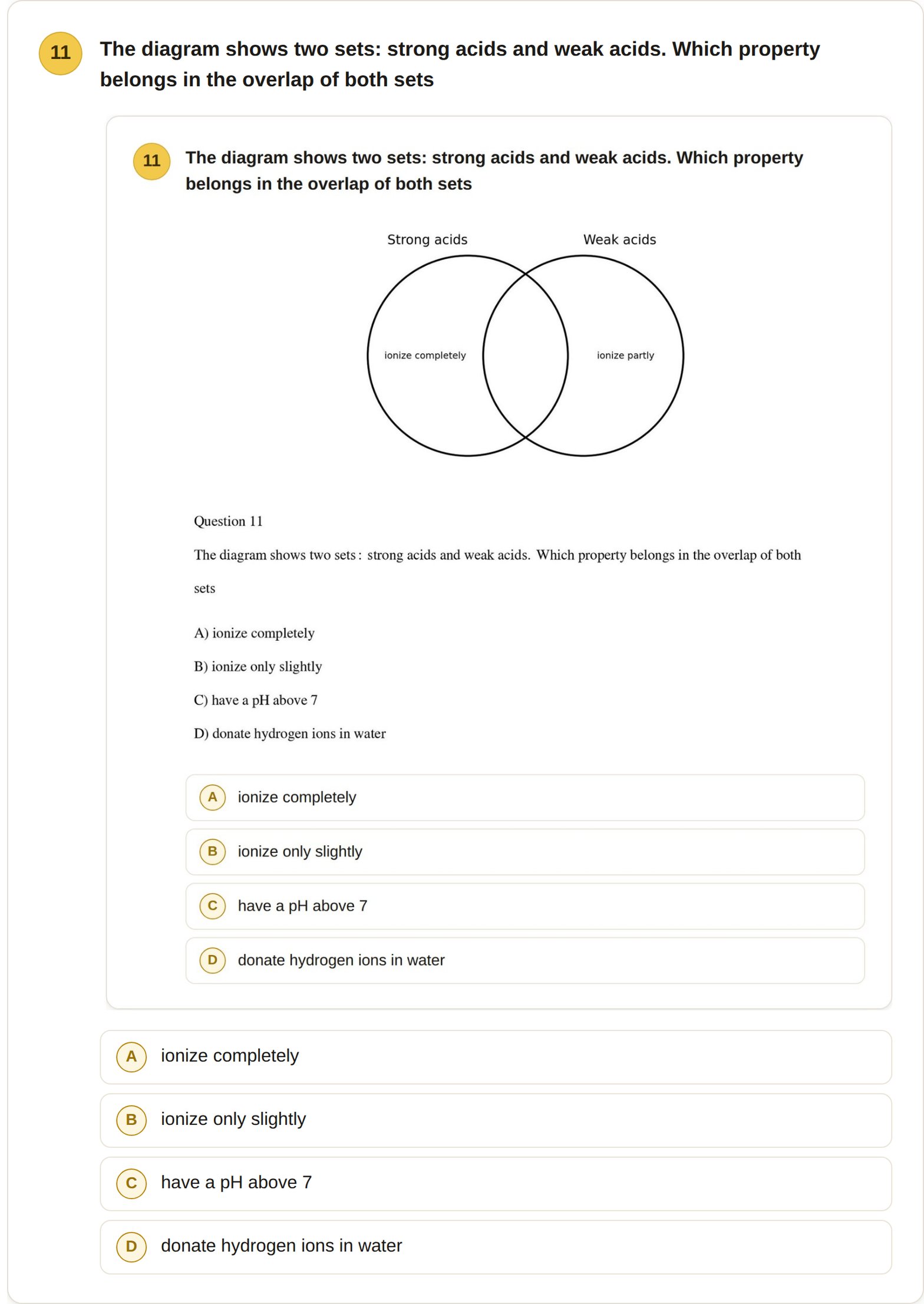
11
The diagram shows two sets: strong acids and weak acids. Which property belongs in the overlap of both sets
A ionize completely B ionize only slightly C have a pH above 7 D donate hydrogen ions in water
What looks wrong with Question 11?
Send anonymously
Cancel
12
A solution with [H₃O⁺] = 1.0 × 10⁻⁴ mol/L has a pH of
A 2 B 10 C 4 D 12
What looks wrong with Question 12?
Send anonymously
Cancel
13
A solution with pH 4 has a pOH of
A 4 B 7 C 14 D 10
What looks wrong with Question 13?
Send anonymously
Cancel
14
A solution with [OH⁻] = 0.010 mol/L has a pH of
A 2 B 12 C 7 D 10
What looks wrong with Question 14?
Send anonymously
Cancel
15
The pH of a 0.0010 mol/L HCl(aq) solution is
A 1 B 11 C 3 D 13
What looks wrong with Question 15?
Send anonymously
Cancel
16
The pH of a 0.020 mol/L NaOH(aq) solution, to the nearest hundredth, is
A 12.30 B 11.30 C 12.70 D 13.30
What looks wrong with Question 16?
Send anonymously
Cancel
17
If the pH of a solution falls by 2, its hydronium ion concentration
A decreases by a factor of 100 B increases by a factor of 100 C increases by a factor of 2 D decreases by a factor of 2
What looks wrong with Question 17?
Send anonymously
Cancel
18
The acid ionization constant, Kₐ, is larger for
A a stronger weak acid B a weaker weak acid C a stronger weak base D a solution with a higher pH
What looks wrong with Question 18?
Send anonymously
Cancel
19
A 0.10 mol/L solution of a weak acid, HX, has a pH of 3.00. The Kₐ of HX is approximately
A 1.0 × 10⁻³ B 1.0 × 10⁻⁷ C 1.0 × 10⁻² D 1.0 × 10⁻⁵
What looks wrong with Question 19?
Send anonymously
Cancel
20
Ethanoic acid has Kₐ = 1.8 × 10⁻⁵. The pH of a 0.10 mol/L solution, to the nearest hundredth, is
A 1.87 B 3.87 C 2.87 D 4.87
What looks wrong with Question 20?
Send anonymously
Cancel
21
Ammonia, NH₃, has Kb = 1.8 × 10⁻⁵. The pH of a 0.10 mol/L solution, to the nearest hundredth, is
A 9.13 B 10.13 C 12.13 D 11.13
What looks wrong with Question 21?
Send anonymously
Cancel
22
For a conjugate acid-base pair, Kₐ × Kb equals
A Kw = 1.0 × 10⁻⁷ B Kw = 1.0 × 10⁻¹⁴ C 14.00 D 7.00
What looks wrong with Question 22?
Send anonymously
Cancel
23
The Kₐ of NH₄⁺(aq) is 5.6 × 10⁻¹⁰. The Kb of NH₃(aq) is approximately
A 5.6 × 10⁻¹⁰ B 1.0 × 10⁻¹⁴ C 1.8 × 10⁻⁵ D 5.6 × 10⁻⁴
What looks wrong with Question 23?
Send anonymously
Cancel
24
A buffer solution resists changes in pH because it contains
A a weak acid and its conjugate base in comparable amounts B a strong acid and a strong base in equal amounts C only a weak acid D only a salt of a strong acid
What looks wrong with Question 24?
Send anonymously
Cancel
25
A buffer contains 0.30 mol/L HF and 0.30 mol/L NaF. With Kₐ = 3.5 × 10⁻⁴ for HF, its pH is about
A 2.46 B 3.46 C 4.46 D 5.46
What looks wrong with Question 25?
Send anonymously
Cancel