Reading I - Keep the Library Open
Use this reading for questions 1 to 3.
Our town should keep the library open on Sundays. Students who work on Saturdays need a quiet place to study, and many families have no computer at home. A Sunday opening would cost some money, but the gain for learners is worth it.
1
According to Reading I, what is the writer's main claim
A the library should stay open on Sundays B libraries should close on weekends C students should work on Saturdays D computers should be banned from homes
What looks wrong with Question 1?
Send anonymously
Cancel
2
According to Reading I, which detail supports the claim about Sunday opening
A the library has a large front door B many people enjoy reading novels C the town has several parks D students who work on Saturdays need a quiet place to study
What looks wrong with Question 2?
Send anonymously
Cancel
3
According to Reading I, when the writer admits that Sunday opening would cost money, the writer is
A ending the piece without a conclusion B describing the library building C addressing a possible opposing view D changing the claim completely
What looks wrong with Question 3?
Send anonymously
Cancel
Reading II - How Compost Works
Use this reading for questions 4 to 6.
A community compost bin turns food scraps into soil. First, residents add fruit peels and leaves. Then tiny organisms break the material down, and heat builds inside the bin. After several weeks, the dark crumbly material can feed garden beds.
4
According to Reading II, what is the main idea of the passage
A where to buy fruit and vegetables B how a community compost bin turns scraps into soil C why libraries should open on Sundays D how to build a house from wood
What looks wrong with Question 4?
Send anonymously
Cancel
5
According to Reading II, the passage is organised mainly by
A steps in order, from adding scraps to finished soil B alphabetical order of the words used C a story with characters and a climax D arguments for and against composting
What looks wrong with Question 5?
Send anonymously
Cancel
6
According to Reading II, which detail is an example of material added to the bin
A garden beds B the library roof C a study timetable D fruit peels and leaves
What looks wrong with Question 6?
Send anonymously
Cancel
7
Which sentence is the strongest thesis for an essay arguing that schools should start later
A Schools should start later so students can sleep, learn, and arrive ready B I like mornings very much C There are many schools in the world D This essay will talk about schools and mornings
What looks wrong with Question 7?
Send anonymously
Cancel
8
A persuasive paragraph usually follows which structure
A a conclusion placed before the claim B claim, reasons, and evidence that supports the reasons C a list of jokes with no claim at all D a description of the weather only
What looks wrong with Question 8?
Send anonymously
Cancel
9
Which of these is the strongest supporting evidence for a claim about exercise and health
A a large health study that measured fitness over two years B one person's guess about exercise C a slogan printed on a poster D a story about a single walk taken once
What looks wrong with Question 9?
Send anonymously
Cancel
10
Which sentence states a fact rather than an opinion
A The library is the best place in town B Sunday opening is a wonderful idea C Everyone loves the library most D The town library opened in 1998
What looks wrong with Question 10?
Send anonymously
Cancel
11
Which sentence states an opinion rather than a fact
A The new playground is the most exciting place in town B The playground opened last spring C The playground has three slides D The school has 400 students
What looks wrong with Question 11?
Send anonymously
Cancel
12
A student writes a letter to the town council asking for a crosswalk. The real-world audience is
A readers of a poetry magazine B the town council, who can decide about crosswalks C the student's private diary D characters in a fictional story
What looks wrong with Question 12?
Send anonymously
Cancel
13
A persuasive conclusion should mainly
A restate the claim and call the reader to act B introduce a completely new argument C list every detail from the piece again D ask the reader to ignore the claim
What looks wrong with Question 13?
Send anonymously
Cancel
14
A writer gives three reasons for a proposal, saving the strongest reason for last. This ordering is used to
A hide the strongest reason from readers B make the piece shorter C confuse the reader about the claim D build the argument toward its strongest point
What looks wrong with Question 14?
Send anonymously
Cancel
15
A claim supported only by one personal story is weak because
A stories must always be fictional B readers dislike all personal stories C one story cannot show what is true for most people D personal stories are never interesting
What looks wrong with Question 15?
Send anonymously
Cancel
16
An expository piece differs from a persuasive piece mainly because expository writing aims to
A argue without giving any reasons B explain or inform, rather than convince the reader to act C entertain with jokes and nothing else D hide all facts from the reader
What looks wrong with Question 16?
Send anonymously
Cancel
17
When a writer answers an opposing view with evidence, the writer is making a
A rebuttal, or answer to the opposing view B new thesis for a different piece C list of unrelated facts D summary of the setting
What looks wrong with Question 17?
Send anonymously
Cancel
18
A writer adapts a proposal about school lunches for parents rather than for classmates. The version for parents should mainly
A use slang that only classmates understand B leave out all reasons and evidence C argue that parents should not read it D use a respectful tone and address costs and health
What looks wrong with Question 18?
Send anonymously
Cancel
19
The diagram shows signatures on a petition over four weeks. In which week did the number of signatures rise the most
A Week 1 B Week 2 C Week 3 D Week 4
What looks wrong with Question 19?
Send anonymously
Cancel
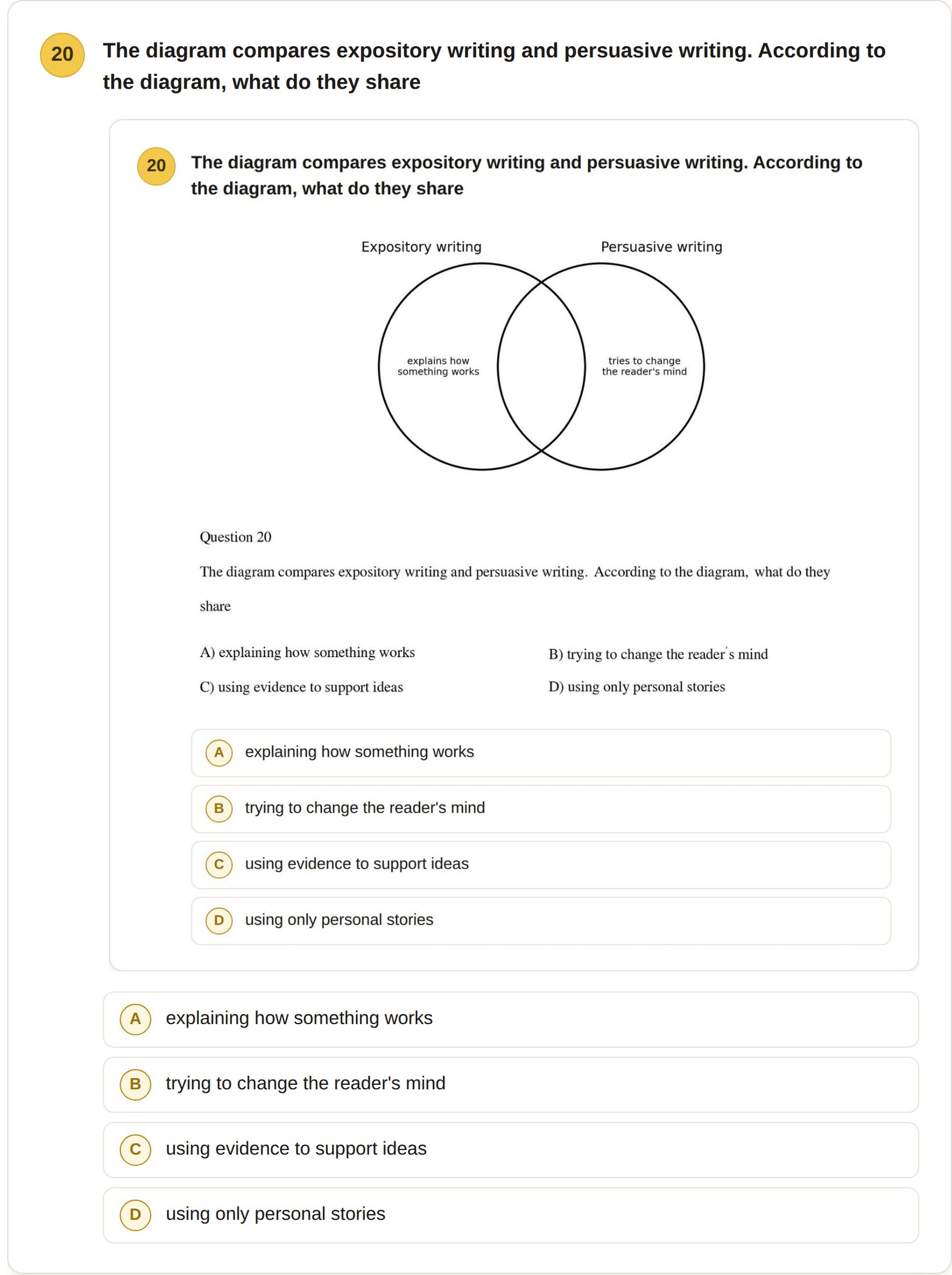
20
The diagram compares expository writing and persuasive writing. According to the diagram, what do they share
A explaining how something works B trying to change the reader's mind C using evidence to support ideas D using only personal stories
What looks wrong with Question 20?
Send anonymously
Cancel
21
Which signal word most clearly marks an opinion in a sentence
A has B did C should D was
What looks wrong with Question 21?
Send anonymously
Cancel
22
A writer claims that a new bike lane will make streets safer. Which detail is relevant evidence for that claim
A a list of favourite bike colours B a traffic count showing fewer crashes on streets with bike lanes C the colour of the bikes sold in town D the name of the first bicycle ever made
What looks wrong with Question 22?
Send anonymously
Cancel
23
An opinion piece about a school rule should be written in a tone that is
A respectful, so readers take the argument seriously B rude, so readers feel attacked C silent, with no words at all D confusing, so readers give up
What looks wrong with Question 23?
Send anonymously
Cancel
24
A student explains how rain gardens work for a neighbourhood newsletter. The form and audience fit because the piece
A argues that newsletters should be banned B tells a fictional story with no facts C lists jokes with no explanation D informs local readers about a local topic in plain language
What looks wrong with Question 24?
Send anonymously
Cancel
25
Which opening best states the claim of an opinion piece about recycling at school
A Our school should recycle paper, cans, and bottles every week B Recycling is a word with many letters C I went to school yesterday morning D There are many kinds of bins in the world
What looks wrong with Question 25?
Send anonymously
Cancel