Reading I - The Keeper of the Light
Use this reading for questions 1 to 7.
Every summer since she was twelve, Wren had helped her grandfather tend the lighthouse on a rocky point north of town. He kept a careful log of each night: the wind, the state of the sea, and the hour the lamp was lit. Wren learned to polish the lens, to trim the wick, and to read the weather in the colour of the sky at dusk.
In August of the summer she turned seventeen, a storm arrived two days early and her grandfather fell ill with a fever. A small fishing boat was late returning to harbour, and Wren had to decide whether to keep the lamp burning through the worst of the wind or to save fuel in case the storm lasted another night. She checked the log, remembered her grandfather's rule to light for any boat still out, and kept the lamp bright.
By morning the boat was safe in the harbour, and her grandfather, still weak, squeezed her hand and said the light had done its work. Wren understood then that duty was not the opposite of freedom. Keeping the light had been her own choice, made with care, and that choice had given the night its meaning.
1
According to Reading I, what is the central idea of the story?
A Wren leaves the lighthouse to seek freedom elsewhere B Wren learns that duty and freedom can exist side by side C Wren proves that storms always arrive on schedule D Wren decides that keeping a log is a waste of time
What looks wrong with Question 1?
Send anonymously
Cancel
2
According to Reading I, why does the author describe the log and Wren's training in the first paragraph?
A to show that Wren dislikes her grandfather B to prove that lighthouses no longer matter C to explain how fishing boats are built D to show the careful habits behind her later choice
What looks wrong with Question 2?
Send anonymously
Cancel
3
According to Reading I, from which point of view is the story told?
A third person, following Wren and her thoughts B first person, told by the grandfather C second person, speaking directly to the reader D third person, knowing every character equally well
What looks wrong with Question 3?
Send anonymously
Cancel
4
According to Reading I, what does the lamp most clearly stand for?
A the danger of living near the sea B the wealth of the fishing town C responsibility and guidance offered to others D the speed of the approaching storm
What looks wrong with Question 4?
Send anonymously
Cancel
5
According to Reading I, what can the reader infer about Wren at the end of the story?
A she regrets keeping the lamp lit B she sees her duty as a choice she made herself C she plans to leave the lighthouse forever D she believes rules should never be followed
What looks wrong with Question 5?
Send anonymously
Cancel
6
According to Reading I, what shapes Wren's decision during the storm?
A her grandfather's rule to light for any boat still out B a wish to save fuel at any cost C a letter from the fishing boat crew D her fear of being alone in the lighthouse
What looks wrong with Question 6?
Send anonymously
Cancel
7
According to Reading I, which sentence best states a theme of the story?
A storms are stronger in August than in July B grandfathers always keep careful logs C fishing boats should never sail at night D responsibility freely chosen can give meaning to a task
What looks wrong with Question 7?
Send anonymously
Cancel
Reading II - Field Notes in November
Use this reading for questions 8 to 12.
The field in November is quiet after harvest.
Geese cross a grey sky, and their calls thin out over the stubble.
I walk the lane alone, counting fence posts, thinking of summers that will not return.
Nothing here is wasted: the husks feed the birds, and the cold sharpens the air.
When I reach the gate, I turn back once, and the field keeps its silence like a promise kept.
8
According to Reading II, what is the main idea of the poem?
A the speaker is angry that summer has ended B the speaker plans to leave the farm for good C the speaker finds quiet meaning in a late autumn field D the speaker warns readers about winter storms
What looks wrong with Question 8?
Send anonymously
Cancel
9
According to Reading II, which word best describes the speaker's attitude toward the November field?
A bitter, because summer will not return B reflective and calm, valuing what remains C hurried, because winter is coming D fearful of walking the lane alone
What looks wrong with Question 9?
Send anonymously
Cancel
10
According to Reading II, what do the geese, stubble, and cold air help the poet create?
A a quiet autumn mood in a harvested field B a warning about dangerous travel C a celebration of a summer festival D a complaint about farm work
What looks wrong with Question 10?
Send anonymously
Cancel
11
According to Reading II, the line about silence like a promise kept is an example of what?
A a fact about the weather B a historical date C a direct order to the reader D a simile comparing silence to a promise
What looks wrong with Question 11?
Send anonymously
Cancel
12
According to Reading II, which word best describes the tone of the poem?
A bitter B hurried C peaceful D angry
What looks wrong with Question 12?
Send anonymously
Cancel
13
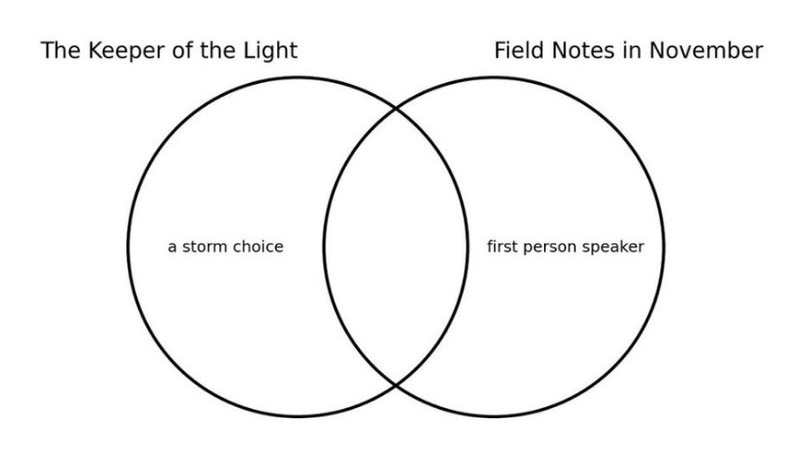
In the diagram, which idea belongs in the overlapping middle region shared by both texts?
A a character faces a choice during a storm B nature shapes the mood of the text C a speaker tells the poem in first person D a grandfather keeps a careful log
What looks wrong with Question 13?
Send anonymously
Cancel
14
How do Reading I and Reading II differ most clearly in voice?
A the story uses third person for Wren, the poem first person B the story uses second person, the poem third person C both texts use exactly the same narrator D the story has no narrator, the poem has two
What looks wrong with Question 14?
Send anonymously
Cancel
15
How does knowing that Wren is seventeen shape a reading of Reading I?
A it proves she is too young to work B it shows the storm was not real C it explains why the boat was late D it marks her choice as a step toward adult responsibility
What looks wrong with Question 15?
Send anonymously
Cancel
16
What do Reading I and Reading II together suggest about understanding oneself and the world?
A only dramatic events can teach anything B attention to ordinary places can reveal meaning C feelings should be ignored when deciding D nature always prevents clear thinking
What looks wrong with Question 16?
Send anonymously
Cancel
17
Which choice best separates a topic from a theme in literature?
A a topic is a character, a theme is a setting B a topic names a subject, a theme states a message about it C a topic is always hidden, a theme is always stated D a topic and a theme mean exactly the same thing
What looks wrong with Question 17?
Send anonymously
Cancel
18
What is the most useful first move in a close reading of a passage?
A reread key lines slowly and note evidence in the text B count the words in each paragraph C memorise the title before reading D skip to the final line and stop
What looks wrong with Question 18?
Send anonymously
Cancel
19
In literary study, what is an unreliable narrator?
A a narrator who speaks very quietly B a narrator who appears only once C a narrator who writes in verse D a narrator whose account the reader has reason to doubt
What looks wrong with Question 19?
Send anonymously
Cancel
20
In critical reading, what does perspective mean?
A the number of pages in a book B the date a book was printed C a position and values that shape how events are seen D the font used for the title
What looks wrong with Question 20?
Send anonymously
Cancel
21
The diagram shows how often light is mentioned in each chapter of a novel. What pattern does the diagram show?
A mentions fall steadily from chapter 1 to 5 B mentions rise overall, with a small dip in chapter 3 C mentions stay exactly the same each chapter D mentions rise only in chapter 1
What looks wrong with Question 21?
Send anonymously
Cancel
22
How does a summary differ from an inference about a text?
A a summary retells main points, an inference draws a conclusion B a summary invents new events, an inference copies lines C a summary judges the author, an inference counts pages D a summary and an inference are identical
What looks wrong with Question 22?
Send anonymously
Cancel
23
Which kind of support makes an interpretation of a text strongest?
A a guess about the author's life B the length of the passage C how popular the book is D direct evidence quoted or described from the text
What looks wrong with Question 23?
Send anonymously
Cancel
24
In literary study, what is voice?
A the price of a book B the number of chapters C the distinctive style and tone of a narrator or speaker D the size of the print
What looks wrong with Question 24?
Send anonymously
Cancel
25
Why can social and historical context matter when reading literature?
A context always proves a reading wrong B context can change how words and events are understood C context replaces the need to read the text D context only matters for very old books
What looks wrong with Question 25?
Send anonymously
Cancel