Media Text I - A Bottle Advertisement
Use this reading for questions 1 to 4.
The advertisement shows a climber drinking from a bright blue bottle beside a mountain stream, under the slogan Drink Pure. Live Pure. Small print at the bottom says the bottle is made from recycled plastic. No factories, towns, or other people appear in the image.
1
According to Media Text I, what technique does the slogan use?
A a quotation from a scientist B a short, repeated slogan that is easy to remember C a graph of sales figures D a long list of ingredients
What looks wrong with Question 1?
Send anonymously
Cancel
2
According to Media Text I, why is the bottle shown beside a mountain stream?
A to show where bottles are made B to show the price of the bottle C to warn about mountain climbing D to link the product with pure, untouched nature
What looks wrong with Question 2?
Send anonymously
Cancel
3
According to Media Text I, who is the most likely target audience?
A young, active people who enjoy the outdoors B factory owners only C people who never drink water D children under five
What looks wrong with Question 3?
Send anonymously
Cancel
4
According to Media Text I, what does the image leave out, and why does that matter?
A it leaves out the price, so buyers cannot decide B it leaves out the climber's name C it leaves out factories and towns, presenting nature as untouched D it leaves out the colour blue
What looks wrong with Question 4?
Send anonymously
Cancel
Media Text II - Recycling Report
Use this reading for questions 5 to 7.
The city recycling program collected 12,000 tonnes last year, up from 10,000 tonnes the year before. City staff say the rise followed new sorting bins in schools. One resident called the result encouraging, while another said more work remains to reduce waste overall.
5
According to Media Text II, what is the purpose of a news headline?
A to hide the main news B to summarise the main news briefly and attract readers C to list every detail in the story D to replace the story entirely
What looks wrong with Question 5?
Send anonymously
Cancel
6
According to Media Text II, which statement is a fact?
A the program collected 12,000 tonnes last year B the result is encouraging C more work remains D recycling is the best activity
What looks wrong with Question 6?
Send anonymously
Cancel
7
According to Media Text II, which statement is an opinion?
A the program collected 12,000 tonnes B the rise followed new sorting bins C the year before saw 10,000 tonnes D one resident called the result encouraging
What looks wrong with Question 7?
Send anonymously
Cancel
Speech I - Keep the Library Open
Use this reading for questions 8 to 10.
Friends, we gather today not to close a door, but to open one. Our library is not just a room of books. It is a room where a newcomer learns a new language, where a student finds a quiet place, where a senior reads the morning news. Will we let those doors close early? I ask you: will we?
8
According to Speech I, what does the question Will we let those doors close early do?
A it asks for a spoken answer from each listener B it ends the speech at once C it is a rhetorical question that engages listeners and stresses a point D it gives the library's opening hours
What looks wrong with Question 8?
Send anonymously
Cancel
9
According to Speech I, why does the speaker repeat where a three times?
A to fill time B to build emphasis through a list of library users C to confuse the audience D to change the subject
What looks wrong with Question 9?
Send anonymously
Cancel
10
According to Speech I, how could pausing before the final question strengthen the delivery?
A a pause gives listeners time to feel the weight of the question B a pause makes the speech shorter C a pause hides the main point D a pause proves the speaker forgot the words
What looks wrong with Question 10?
Send anonymously
Cancel
11
When listening to a speech, what should a listener note first?
A the speaker's shoes B the time of day C the number of slides D the main claim and the reasons given for it
What looks wrong with Question 11?
Send anonymously
Cancel
12
How does cropping a photograph change its meaning?
A cropping only changes the file size B cropping only changes the colour C cropping chooses what is shown and what is hidden D cropping always makes a photo false
What looks wrong with Question 12?
Send anonymously
Cancel
13
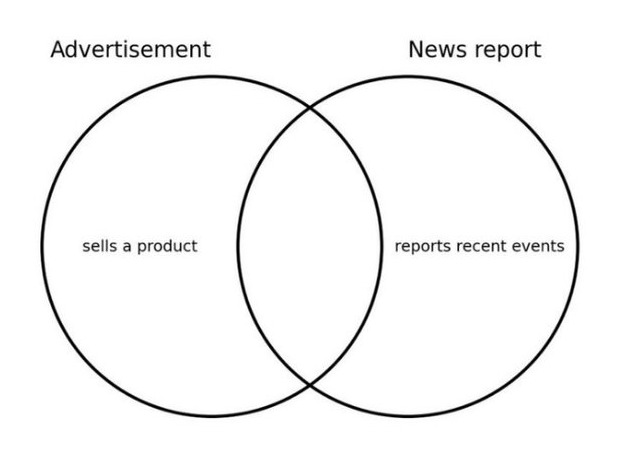
In the diagram, which idea belongs in the overlapping middle region shared by both media forms?
A aims to sell a product B made for an audience with a purpose C reports recent events D uses a headline only
What looks wrong with Question 13?
Send anonymously
Cancel
14
The diagram shows views of a school video over four weeks. What trend does the line show?
A views fall every week B views rise overall, with a small dip in week 3 C views stay exactly the same D views rise only in week 1
What looks wrong with Question 14?
Send anonymously
Cancel
15
In media study, what is a stereotype?
A a detailed portrait of one person B an oversimplified, fixed image of a whole group C a type of camera D a news headline
What looks wrong with Question 15?
Send anonymously
Cancel
16
Why does camera angle matter in a visual text?
A angle only affects file size B a low angle can make a subject look powerful C angle never affects meaning D angle only matters in colour photos
What looks wrong with Question 16?
Send anonymously
Cancel
17
How can colour be used as a media technique?
A warm colours can suggest energy or warmth B colour has no effect on viewers C colour only shows the price D colour always means danger
What looks wrong with Question 17?
Send anonymously
Cancel
18
How can music in an advertisement influence viewers?
A music only fills silence B music can create a mood that supports the message C music proves the product works D music replaces all images
What looks wrong with Question 18?
Send anonymously
Cancel
19
How does register affect spoken language?
A register is the speaker's age B register is the room size C formal or informal language suits different settings and audiences D register never changes
What looks wrong with Question 19?
Send anonymously
Cancel
20
What is the purpose of a caption under a photograph in a news story?
A to hide the photo B to explain what the photo shows and add context C to repeat the headline exactly D to sell the newspaper
What looks wrong with Question 20?
Send anonymously
Cancel
21
Why does word choice matter in how language shapes ideas?
A different words for the same group can create different feelings B word choice never affects meaning C longer words are always truer D word choice only matters in poems
What looks wrong with Question 21?
Send anonymously
Cancel
22
What is the best first check when a media claim seems one sided?
A share it at once B compare it with other sources and check its evidence C ignore the source entirely D trust it because it has a photo
What looks wrong with Question 22?
Send anonymously
Cancel
23
Why might two people see different news in their online feeds?
A feeds are personalised by past activity and choices B feeds are identical for everyone C feeds are chosen at random each hour D feeds only show local weather
What looks wrong with Question 23?
Send anonymously
Cancel
24
In spoken language, why does emphasis on a single word matter?
A emphasis changes which idea sounds most important B emphasis only makes speech louder C emphasis has no effect on meaning D emphasis always shows anger
What looks wrong with Question 24?
Send anonymously
Cancel
25
What should a critical viewer ask about any media text?
A who made it, for whom, and with what purpose B how long did it take to load C what colour is the background D how many people liked it
What looks wrong with Question 25?
Send anonymously
Cancel