Reading I - A Radio in the Kitchen, 1936
Use this reading for questions 1 to 3.
Our family bought a radio last winter, and now it sits on the kitchen table like another member of the family. In the evening we gather around it to hear the news, a hockey game, or a singer from far away. My father says that when he was a boy, news travelled by letter and took weeks.
Last month the radio carried a speech by a foreign leader to listeners in many countries at once. My mother turned it down and said a voice in the kitchen is powerful, whether it tells the truth or not. I think she is right: the same radio that brings us music can also carry ideas meant to persuade a whole crowd.
1
The main idea of Reading I is that radio in the 1930s changed how news and ideas reached people
A quickly, across great distances, for good or for persuasion B only within one small town C by replacing all newspapers at once D only for people who owned a car
What looks wrong with Question 1?
Send anonymously
Cancel
2
According to Reading I, news reached the father as a boy mainly by
A radio broadcasts every evening B letters that took weeks C television news at once D telephone calls from abroad
What looks wrong with Question 2?
Send anonymously
Cancel
3
According to Reading I, the mother warns that a voice on the radio is powerful because it can
A carry ideas meant to persuade a whole crowd B only play music and nothing else C reach nobody outside the kitchen D stop all other news from existing
What looks wrong with Question 3?
Send anonymously
Cancel
4
A long term cause of the First World War was rivalry among European powers over colonies, armies, and
A alliances that could drag many countries into one war B shared trade agreements only C a single sports event D a shortage of radios
What looks wrong with Question 4?
Send anonymously
Cancel
5
Trench warfare on the Western Front in the First World War meant soldiers fought from
A fast moving tanks only B airplanes on the ground C long dug out defensive lines facing each other D ships far inland
What looks wrong with Question 5?
Send anonymously
Cancel
6
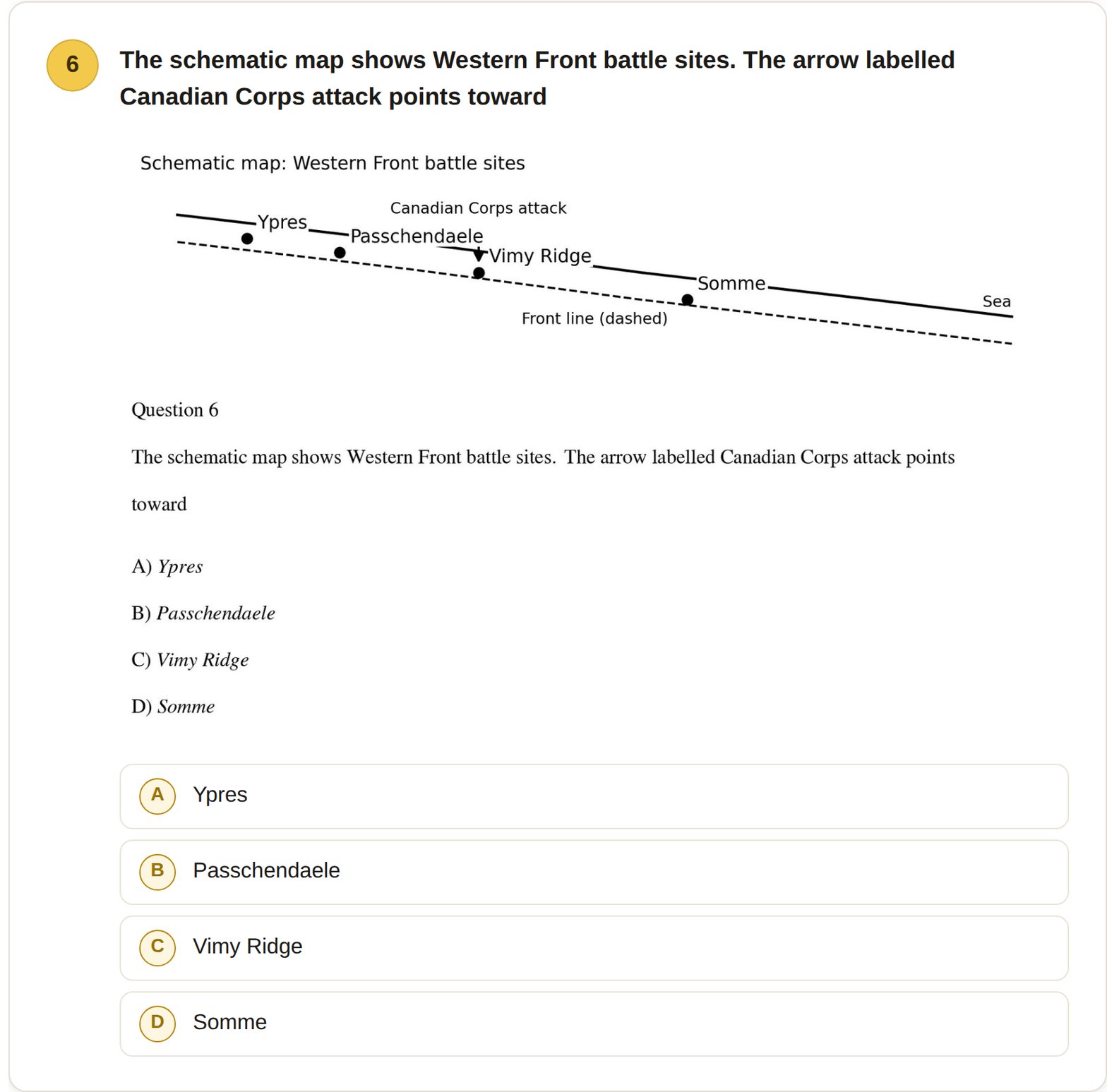
The schematic map shows Western Front battle sites. The arrow labelled Canadian Corps attack points toward
A Ypres B Passchendaele C Vimy Ridge D Somme
What looks wrong with Question 6?
Send anonymously
Cancel
7
Canadian soldiers captured Vimy Ridge in April 1917 during the
A First World War B War of 1812 C Korean War D Boer War
What looks wrong with Question 7?
Send anonymously
Cancel
8
The Treaty of Versailles in 1919 formally ended the First World War for Germany and created the
A United Nations B North Atlantic Treaty Organization C League of Nations D European Union
What looks wrong with Question 8?
Send anonymously
Cancel
9
A weakness of the League of Nations was that it had no reliable way to
A hold meetings B admit any members C enforce its decisions against aggressive states D write reports
What looks wrong with Question 9?
Send anonymously
Cancel
10
The Great Depression that began in 1929 was worsened by bank failures, falling trade, and
A a shortage of workers everywhere B an end to all farming C a sudden rise in wages for all D mass unemployment and falling farm prices
What looks wrong with Question 10?
Send anonymously
Cancel
11
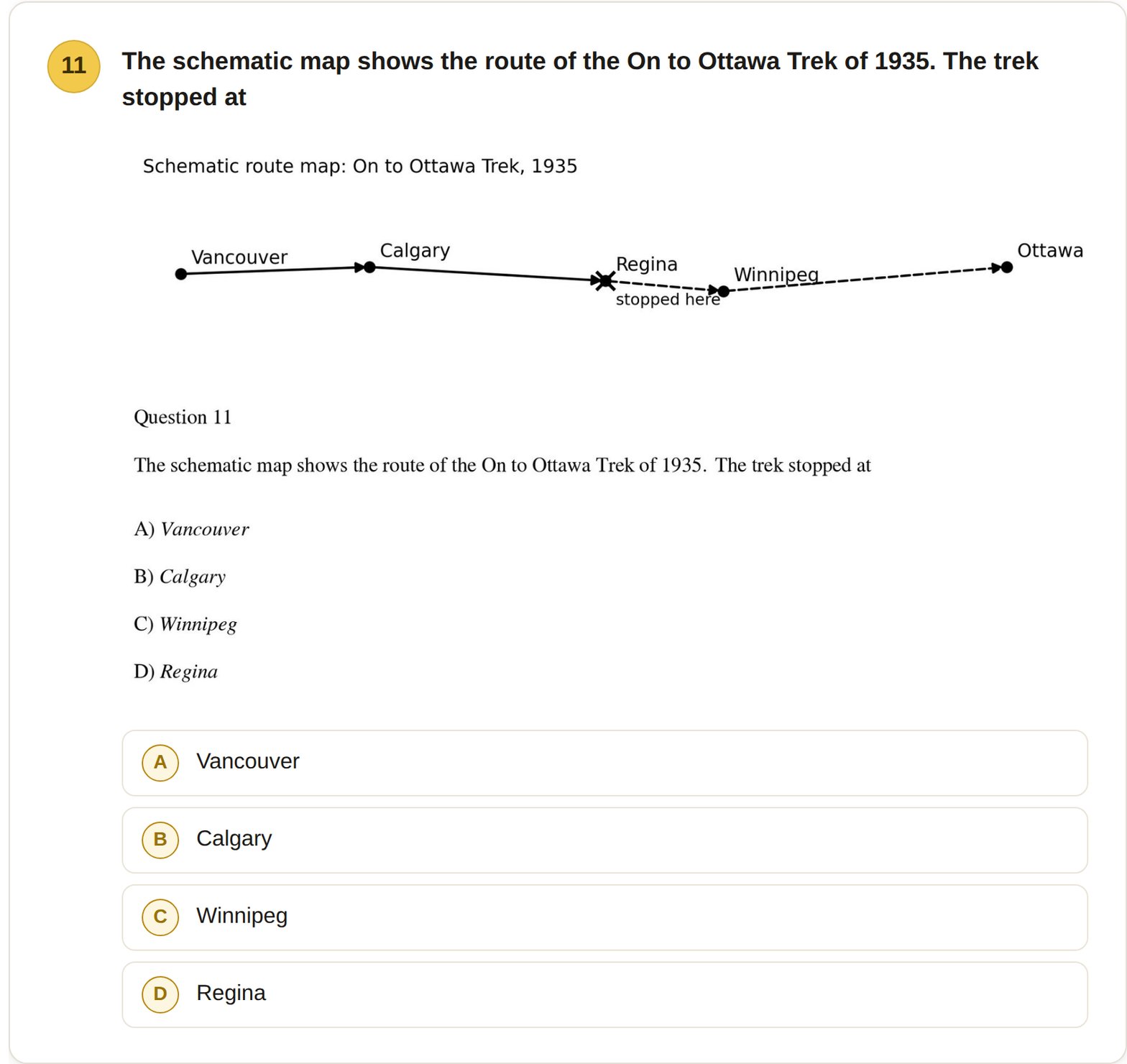
The schematic map shows the route of the On to Ottawa Trek of 1935. The trek stopped at
A Vancouver B Calgary C Winnipeg D Regina
What looks wrong with Question 11?
Send anonymously
Cancel
12
The On to Ottawa Trek of 1935 was a protest by unemployed men from relief camps who wanted
A work and better conditions B an end to all railways C lower taxes on the rich only D a new province
What looks wrong with Question 12?
Send anonymously
Cancel
13
A totalitarian movement is best defined as a political movement that seeks total control over
A one small village only B sports teams alone C foreign trade alone D political life, the economy, culture, and private life
What looks wrong with Question 13?
Send anonymously
Cancel
14
Propaganda in a totalitarian state is best defined as information spread to
A persuade people to support the regime and its leader B present many opposing views fairly C report election results honestly D teach only mathematics
What looks wrong with Question 14?
Send anonymously
Cancel
15
Fascism in Italy under Mussolini in the 1920s and 1930s stressed the nation, a strong leader, and
A free elections with many parties B rule by local councils alone C an end to all government D suppression of opposition and dissent
What looks wrong with Question 15?
Send anonymously
Cancel
16
Nazi rule in Germany in the 1930s was totalitarian in part because it banned opposition parties, controlled the press, and
A protected all minorities equally B held free elections every year C gave up all military power D persecuted Jews and other targeted groups
What looks wrong with Question 16?
Send anonymously
Cancel
17
Stalinist rule in the Soviet Union in the 1930s used purges, state control of the economy, and
A a free press B a cult of the leader and strict censorship C open borders for all critics D an end to central planning
What looks wrong with Question 17?
Send anonymously
Cancel
18
Communication technology such as radio and film helped totalitarian leaders because it let them
A reach large audiences directly with one message B hear criticism from every citizen C ban all public speeches D print only local news
What looks wrong with Question 18?
Send anonymously
Cancel
19
The Second World War began in 1939 when Germany invaded Poland and Britain and France then
A declared war on Germany B signed an alliance with Germany C left the League of Nations D invaded Canada
What looks wrong with Question 19?
Send anonymously
Cancel
20
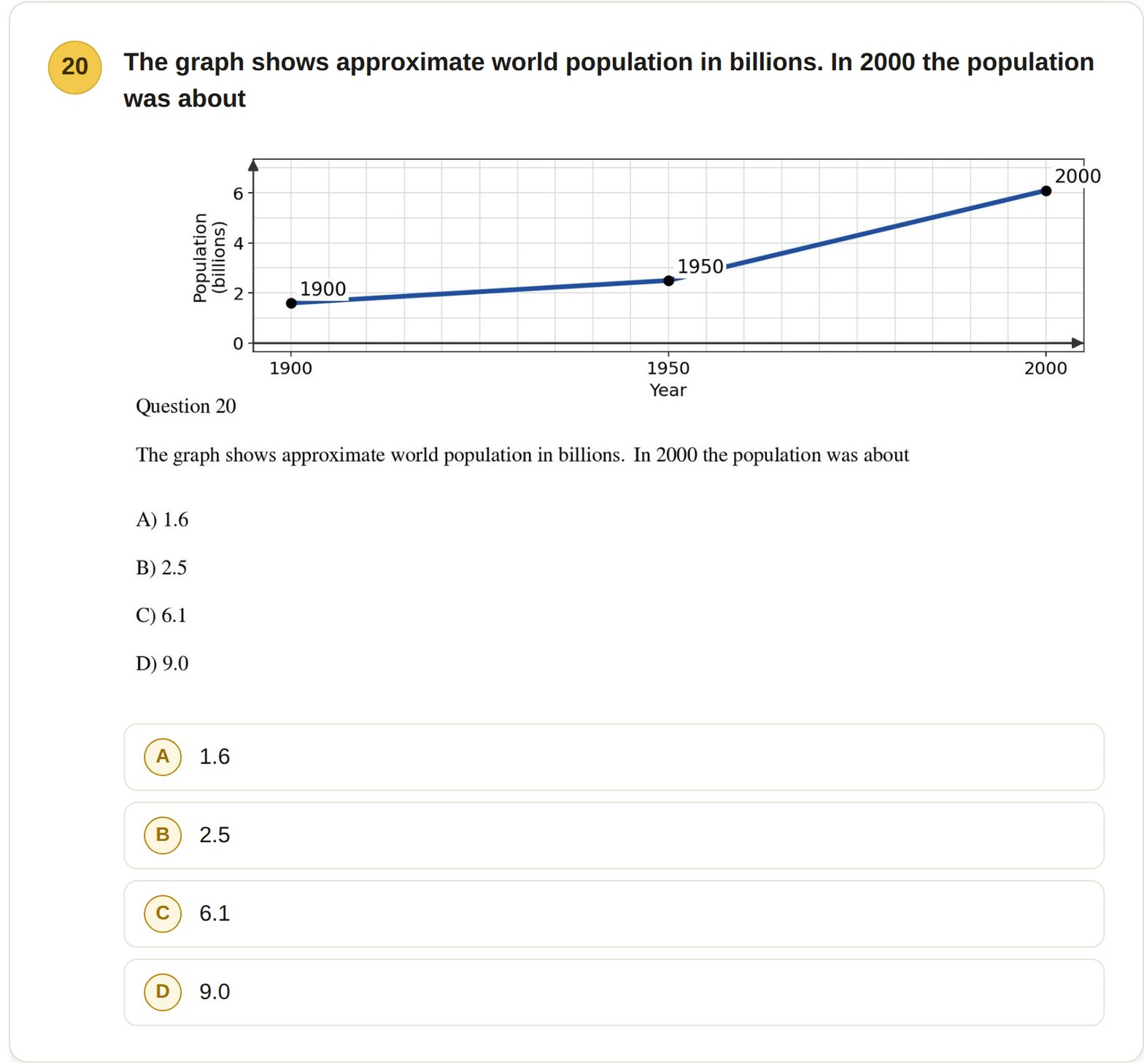
The graph shows approximate world population in billions. In 2000 the population was about
A 1.6 B 2.5 C 6.1 D 9.0
What looks wrong with Question 20?
Send anonymously
Cancel
21
The Holocaust was the Nazi genocide in which about six million Jews were murdered, along with
A no other victims at all B millions of other targeted people, including Roma and disabled people C only soldiers in battle D only people outside Europe
What looks wrong with Question 21?
Send anonymously
Cancel
22
The United Nations was founded in 1945 mainly to
A run a single world army B promote peace, security, and cooperation among countries C set world prices for all goods D replace every national government
What looks wrong with Question 22?
Send anonymously
Cancel
23
The Cold War after the Second World War was mainly a long rivalry between the United States and its allies and
A the Soviet Union and its allies B the Ottoman Empire C the League of Nations D the Roman Empire
What looks wrong with Question 23?
Send anonymously
Cancel
24
Television and later the internet changed political communication by letting events and speeches reach
A only one household at a time B huge audiences quickly, in images as well as words C nobody outside a capital city D only readers of newspapers
What looks wrong with Question 24?
Send anonymously
Cancel
25
A historian studying totalitarian movements should check a source for bias by asking who made it, for whom, and
A whether it is printed in colour B what purpose and point of view it serves C how long the document is D whether it is famous
What looks wrong with Question 25?
Send anonymously
Cancel