1
From the surface inward, the main layers of Earth are
A crust, mantle, outer core, inner core B mantle, crust, inner core, outer core C crust, outer core, mantle, inner core D inner core, outer core, mantle, crust
What looks wrong with Question 1?
Send anonymously
Cancel
2
The crust beneath the oceans is mainly
A thin and dense basalt B solid nickel C thick and light granite D molten iron
What looks wrong with Question 2?
Send anonymously
Cancel
3
The mantle is best described as rock that is mostly
A made of pure iron B the same as the crust C solid but able to flow very slowly D completely liquid
What looks wrong with Question 3?
Send anonymously
Cancel
4
Earth magnetic field is generated mainly by motion in the
A crust B upper mantle C atmosphere D outer core
What looks wrong with Question 4?
Send anonymously
Cancel
5
The lithosphere consists of the crust plus the uppermost part of the
A mantle B outer core C inner core D asthenosphere only
What looks wrong with Question 5?
Send anonymously
Cancel
6
The asthenosphere is the layer that allows lithospheric plates to
A become part of the core B move slowly over it C melt completely D stop moving
What looks wrong with Question 6?
Send anonymously
Cancel
7
Plate tectonics states that Earth outer shell is divided into plates that
A melt every century B float on liquid water C move slowly over the mantle D stay fixed in place
What looks wrong with Question 7?
Send anonymously
Cancel
8
At a divergent plate boundary, plates move
A toward each other B past each other sideways C downward into the core D apart from each other
What looks wrong with Question 8?
Send anonymously
Cancel
9
New oceanic crust forms mainly at
A mid ocean ridges B deep ocean trenches C transform faults D continental interiors
What looks wrong with Question 9?
Send anonymously
Cancel
10
At a convergent boundary, the denser oceanic plate usually
A stops at the boundary B sinks beneath the other plate C rises over the other plate D slides sideways
What looks wrong with Question 10?
Send anonymously
Cancel
11
The process in which one plate sinks beneath another is called
A weathering B erosion C subduction D rifting
What looks wrong with Question 11?
Send anonymously
Cancel
12
A transform boundary is one where plates
A pull apart to form new crust B collide and form mountains C melt into the mantle D slide past each other horizontally
What looks wrong with Question 12?
Send anonymously
Cancel
13
The San Andreas Fault is a well known example of a
A transform fault B mid ocean ridge C subduction zone D rift valley
What looks wrong with Question 13?
Send anonymously
Cancel
14
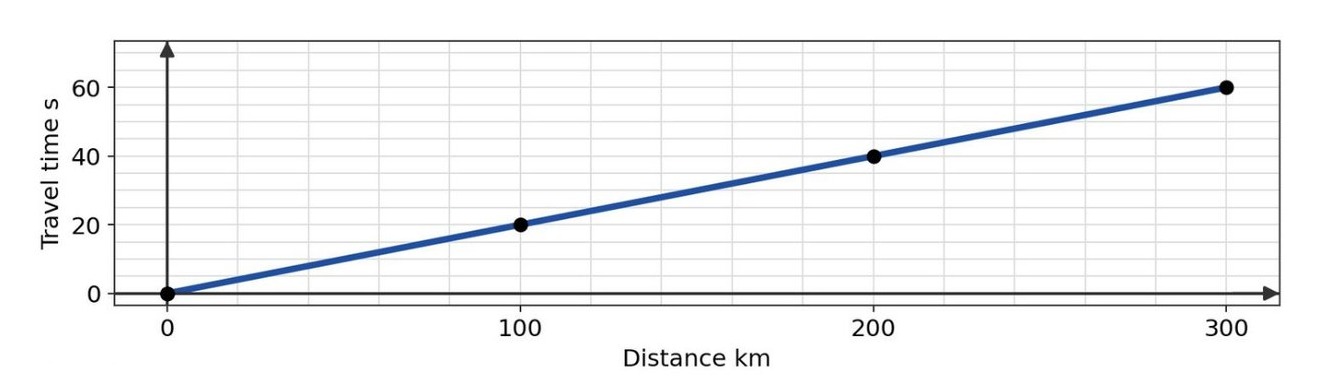
The graph shows travel time against distance for a seismic wave. The travel time at a distance of 200 kilometres, in seconds, is
A 20 B 40 C 60 D 80
What looks wrong with Question 14?
Send anonymously
Cancel
15
The point inside Earth where an earthquake starts is called the
A crest B trench C focus D epicentre
What looks wrong with Question 15?
Send anonymously
Cancel
16
The point on the surface directly above the focus is called the
A focus B ridge C fault D epicentre
What looks wrong with Question 16?
Send anonymously
Cancel
17
P waves travel faster than S waves and are the first to arrive at a seismic station because they
A compress and expand material along their path B travel only on the surface C are slowed by water D travel through air only
What looks wrong with Question 17?
Send anonymously
Cancel
18
S waves cannot travel through liquid, which tells scientists that part of Earth core is
A made of gas B liquid C solid rock D empty
What looks wrong with Question 18?
Send anonymously
Cancel
A ocean temperature B wind speed C ground motion during an earthquake D air pressure only
What looks wrong with Question 19?
Send anonymously
Cancel
20
The moment magnitude scale measures an earthquake mainly by the
A damage to buildings only B depth of the ocean C number of aftershocks D energy released at the source
What looks wrong with Question 20?
Send anonymously
Cancel
21
An earthquake under the ocean can generate a tsunami when it
A suddenly moves the seafloor up or down B warm the ocean surface C creates a storm at sea D melts sea ice
What looks wrong with Question 21?
Send anonymously
Cancel
22
The schematic map of Canada shows earthquake hazard levels by region in the data shown. The region at level 3 , the highest level, is
A Prairies B British Columbia C Ontario D Atlantic
What looks wrong with Question 22?
Send anonymously
Cancel
23
Soil that shakes and behaves like a liquid during strong shaking is an example of
A rifting B weathering C liquefaction D subduction
What looks wrong with Question 23?
Send anonymously
Cancel
24
A practical earthquake safety step for a home is to
A store glass on high open shelves B block all exits C turn off all lights permanently D secure heavy furniture and water heaters
What looks wrong with Question 24?
Send anonymously
Cancel
25
During an earthquake, the safest immediate action indoors is usually to
A drop, cover and hold on B run outside at once C stand under a doorway only D use an elevator
What looks wrong with Question 25?
Send anonymously
Cancel