Reading I - A Town Sustainability Report
Use this reading for question 1.
Our town council reports that households now separate food waste for compost, the school runs on solar panels, and farmers near the river use drip irrigation to use less water. A community garden grows vegetables for the food bank, and a new bus route links outlying homes to the town centre.
The report also warns that summer river levels are lower than in past years, and that some families still struggle to afford fresh food. The council plans more insulation for older homes and a repair shop so broken goods are fixed instead of thrown away.
1
The main idea of the town sustainability report is that the town is trying to
A use more water and energy B close all schools C reduce waste and energy use, save water, and help families access food D ban all buses
What looks wrong with Question 1?
Send anonymously
Cancel
2
According to the town sustainability report, one water saving action is
A drip irrigation by farmers near the river B flooding fields daily C leaving taps running D draining the river
What looks wrong with Question 2?
Send anonymously
Cancel
3
According to the town sustainability report, a problem that remains is that
A river levels are higher than ever B summer river levels are lower and some families struggle to afford fresh food C no one recycles at all D the town has no food bank
What looks wrong with Question 3?
Send anonymously
Cancel
4
Renewable resources differ from nonrenewable resources because renewable resources
A can never be used up B are replenished naturally on a human timescale, while nonrenewable resources form too slowly to replace C are always fossil fuels D cannot produce energy
What looks wrong with Question 4?
Send anonymously
Cancel
5
Which of the following is a renewable energy source
A coal B oil C solar power D natural gas
What looks wrong with Question 5?
Send anonymously
Cancel
6
Fossil fuels such as coal, oil, and natural gas are nonrenewable because they
A form quickly each year B never run out C come from sunlight alone D formed over millions of years and are used far faster than they form
What looks wrong with Question 6?
Send anonymously
Cancel
7
Resources are unevenly distributed around the world because of differences in
A geology, climate, history, and technology, which affect where resources occur and can be used B nothing at all C population size alone D time zones alone
What looks wrong with Question 7?
Send anonymously
Cancel
8
The schematic map of Canada shows permafrost thaw impact levels by region in the data shown. The region at level 3 , the highest level, is
A Prairies B North C Ontario D Atlantic
What looks wrong with Question 8?
Send anonymously
Cancel
9
The schematic map of Canada shows resource pressure levels in a scenario. The region shown at level 3, the highest level, is
A the Prairies B Quebec C Ontario D the Atlantic region
What looks wrong with Question 9?
Send anonymously
Cancel
10
Sustainable development is best defined as development that
A uses up resources as fast as possible B ignores the environment C stops all economic activity D meets present needs without harming the ability of future generations to meet theirs
What looks wrong with Question 10?
Send anonymously
Cancel
11
The three pillars of sustainability are
A environment, economy, and society B mining, farming, and fishing C air, land, and sea only D cities, towns, and villages
What looks wrong with Question 11?
Send anonymously
Cancel
12
Human caused climate change is driven mainly by
A a change in ocean colour B greenhouse gases released by burning fossil fuels, which trap heat in the atmosphere C volcanoes alone in recent decades D a fall in greenhouse gases
What looks wrong with Question 12?
Send anonymously
Cancel
13
A consequence of global warming includes
A falling sea levels everywhere B an end to all storms C melting ice, rising sea levels, and more frequent extreme weather D cooler oceans everywhere
What looks wrong with Question 13?
Send anonymously
Cancel
14
Water scarcity can be caused by
A too much rainfall everywhere B too few people C a lack of oceans D overuse, pollution, and drought reducing usable water supplies
What looks wrong with Question 14?
Send anonymously
Cancel
15
A water conservation measure is
A efficient irrigation, fixing leaks, and reusing treated water B leaving irrigation running all day C polluting rivers D pumping aquifers without limit
What looks wrong with Question 15?
Send anonymously
Cancel
16
Hunger in the world is often a problem of access and distribution, not only of total food production, because
A the world grows no food at all B poverty, conflict, and poor transport can stop people reaching food that exists C everyone has the same income D food never spoils
What looks wrong with Question 16?
Send anonymously
Cancel
17
Food security means that people have
A food only on holidays B only imported food C reliable access to enough safe and nutritious food D no need for farms
What looks wrong with Question 17?
Send anonymously
Cancel
18
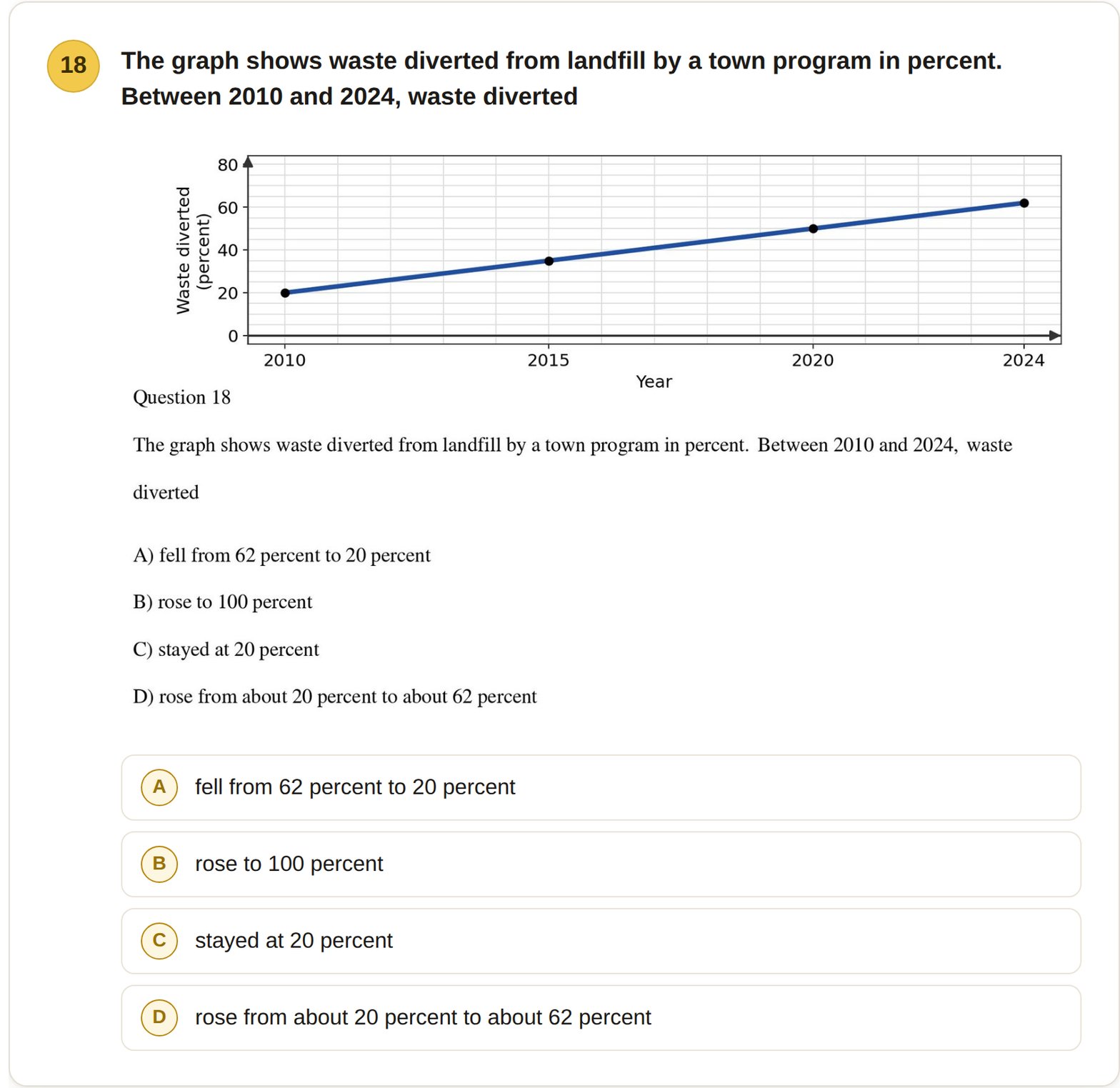
The graph shows waste diverted from landfill by a town program in percent. Between 2010 and 2024, waste diverted
A fell from 62 percent to 20 percent B rose to 100 percent C stayed at 20 percent D rose from about 20 percent to about 62 percent
What looks wrong with Question 18?
Send anonymously
Cancel
19
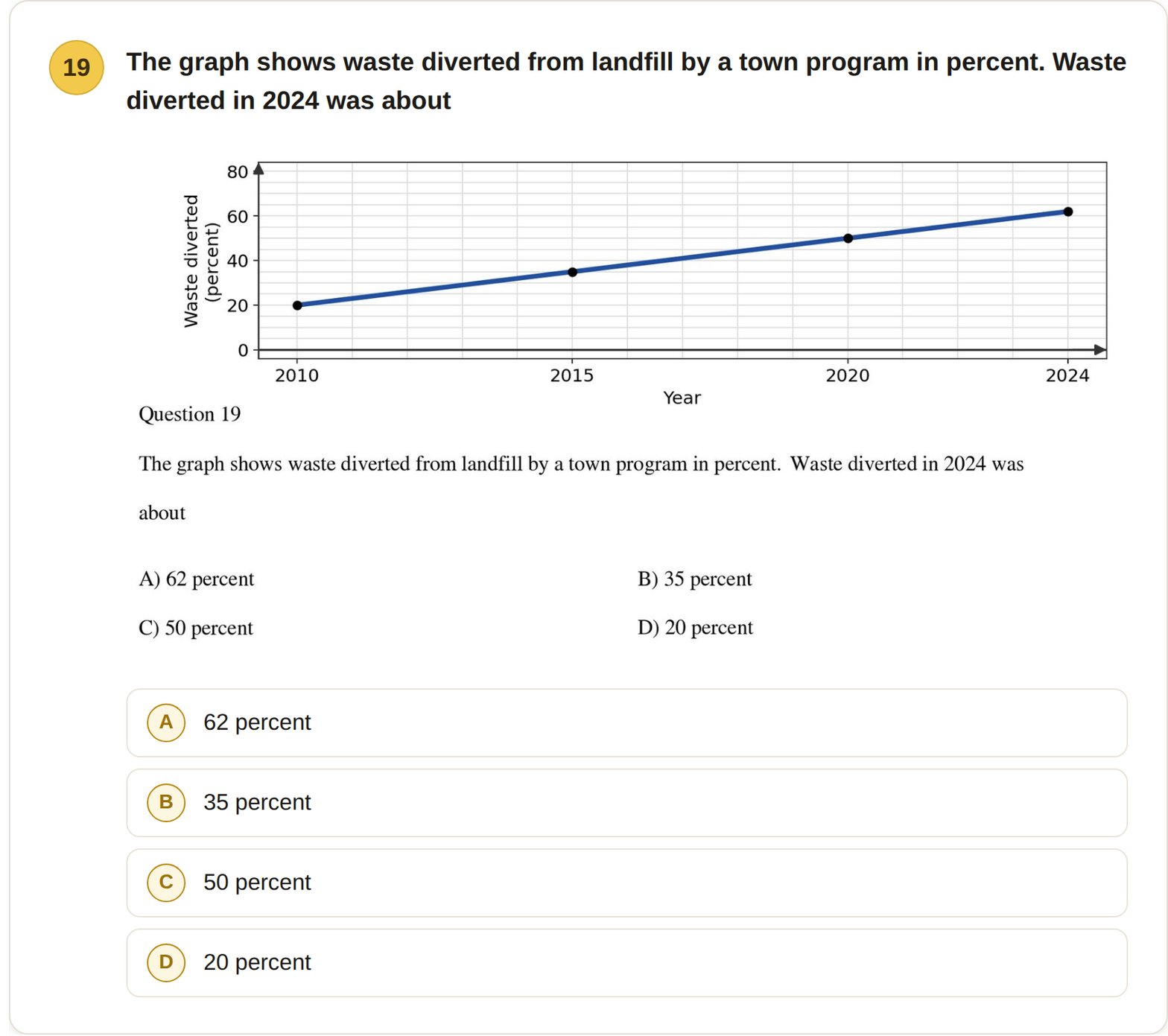
The graph shows waste diverted from landfill by a town program in percent. Waste diverted in 2024 was about
A 62 percent B 35 percent C 50 percent D 20 percent
What looks wrong with Question 19?
Send anonymously
Cancel
20
Under the Paris Agreement, countries agreed to work to
A increase greenhouse gas emissions B limit global warming, aiming well below 2 degrees above preindustrial levels C ban all energy use D ignore climate change
What looks wrong with Question 20?
Send anonymously
Cancel
21
The United Nations Sustainable Development Goals are
A goals for one country only B rules for space travel only C global goals to tackle poverty, health, education, and environmental problems by 2030 D a single trade deal
What looks wrong with Question 21?
Send anonymously
Cancel
22
Deforestation harms the environment because it causes
A more habitat for forest species B an end to all farming C richer soils everywhere D habitat loss, carbon release, and soil erosion
What looks wrong with Question 22?
Send anonymously
Cancel
23
A sustainable forestry practice is to
A harvest at a rate the forest can regrow and replant harvested areas B clear all forest with no replanting C ban all use of wood D burn forest after harvest
What looks wrong with Question 23?
Send anonymously
Cancel
24
The tragedy of the commons describes a shared resource that is
A protected by everyone automatically B overused when no rules limit use, because each user gains while all share the loss C never used by anyone D owned by one person only
What looks wrong with Question 24?
Send anonymously
Cancel
25
Mitigation and adaptation to climate change differ because mitigation reduces the causes of warming, while adaptation
A increases emissions B adjusts lives and places to cope with changes already happening, such as building sea walls C denies warming exists D stops all weather
What looks wrong with Question 25?
Send anonymously
Cancel