1
Taxonomy is the science of
A naming and classifying organisms B counting cells in a tissue C measuring fossil ages D growing crops in soil
What looks wrong with Question 1?
Send anonymously
Cancel
2
Modern classification groups organisms mainly by
A evolutionary relationships B habitat alone C body size alone D colour alone
What looks wrong with Question 2?
Send anonymously
Cancel
3
From largest to smallest, the correct order of taxonomic ranks is
A kingdom, domain, class, phylum, genus, family, order, species B domain, phylum, kingdom, order, class, species, genus, family C domain, kingdom, phylum, class, order, family, genus, species D species, genus, family, order, class, phylum, kingdom, domain
What looks wrong with Question 3?
Send anonymously
Cancel
4
Two organisms in the same genus but different species share a
A more distant relationship than two in different kingdoms B common ancestor only at the domain level C scientific name D closer relationship than two in different genera
What looks wrong with Question 4?
Send anonymously
Cancel
5
In binomial nomenclature, the scientific name of a wolf is written as
A Canis lupus B canis Lupus C Canis Lupus D lupus canis
What looks wrong with Question 5?
Send anonymously
Cancel
6
In a scientific name, the first word names the
A kingdom B genus C species D family
What looks wrong with Question 6?
Send anonymously
Cancel
7
A dichotomous key helps identify an organism by offering
A random guesses B only colour choices C pairs of contrasting choices D one long description
What looks wrong with Question 7?
Send anonymously
Cancel
8
The three domains of life are
A Plants, Animals, Fungi B Monera, Protista, Plantae C Viruses, Bacteria, Protists D Bacteria, Archaea, Eukarya
What looks wrong with Question 8?
Send anonymously
Cancel
9
Viruses are not classed as living things mainly because they
A cannot reproduce without a host cell B have no genetic material C never change over time D are too small to see
What looks wrong with Question 9?
Send anonymously
Cancel
10
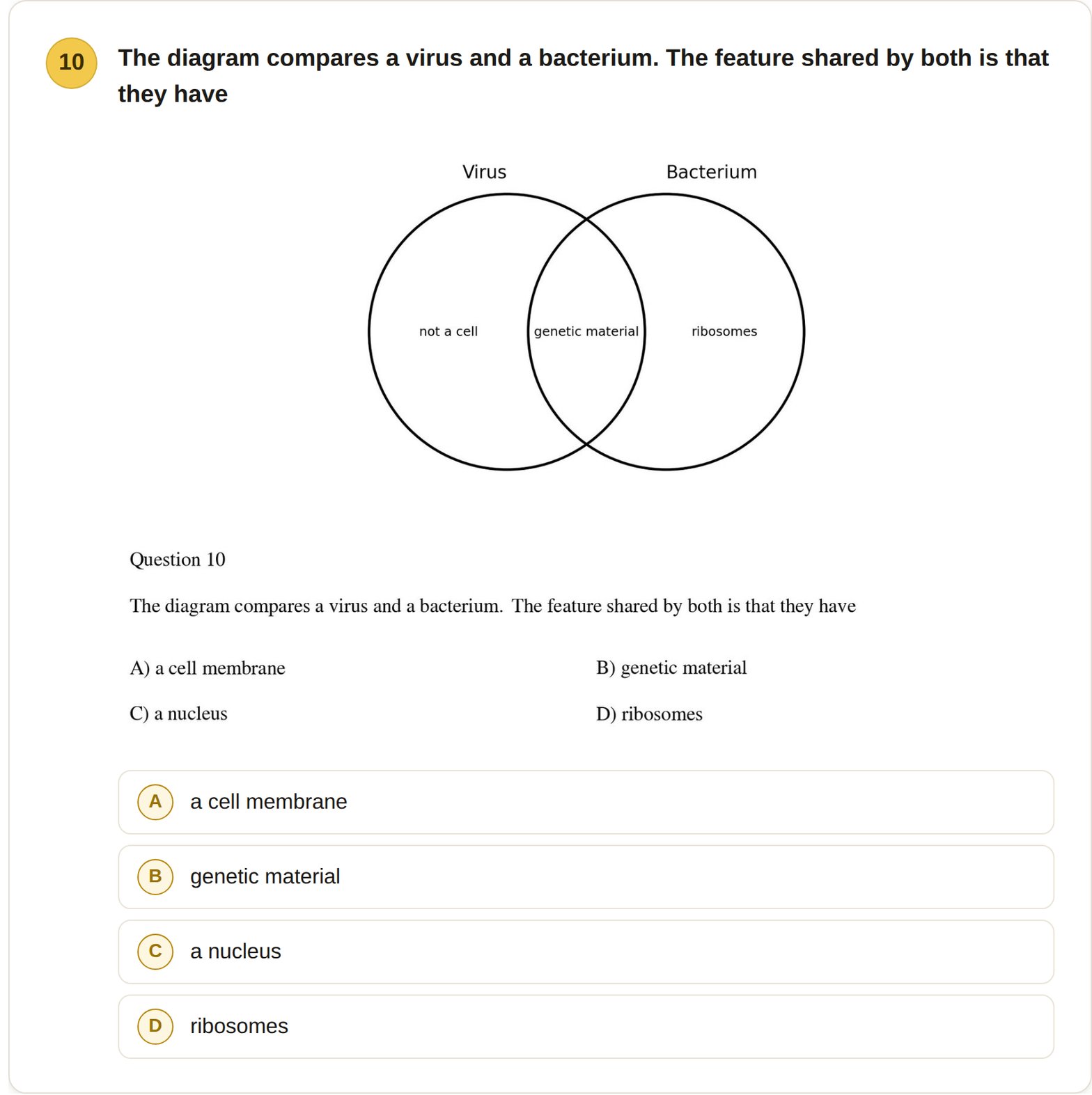
The diagram compares a virus and a bacterium. The feature shared by both is that they have
A a cell membrane B genetic material C a nucleus D ribosomes
What looks wrong with Question 10?
Send anonymously
Cancel
11
Monerans, such as bacteria, are best described as
A nonliving particles B plantlike with chloroplasts C prokaryotic and usually single-celled D eukaryotic and multicellular
What looks wrong with Question 11?
Send anonymously
Cancel
12
A bacterium differs from a protist mainly because the bacterium has
A no cell membrane B no DNA C a large central vacuole D no membrane-bound nucleus
What looks wrong with Question 12?
Send anonymously
Cancel
13
Protists are best described as mostly single-celled
A eukaryotes B prokaryotes C viruses D fungi
What looks wrong with Question 13?
Send anonymously
Cancel
14
Algae are protists that
A live only in soil B make food by photosynthesis C eat other protists only D form mushrooms
What looks wrong with Question 14?
Send anonymously
Cancel
15
Fungi obtain food mainly by
A eating with a mouth B making food from sunlight C absorbing nutrients from their surroundings D photosynthesis in leaves
What looks wrong with Question 15?
Send anonymously
Cancel
16
The cell walls of fungi contain
A cellulose B silica C keratin D chitin
What looks wrong with Question 16?
Send anonymously
Cancel
17
Mushrooms are important decomposers because they
A break down dead matter and recycle nutrients B make oxygen for animals C fix nitrogen in roots D pollinate flowers
What looks wrong with Question 17?
Send anonymously
Cancel
18
Plants differ from fungi because plants
A lack cell walls B make food by photosynthesis C absorb all their food D have chitin cell walls
What looks wrong with Question 18?
Send anonymously
Cancel
19
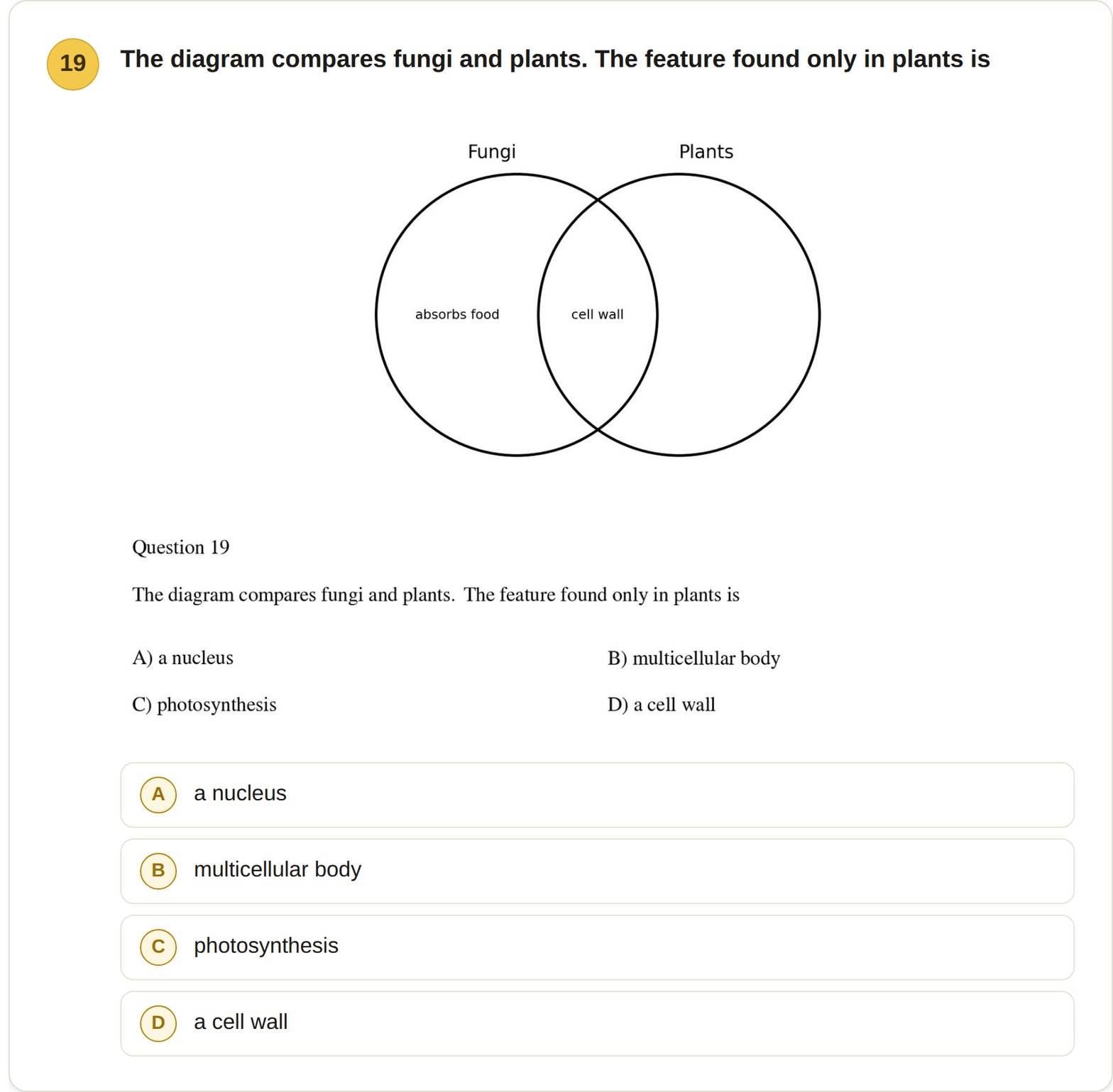
The diagram compares fungi and plants. The feature found only in plants is
A a nucleus B multicellular body C photosynthesis D a cell wall
What looks wrong with Question 19?
Send anonymously
Cancel
20
Animals differ from plants because animals
A have cellulose cell walls B are always single-celled C make food from sunlight D cannot photosynthesize and lack cell walls
What looks wrong with Question 20?
Send anonymously
Cancel
21
Which group includes organisms that are multicellular, eat food, and can move at some life stage
A animals B plants C fungi D monerans
What looks wrong with Question 21?
Send anonymously
Cancel
22
A cladogram shows relationships by grouping organisms that share
A the same diet B derived traits C the same habitat D the same size
What looks wrong with Question 22?
Send anonymously
Cancel
23
The graph shows the diameter of a fungal colony over five days. On day 4, the diameter is
A 8 mm B 12 mm C 16 mm D 20 mm
What looks wrong with Question 23?
Send anonymously
Cancel
24
Which kingdom includes seaweeds and amoebas
A Plantae B Animalia C Fungi D Protista
What looks wrong with Question 24?
Send anonymously
Cancel
25
Using the same fungal colony graph, the increase in diameter from day 1 to day 5 is
What looks wrong with Question 25?
Send anonymously
Cancel