1
A cactus has spines instead of broad leaves. The spines help it
A reduce water loss and deter herbivores B absorb more sunlight for roots C store oxygen in leaves D attract pollinators at night
What looks wrong with Question 1?
Send anonymously
Cancel
2
A waxy cuticle on a desert leaf mainly
A protects roots from frost B increases photosynthesis at night C reduces water loss by evaporation D absorbs water from air
What looks wrong with Question 2?
Send anonymously
Cancel
3
Stomata on a leaf are small openings that let gases
A store starch in stems B carry water to flowers C move in and out of the leaf D move only into roots
What looks wrong with Question 3?
Send anonymously
Cancel
4
When stomata close on a hot dry day, the plant
A loses more water and grows faster B stops making roots C absorbs oxygen through roots D loses less water but takes in less carbon dioxide
What looks wrong with Question 4?
Send anonymously
Cancel
5
Xylem tissue in a plant mainly transports
A water upward B sugars downward C oxygen to roots D seeds to soil
What looks wrong with Question 5?
Send anonymously
Cancel
6
Phloem tissue in a plant mainly transports
A pollen to flowers B sugars from leaves C water from roots D minerals from soil
What looks wrong with Question 6?
Send anonymously
Cancel
7
Transpiration in a plant is the loss of water vapour mainly through
A flowers B seeds C stomata D roots
What looks wrong with Question 7?
Send anonymously
Cancel
8
Deep roots help a prairie grass survive drought because they
A store sunlight in leaves B reduce leaf area C attract more rain D reach water deeper in the soil
What looks wrong with Question 8?
Send anonymously
Cancel
9
Fish gills are suited for life in water because they
A have a large surface area for gas exchange B store food for winter C pump blood to fins D filter salt from blood
What looks wrong with Question 9?
Send anonymously
Cancel
10
Lungs in land animals are suited for gas exchange because they
A pump air to the heart B have thin moist walls and a large area C are filled with water D store carbon dioxide
What looks wrong with Question 10?
Send anonymously
Cancel
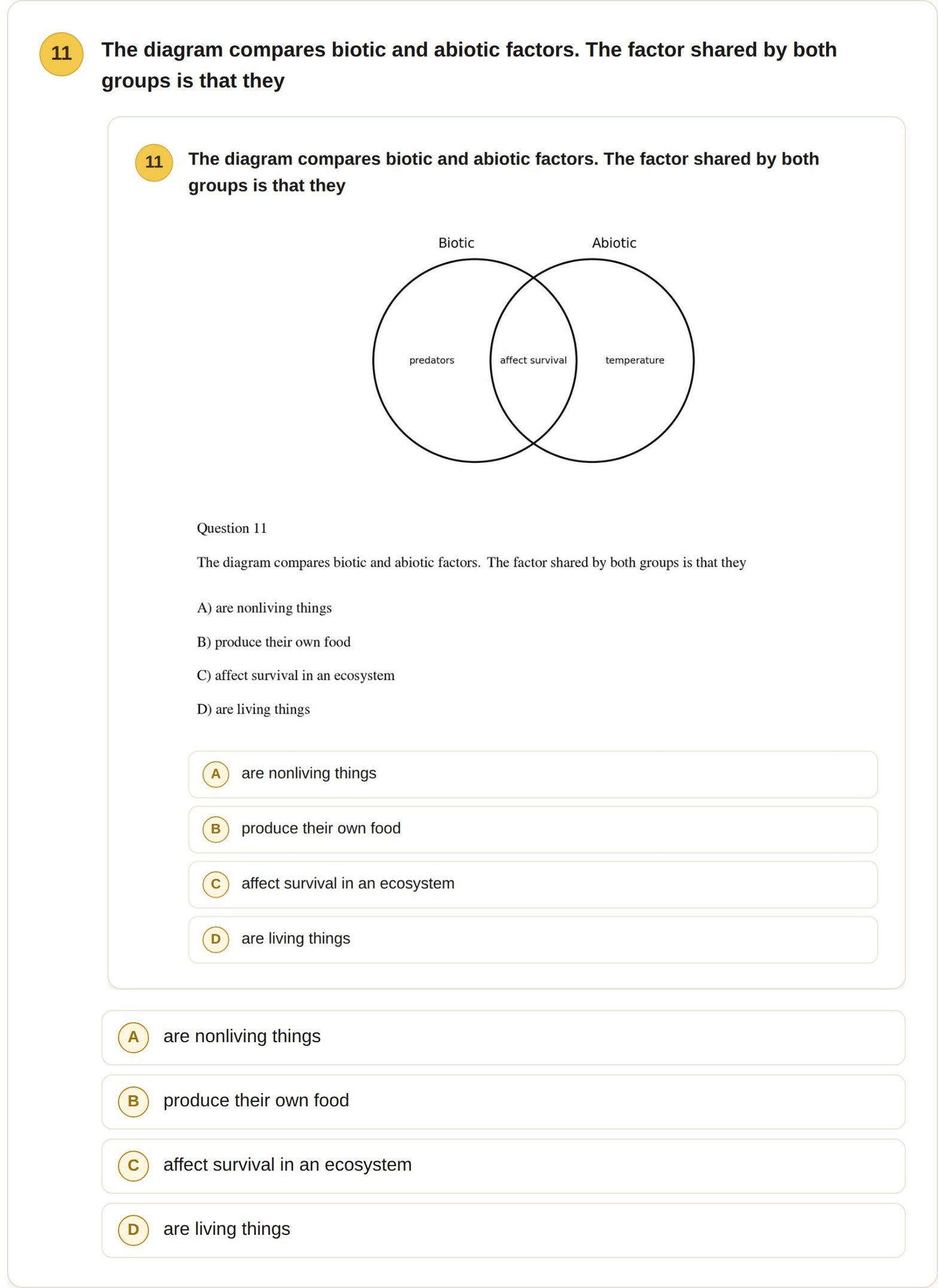
11
The diagram compares biotic and abiotic factors. The factor shared by both groups is that they
A are nonliving things B produce their own food C affect survival in an ecosystem D are living things
What looks wrong with Question 11?
Send anonymously
Cancel
12
Which of the following is an abiotic factor
A predator B competitor C parasite D temperature
What looks wrong with Question 12?
Send anonymously
Cancel
13
Which of the following is a biotic factor
A prey animal B rainfall C soil pH D sunlight
What looks wrong with Question 13?
Send anonymously
Cancel
14
Biodiversity in an ecosystem refers to the
A size of the largest animal B variety of species and genes present C number of rocks present D amount of rainfall
What looks wrong with Question 14?
Send anonymously
Cancel
15
An ecosystem with high biodiversity is often more
A dependent on one species B free of predators C resilient to disturbance D likely to collapse quickly
What looks wrong with Question 15?
Send anonymously
Cancel
16
In a food chain, a producer is an organism that
A eats only other animals B breaks down dead matter C lives as a parasite D makes its own food from sunlight
What looks wrong with Question 16?
Send anonymously
Cancel
17
A limiting factor for a deer population could be
A available food B number of deer C deer colour D deer age
What looks wrong with Question 17?
Send anonymously
Cancel
18
Carrying capacity is the largest population an environment can
A feed for one day B support over a long time C produce in one season D count in a survey
What looks wrong with Question 18?
Send anonymously
Cancel
19
The graph shows a deer population over eight years. In year 6, the population is
A 300 B 400 C 500 D 600
What looks wrong with Question 19?
Send anonymously
Cancel
20
Thick blubber helps a seal survive cold water by
A increasing swimming speed B storing oxygen for dives C absorbing sunlight D providing insulation against heat loss
What looks wrong with Question 20?
Send anonymously
Cancel
21
Hibernation helps an animal survive winter mainly by
A lowering energy use when food is scarce B increasing body temperature C growing thicker fur daily D moving to a warmer climate
What looks wrong with Question 21?
Send anonymously
Cancel
22
Webbed feet help a duck swim because they
A reduce body weight B increase surface area for pushing water C keep feet dry D store food for winter
What looks wrong with Question 22?
Send anonymously
Cancel
23
The graph shows seed germination at different temperatures. At 20 degrees, the percent germinating is
A 40 percent B 60 percent C 80 percent D 100 percent
What looks wrong with Question 23?
Send anonymously
Cancel
24
Using the same germination graph, the increase from 0 degrees to 20 degrees is
What looks wrong with Question 24?
Send anonymously
Cancel
25
Competition between two species for the same food is an interaction between
A two abiotic factors B a biotic and an abiotic factor C no factors D two biotic factors
What looks wrong with Question 25?
Send anonymously
Cancel