Reading I - October Garden
Use this reading for questions 1 to 6.
The garden settles under silver rain
And every leaf lets go of summer light
The sparrows hurry home across the lane
Before the early dark has claimed the night
A single rose still opens to the cold
Its petals bright as lanterns in the green
It does not ask for spring or summer gold
It simply stands where autumn can be seen
1
In Reading I, which sense is strongest in the image of petals bright as lanterns in the green
A sight, because the image describes colour and light that can be seen B sound, because the image describes a noise the petals make C taste, because the image describes a flavour of the rose D smell, because the image describes a scent in the garden
What looks wrong with Question 1?
Send anonymously
Cancel
2
In Reading I, the phrase bright as lanterns is an example of
A a simile, because it compares petals to lanterns using as B a metaphor, because it says the petals are lanterns C personification, because it gives the rose a human voice D hyperbole, because it claims the petals can light a town
What looks wrong with Question 2?
Send anonymously
Cancel
3
In Reading I, the phrase settles under silver rain uses
A a rhyme, because silver and rain end with the same sound B a refrain, because the phrase repeats at the end of the poem C alliteration, because several words begin with the same s sound D onomatopoeia, because the words imitate the sound of rain
What looks wrong with Question 3?
Send anonymously
Cancel
4
In Reading I, the end words rain and lane show that lines 1 and 3 use
A a refrain, because the same word closes both lines B a near rhyme, because the words sound similar but not identical C an exact rhyme, because the words are spelled the same way D no rhyme at all, because the words share no sound
What looks wrong with Question 4?
Send anonymously
Cancel
5
Reading I is built from two stanzas of four lines each. A four line stanza is called a
A quatrain B couplet C tercet D sonnet
What looks wrong with Question 5?
Send anonymously
Cancel
6
In Reading I, the rose that still opens to the cold most likely represents
A wealth, because roses are expensive flowers to grow B secrecy, because the rose hides among the green leaves C youth, because only young plants bloom in October D endurance, because it keeps blooming when autumn turns cold
What looks wrong with Question 6?
Send anonymously
Cancel
Reading II - The Borrowed Jacket
Use this reading for questions 7 to 10.
MAYA enters the kitchen carrying a muddy jacket. She holds it up for DEV to see.
MAYA: Dev, this is my jacket. You wore it to the game yesterday without asking.
DEV: I only borrowed it for one afternoon. The rain started and I had no coat.
MAYA turns to the audience and speaks directly to them. MAYA: He never asks. He just takes.
DEV: I am sorry. I will wash it and I will ask next time. Can we agree on that?
MAYA: Yes, but asking first is the rule from now on, not an extra favour.
7
In Reading II, Maya enters carrying a muddy jacket. What is this stage direction for?
A replaces all dialogue for the rest of the scene B explains the theme of the play in a single line C tells the actors and director what Maya does and carries on stage D tells the audience the full history of Maya and Dev
What looks wrong with Question 7?
Send anonymously
Cancel
8
In Reading II, when Maya turns to the audience and speaks directly to them, this is called an
A chorus, because a group of actors comments on the action B aside, because a character speaks briefly to the audience while the others do not hear it C soliloquy, because Maya is alone on stage with no one else present and speaks her thoughts aloud D monologue, because Dev answers Maya at length in return
What looks wrong with Question 8?
Send anonymously
Cancel
9
According to Reading II, the conflict between Maya and Dev is about
A borrowing without asking and whether asking first should be a rule B losing a jacket during a game in the rain C choosing which sibling will wash the jacket D deciding who owns the kitchen in their house
What looks wrong with Question 9?
Send anonymously
Cancel
10
From the dialogue in Reading II, Dev can best be described as
A angry throughout and unwilling to speak to Maya B silent throughout the whole scene C proud that he never needs to ask permission D careless at first, then willing to apologize and agree to a rule
What looks wrong with Question 10?
Send anonymously
Cancel
11
A soliloquy in a drama is a speech in which a character
A speaks briefly to the audience while others are present B sings a song with a group of other actors C alone on stage speaks thoughts aloud for the audience to hear D speaks a long passage to another character who listens
What looks wrong with Question 11?
Send anonymously
Cancel
12
A monologue in a drama is
A a song performed by the whole cast together B a long speech by one character to other characters on stage C a short remark spoken only to the audience D a scene with no words at all, told through movement
What looks wrong with Question 12?
Send anonymously
Cancel
13
Dramatic irony in a play occurs when the audience knows something that
A a character on stage does not yet know B the playwright has not written into the script C no actor has rehearsed before the show D the stage directions refuse to reveal
What looks wrong with Question 13?
Send anonymously
Cancel
14
Blank verse in poetry is verse that is
A rhymed in couplets with a humorous tone B written with no metre and no rhyme at all C sung to music by a chorus on stage D unrhymed and written in a regular metre, often iambic pentameter
What looks wrong with Question 14?
Send anonymously
Cancel
A nineteen lines in five tercets and a quatrain B two lines that always rhyme as a pair C fourteen lines, often with a set rhyme pattern D four lines with no rhyme pattern at all
What looks wrong with Question 15?
Send anonymously
Cancel
16
Free verse is poetry that
A is written only for performance on stage B does not follow a regular rhyme scheme or metre C always rhymes in couplets from start to finish D must be fourteen lines long to count as a poem
What looks wrong with Question 16?
Send anonymously
Cancel
17
Enjambment in poetry occurs when a line
A runs on into the next line without a pause at the line break B ends with a full stop and a complete thought C repeats the same word at its start and end D rhymes exactly with the line before it
What looks wrong with Question 17?
Send anonymously
Cancel
18
Personification in poetry is a figure of speech that
A compares two things using the words like or as B states that one thing is another thing directly C exaggerates a claim far beyond what is true D gives human qualities to a nonhuman thing
What looks wrong with Question 18?
Send anonymously
Cancel
19
Hyperbole in poetry is a figure of speech that uses
A a comparison using the words like or as B words that imitate the sounds they name C deliberate exaggeration for effect D a quiet understatement of a large event
What looks wrong with Question 19?
Send anonymously
Cancel
20
Onomatopoeia is the use of words that
A compare two unlike things without like or as B imitate the sounds they describe, such as buzz or crash C rhyme exactly at the ends of two lines D give human feelings to animals and objects
What looks wrong with Question 20?
Send anonymously
Cancel
21
A ballad is a poem that
A tells a story, often in simple stanzas with a songlike rhythm B praises a person or event in a formal ode C describes a scene with no story or characters D is always fourteen lines long
What looks wrong with Question 21?
Send anonymously
Cancel
22
In a poem, tone refers to the
A number of stanzas in the whole poem B rhyme scheme used in the final stanza C name of the poet who wrote the poem D attitude of the speaker toward the subject
What looks wrong with Question 22?
Send anonymously
Cancel
23
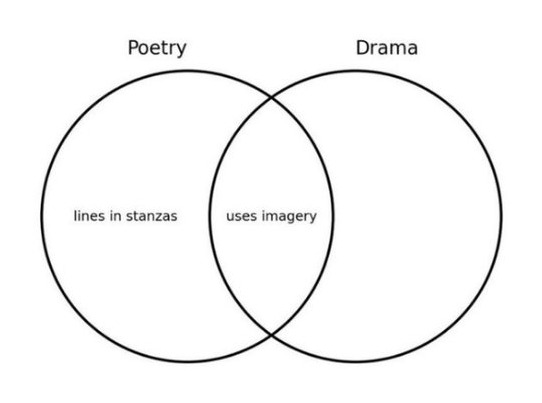
In the diagram, which feature belongs only to drama and not to poetry
A a speaker who expresses thoughts and feelings B a theme explored through words and form C stage directions that tell actors what to do D imagery that helps readers picture a scene
What looks wrong with Question 23?
Send anonymously
Cancel
24
The graph shows the number of lines in each of five stanzas of a poem. The stanza with the most lines is
A stanza 4 B stanza 3 C stanza 1 D stanza 2
What looks wrong with Question 24?
Send anonymously
Cancel
25
In a play, the chorus in classical drama traditionally
A comments on the action and speaks for a wider community view B writes the stage directions for every scene C plays the main hero in every performance D designs the costumes and lighting for the show
What looks wrong with Question 25?
Send anonymously
Cancel