British Columbia Literary Studies 11 (MLTST11) · Unit C · 25 questions
Nonfiction and Informational Texts — Practice Test
This practice test was made by AI and there may be mistakes. If a question or answer looks wrong, use the Flag a mistake button to let Brett know so he can fix it.
Reading I - Later Start, Sharper Minds
Use this reading for questions 1 to 6.
Our school should start later in the morning, and the reason is simple. Students who arrive half asleep cannot learn well in first period, no matter how good the lesson is. Teachers in our school have noticed that the same students who stare blankly at eight in the morning become alert and ready to take part by nine. If we want learning to matter, we should schedule it for hours when students are awake enough to use it.
Some people will say that a later start would disrupt bus schedules and after school sports. That is a fair concern, but schedules can be adjusted, and many schools have already moved their start times without cancelling a single team. The cost of changing a timetable is small beside the cost of teaching students who are too tired to remember what they heard.
So why do we keep starting the day before our minds are ready? A later start would not solve every problem in our school, but it would give every student a fairer chance to learn. The question is not whether change is easy. The question is whether we care more about habit or about learning.
1
According to Reading I, what is the main argument of the editorial
When the town library asked residents what they wanted, the answers were clear. Working adults wanted evening hours, teenagers wanted a quiet room to study after school, and parents wanted weekend story times for younger children. The library had opened at nine and closed at five for many years, a schedule that suited almost no one who answered the survey.
The library changed its hours, added evening opening three nights a week, and turned an unused storage room into a study room for teenagers. Within a year, visits had risen, the study room was busy every afternoon, and the weekend story times were full. The change worked because the library listened first and planned around what people actually said they needed.
7
According to Reading II, what is the main idea of the passage
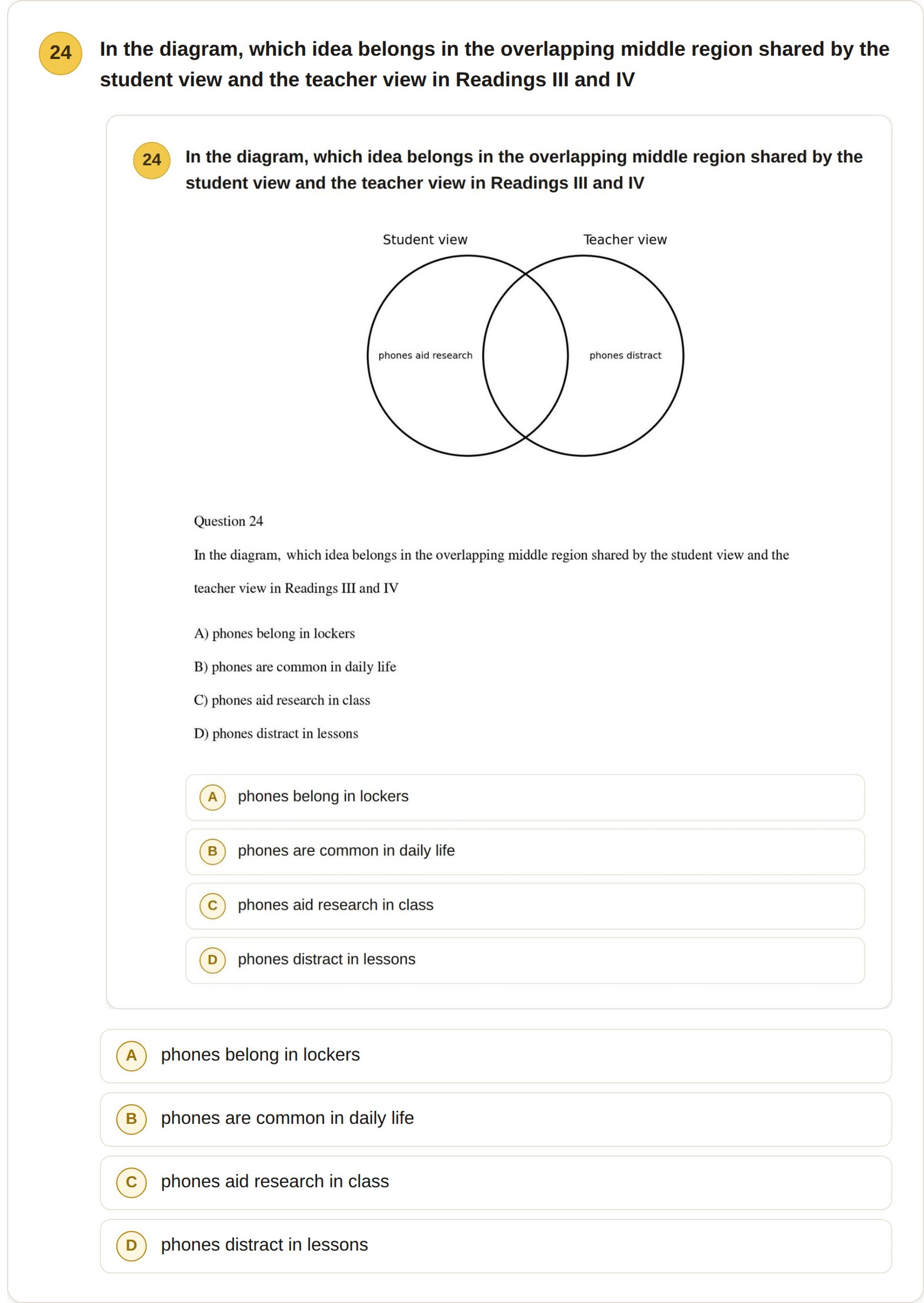
Phones belong in class, used wisely, because they are tools for learning, not just distractions. A student can photograph the board to review notes later, look up a word in seconds, and use a timer to plan revision. When a teacher sets clear rules for when phones come out and when they stay away, students learn to use technology with purpose instead of fearing it.
Critics say phones always distract, but a tool is only as distracting as the rules around it. A pencil can also be used to doodle, yet no one suggests banning pencils. If we teach students to use phones well now, they will carry that skill into workplaces where phones are part of daily life.
10
According to Reading III, a phone can help learning when a student uses it to
Phones should stay in lockers during lessons, because even a silent phone pulls focus away from learning. A notification, a buzz, or even the thought of a message waiting can break concentration, and once concentration breaks, it takes time to rebuild. In my classroom I have watched strong students lose the thread of a discussion after a single glance at a screen.
Supporters say phones help with research, but research can wait for a library computer or a set time after the lesson. Lessons are short, and attention is the most valuable thing a student brings to class. Protecting that attention matters more than the convenience of having every answer in a pocket.
11
According to Reading IV, the main reason phones should stay in lockers is that