1
The lowest layer of the atmosphere, where almost all weather happens, is the
A troposphere B stratosphere C mesosphere D thermosphere
What looks wrong with Question 1?
Send anonymously
Cancel
2
The layer of the atmosphere that contains most of the ozone that absorbs ultraviolet radiation is the
A troposphere B stratosphere C exosphere D mesosphere
What looks wrong with Question 2?
Send anonymously
Cancel
3
Meteors usually burn up in this layer of the atmosphere
A mesosphere B troposphere C stratosphere D exosphere
What looks wrong with Question 3?
Send anonymously
Cancel
4
Auroras most often appear in this layer of the atmosphere
A thermosphere B troposphere C stratosphere D mesosphere
What looks wrong with Question 4?
Send anonymously
Cancel
5
The outermost and thinnest layer of the atmosphere is the
A troposphere B exosphere C stratosphere D mesosphere
What looks wrong with Question 5?
Send anonymously
Cancel
6
In the troposphere, air temperature generally changes with increasing altitude by
A increasing B staying the same C decreasing D rising then falling sharply
What looks wrong with Question 6?
Send anonymously
Cancel
7
Sea level temperature is 20 degrees. Temperature falls 6.5 degrees for each 1000 metres of altitude. The temperature at 2000 metres, in degrees, is
What looks wrong with Question 7?
Send anonymously
Cancel
8
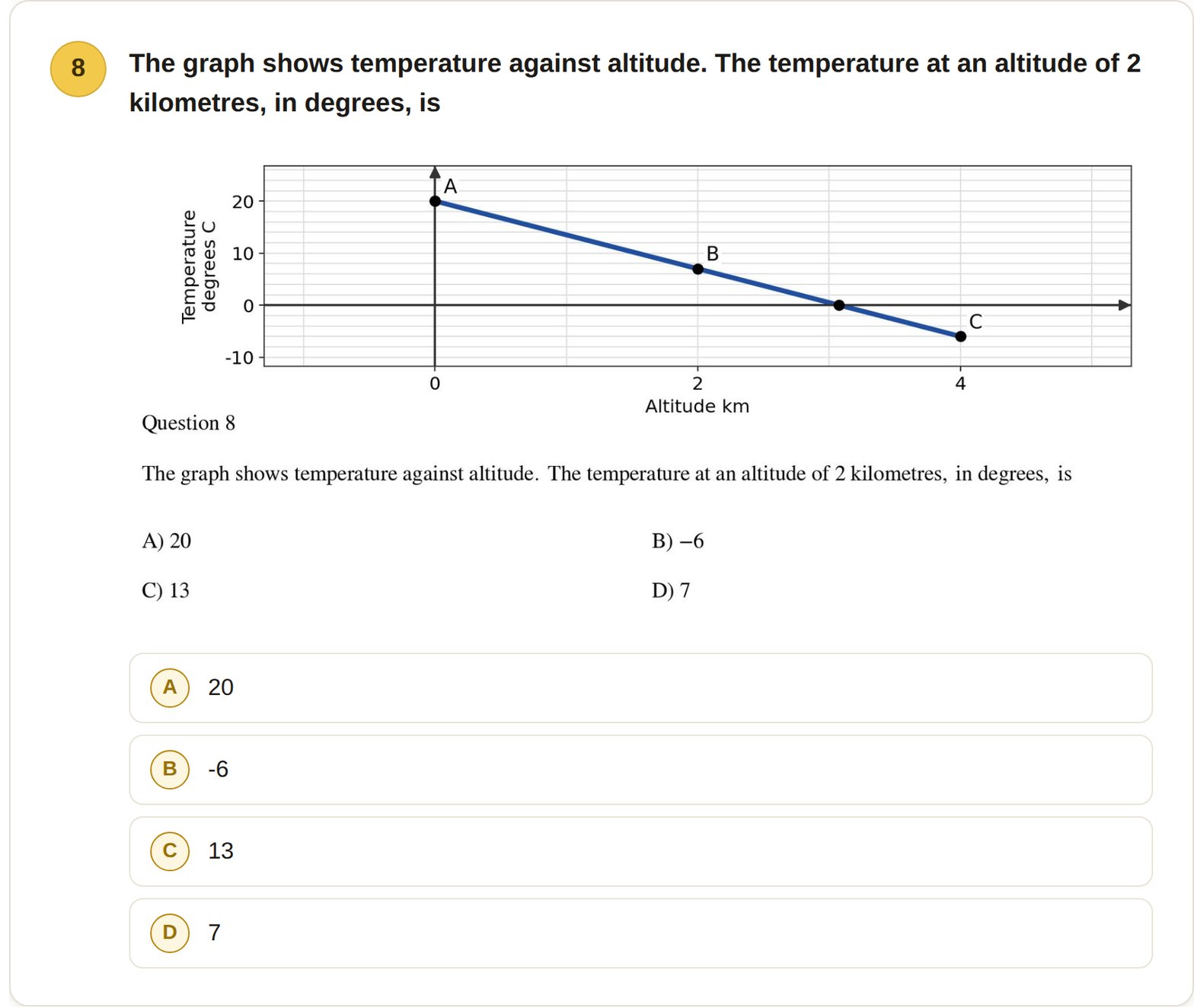
The graph shows temperature against altitude. The temperature at an altitude of 2 kilometres, in degrees, is
A 20 B -6 C 13 D 7
What looks wrong with Question 8?
Send anonymously
Cancel
9
Weather differs from climate in that weather describes atmospheric conditions over a short time while climate describes
A long term average conditions and patterns in a place B only rainfall in one day C conditions on other planets D the forecast for tomorrow only
What looks wrong with Question 9?
Send anonymously
Cancel
10
A high pressure system usually brings clear skies because air in it is
A rising and cooling rapidly B sinking and warming, which discourages cloud formation C moving only at night D always carrying ocean moisture
What looks wrong with Question 10?
Send anonymously
Cancel
11
A low pressure system usually brings cloudy and wet weather because air in it is
A sinking and warming steadily B blocked by mountains only C rising and cooling, which encourages cloud formation D completely still
What looks wrong with Question 11?
Send anonymously
Cancel
12
A cold front usually brings a short period of heavy rain because cold air
A warms the ground for weeks B stops all wind movement C only moves in summer D pushes steeply under warm air and forces it up quickly
What looks wrong with Question 12?
Send anonymously
Cancel
13
A warm front usually brings gradual light rain because warm air
A slides gently up over colder air along a shallow slope B falls straight to the ground C pushes cold air down rapidly D only forms over oceans
What looks wrong with Question 13?
Send anonymously
Cancel
14
In the Northern Hemisphere the Coriolis effect deflects moving air to the
A left B right C north only D south only
What looks wrong with Question 14?
Send anonymously
Cancel
15
The jet stream is best described as a narrow band of fast moving air high in the atmosphere that
A creates ocean tides B holds clouds in one place C steers weather systems across midlatitudes D warms the ground directly
What looks wrong with Question 15?
Send anonymously
Cancel
16
Compared with an inland place at the same latitude, a coastal place usually has a smaller annual temperature range because
A coasts receive no sunlight B inland places are always warmer C wind never reaches coasts D the ocean warms and cools slowly and moderates nearby temperatures
What looks wrong with Question 16?
Send anonymously
Cancel
17
Latitude affects climate mainly because places near the equator receive sunlight
A more directly through the year than places near the poles B only in summer C at the same angle as polar places D reflected from the ocean only
What looks wrong with Question 17?
Send anonymously
Cancel
18
Altitude affects climate because places at higher elevation are usually
A warmer than nearby lowland places B colder than nearby lowland places C wetter in every season D unaffected by temperature change
What looks wrong with Question 18?
Send anonymously
Cancel
19
A warm ocean current passing a coast tends to make that coast
A colder and drier in all seasons B free of wind C warmer and often wetter than a coast beside a cold current D identical to inland places
What looks wrong with Question 19?
Send anonymously
Cancel
20
A rain shadow forms on the leeward side of a mountain range because air descending there
A cools and always produces snow B stops moving entirely C rises again immediately D warms and dries, so clouds and rain decrease
What looks wrong with Question 20?
Send anonymously
Cancel
21
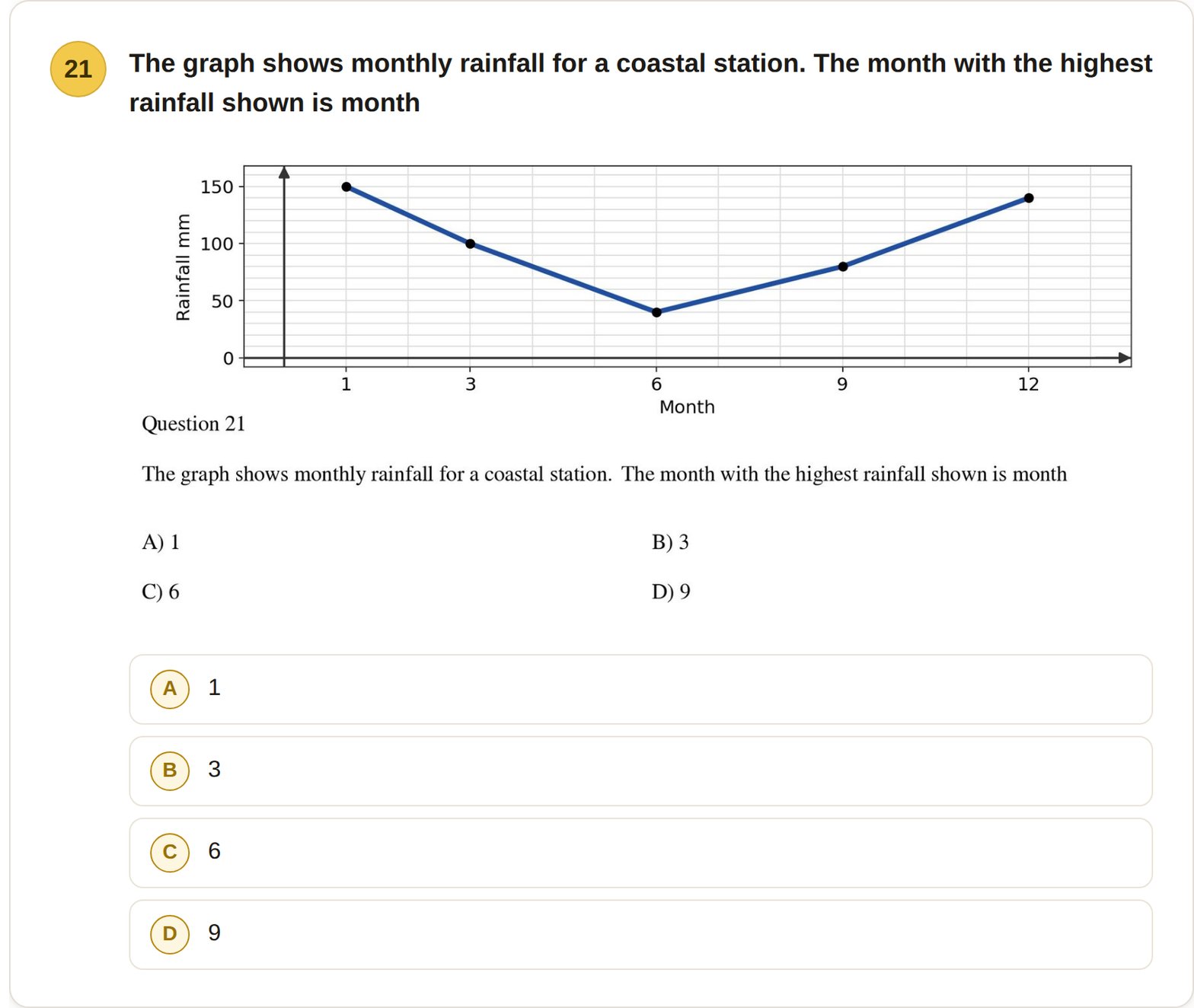
The graph shows monthly rainfall for a coastal station. The month with the highest rainfall shown is month
A 1 B 3 C 6 D 9
What looks wrong with Question 21?
Send anonymously
Cancel
22
The schematic map of Canada shows mild, wet winter climate levels by region in the data shown. The region at level 3 , the highest level, is
A Prairies B British Columbia C North D Ontario
What looks wrong with Question 22?
Send anonymously
Cancel
23
Climate change driven by increased greenhouse gases warms Earth mainly because greenhouse gases
A block all sunlight from reaching Earth B cool the oceans directly C absorb outgoing heat radiation and reradiate some of it back toward the surface D stop all wind movement
What looks wrong with Question 23?
Send anonymously
Cancel
24
The main human source of the recent increase in atmospheric carbon dioxide is
A planting forests B ocean evaporation alone C volcanic eruptions alone D burning fossil fuels such as coal, oil and natural gas
What looks wrong with Question 24?
Send anonymously
Cancel
25
A barometer is the instrument used to measure
A air pressure B wind speed C rainfall amount D humidity only
What looks wrong with Question 25?
Send anonymously
Cancel