1
The crust is best described as the outermost layer of Earth, which is thin and solid and is

British Columbia Physical Geography 12 (MPGEO12) · Unit C · 25 questions
This practice test was made by AI and there may be mistakes. If a question or answer looks wrong, use the Flag a mistake button to let Brett know so he can fix it.
The crust is best described as the outermost layer of Earth, which is thin and solid and is
The mantle is the layer of Earth below the crust that makes up most of Earths volume and moves slowly by
The outer core is best described as a layer of liquid iron and nickel whose movement helps generate Earths
The inner core is solid rather than liquid mainly because pressure at Earths centre is so great that it keeps iron and nickel
The lithosphere is best described as the rigid outer shell of Earth made of the crust and the

The asthenosphere is the layer below the lithosphere that is hot enough to flow very slowly, allowing plates above it to
Plate tectonics is the theory that Earths lithosphere is divided into plates that move over the
At a divergent plate boundary, plates move apart and new crust forms, often at a feature called a

At a convergent plate boundary, plates move together and one plate may sink beneath another in a process called
At a transform plate boundary, plates slide past each other sideways, which commonly produces
In subduction, a dense plate sinks beneath a less dense plate. When the two plates are of the same kind, the plate that sinks is an
The Ring of Fire is the zone around the Pacific Ocean known for frequent earthquakes and
Igneous rock forms when molten rock cools and solidifies, either underground as magma or at the surface as
Sedimentary rock forms when sediments are deposited in layers and then compacted and cemented together, often preserving

Metamorphic rock forms when an existing rock is changed by heat and pressure without melting completely, producing new
Weathering is the process that breaks down or alters rock in place, while the transport of the resulting material by water, wind or ice is called
Erosion differs from weathering because erosion involves the
Deposition occurs when transported sediment settles out of water, wind or ice, often forming layers in a riverbed, lake or
Fold mountains can form at a convergent boundary when layers of rock are squeezed and bent upward by

A river valley with a V shaped cross section is usually formed mainly by

Topsoil is the upper soil horizon that is usually darkest and most fertile because it contains the most
Soil formation is influenced by parent material, climate, organisms, relief and time, and in a wet warm climate soil usually develops
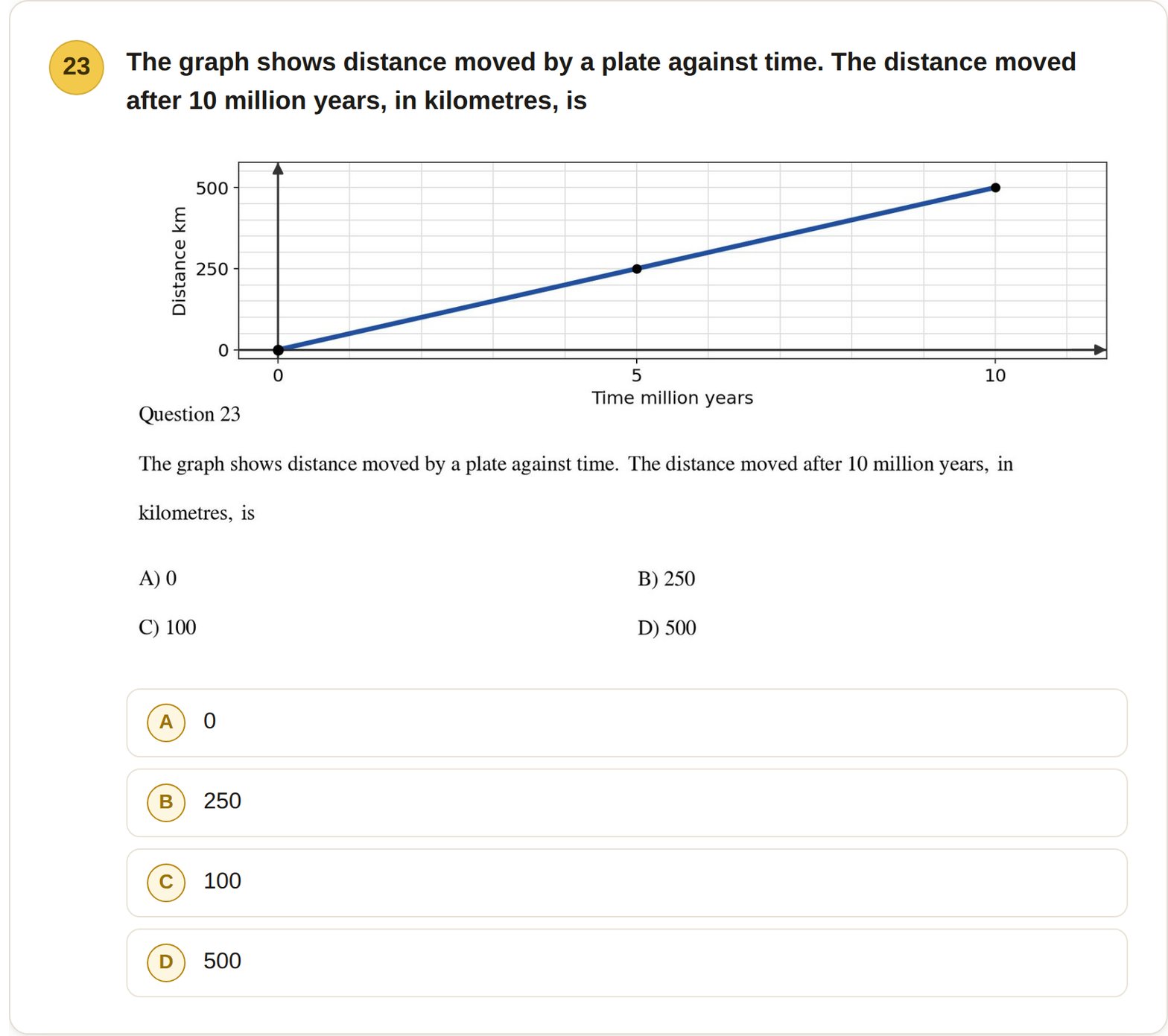
The graph shows distance moved by a plate against time. The distance moved after 10 million years, in kilometres, is
The schematic map of Canada shows mountain relief levels by region in the data shown. The region at level 3 , the highest level, is
The triangle shows a cross section of a mountain with a base of 4 kilometres and a height of 3 kilometres. The label at the peak of the mountain is
Your score: 0 / 25