1
Two vectors of 10 m and 6 m in the same direction combine to a resultant, in metres, of
British Columbia Physics 12 (MPH--12) · Final Exam · 50 questions
This practice test was made by AI and there may be mistakes. If a question or answer looks wrong, use the Flag a mistake button to let Brett know so he can fix it.
Two vectors of 10 m and 6 m in the same direction combine to a resultant, in metres, of
A 5 kg object sits on Earth. Using g = 9.8 m per s squared, its weight, in newtons, is
Two charges of 2 × 10⁻⁶ C and 3 × 10⁻⁶ C are 0.1 m apart. Using k = 9.0 × 10⁹ N m squared per C squared, the force between them, in newtons, is
A voltage of 24 V is applied across an 8 ohm resistor. The current, in amperes, is
An object starts at 5 m per s and accelerates at 2 m per s squared for 4 s. Its final speed, in metres per second, is
A 2 kg mass is lifted upward with an acceleration of 2 m per s squared. Using g = 9.8 m per s squared, the tension, in newtons, is
A point charge of 2 × 10⁻⁶ C is 0.1 m from a point. Using k = 9.0 × 10⁹ N m squared per C squared, the field strength there, in newtons per coulomb, is
Resistors of 12 ohms and 4 ohms are connected in parallel. The total resistance, in ohms, is
A runner covers a displacement of 60 m in 5 s. The average velocity, in metres per second, is
A 2 kg object moves in a circle of radius 3 m at a speed of 6 m per s. The centripetal force, in newtons, is
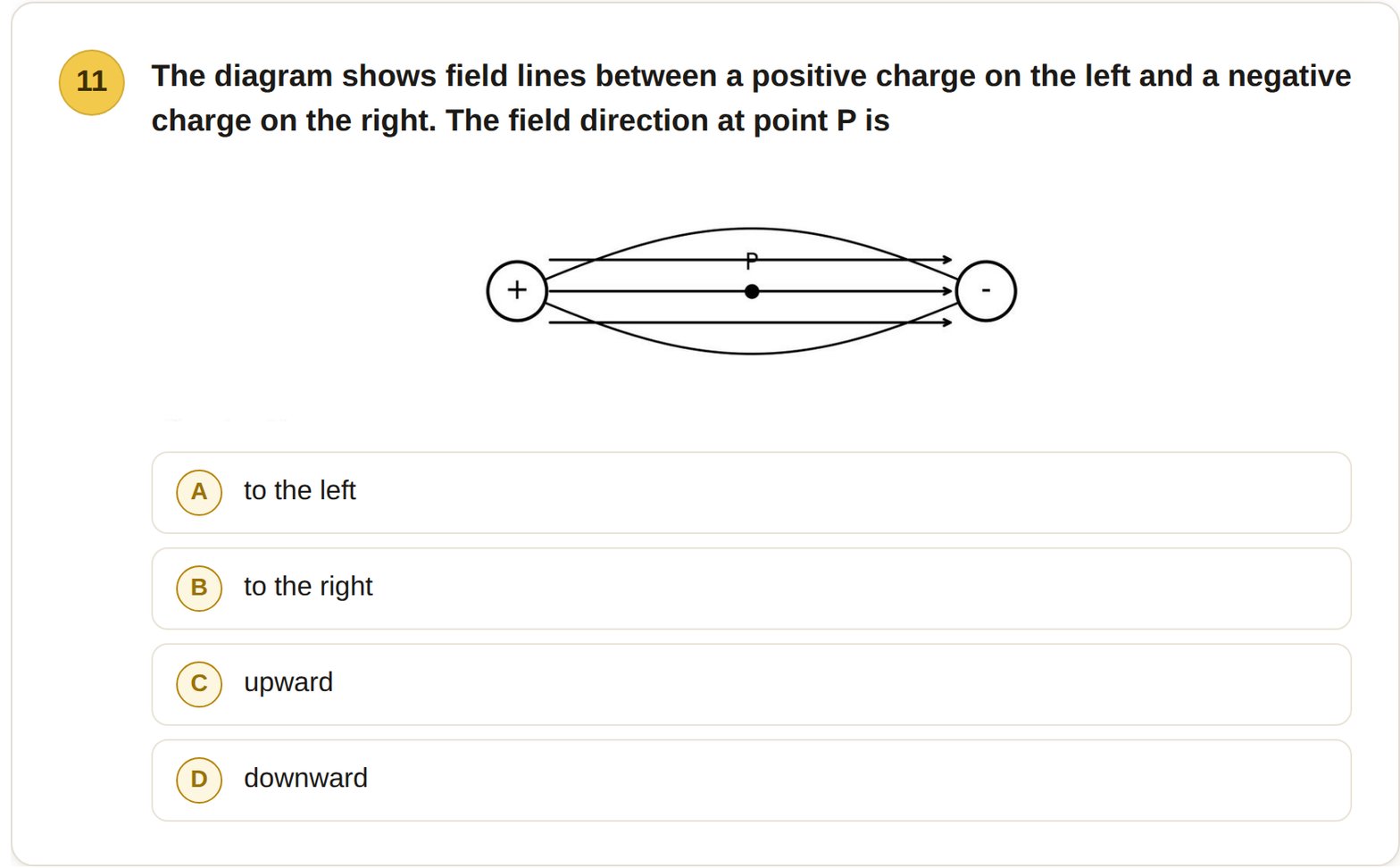
The diagram shows field lines between a positive charge on the left and a negative charge on the right. The field direction at point P is
A voltage of 12 V is applied across a 6 ohm resistor. The power dissipated, in watts, is
A ball is thrown upward at 19.6 m per s. Using g = 9.8 m per s squared, the time to reach the top, in seconds, is
If the distance between two masses is doubled, the gravitational force between them becomes
The graph shows electric field strength against distance with E = 360 / distance² . At a distance of 3 units , the field , in newtons per coulomb , is
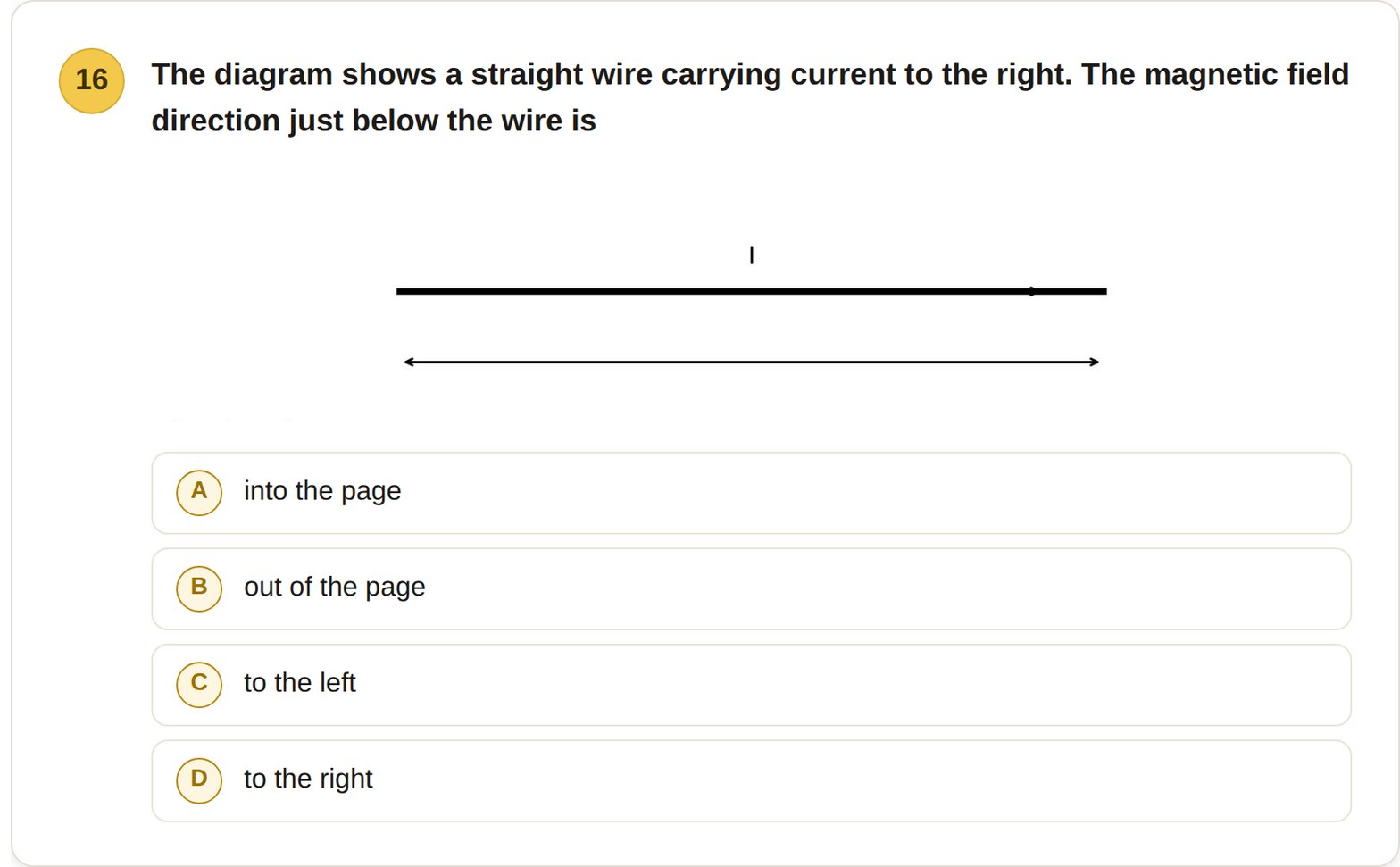
The diagram shows a straight wire carrying current to the right. The magnetic field direction just below the wire is
A projectile is launched with a vertical speed of 19.6 m per s. Using g = 9.8 m per s squared, its total flight time, in seconds, is
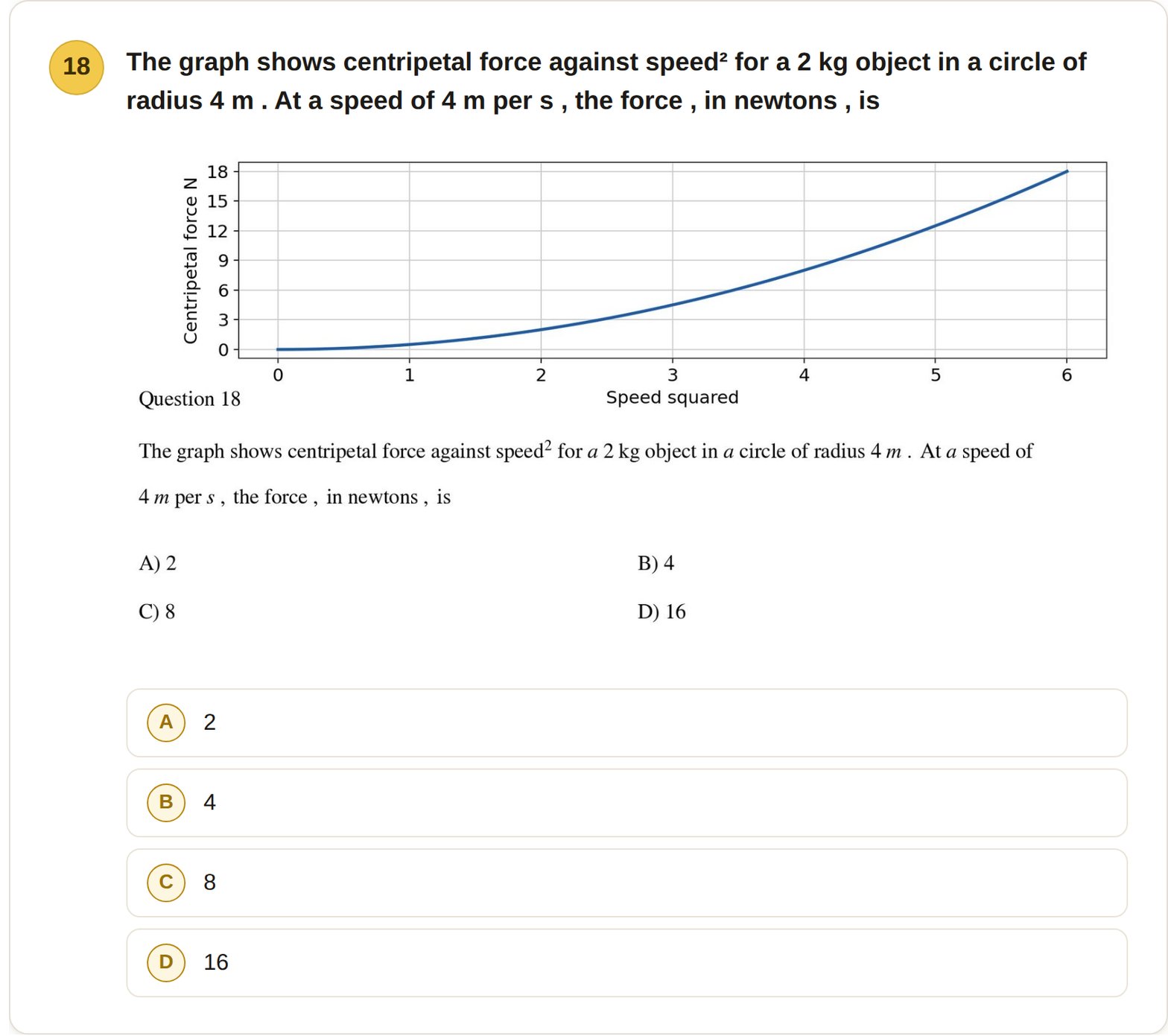
The graph shows centripetal force against speed² for a 2 kg object in a circle of radius 4 m . At a speed of 4 m per s , the force , in newtons , is
Where electric field lines are closest together, the field is
In a series circuit, the current through each component is
A projectile is launched with a horizontal speed of 12 m per s and a vertical speed of 19.6 m per s. Using g = 9.8 m per s squared, its range, in metres, is
If the distance between two masses is tripled, the gravitational force between them becomes
In an insulator, electric charges
Electromagnetic induction occurs when a changing magnetic flux
Which of the following is a vector quantity
The centripetal force that keeps a satellite in circular orbit is
A point charge of 1 × 10⁻⁶ C is 0.3 m from a point. Using k = 9.0 × 10⁹ N m squared per C squared, the potential there, in volts, is
In a series circuit, the total supply voltage is
A car travelling at 20 m per s brakes with an acceleration of -4 m per s squared. Its stopping distance, in metres, is
A block on a flat surface has a coefficient of static friction of 0.5 and a mass of 4 kg. Using g = 9.8 m per s squared, the maximum static friction, in newtons, is
Two charges of 4 × 10⁻⁶ C and 5 × 10⁻⁶ C are 0.2 m apart. Using k = 9.0 × 10⁹ N m squared per C squared, the force between them, in newtons, is
A voltage of 18 V drives a current of 2 A through a resistor. The resistance, in ohms, is
Ignoring air resistance, the vertical speed of a projectile at the top of its flight, in metres per second, is
A 2.5 kg object sits on Earth. Using g = 9.8 m per s squared, its weight, in newtons, is
The graph shows electric field strength against distance with E = 180 / distance² . At a distance of 3 units , the field , in newtons per coulomb , is
Resistors of 10 ohms and 10 ohms are connected in parallel. The total resistance, in ohms, is
A stone is dropped from rest. Using g = 9.8 m per s squared, the distance it falls in 3 s, in metres, is
A wheel makes 40 revolutions in 10 s. Its period, in seconds, is
An object carries a total charge of -4.8 × 10⁻¹⁹ C. Using e = 1.6 × 10⁻¹⁹ C, the number of excess electrons on it is
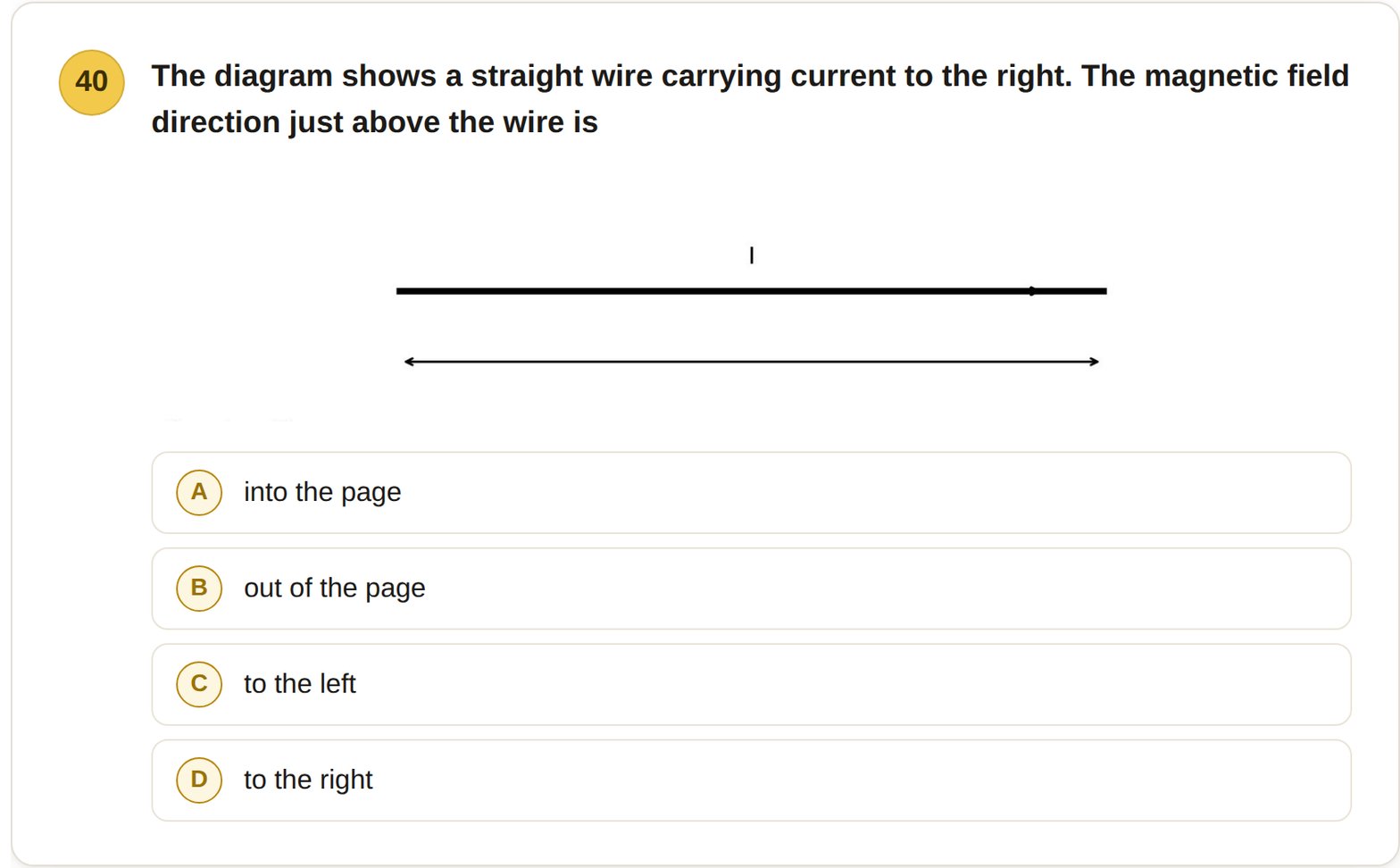
The diagram shows a straight wire carrying current to the right. The magnetic field direction just above the wire is
A projectile is launched with a vertical speed of 29.4 m per s. Using g = 9.8 m per s squared, its total flight time, in seconds, is
If the orbital radius of a satellite increases by a factor of 9, its orbital period increases by a factor of
If the distance between two charges is tripled, the electric force between them becomes
Outside a bar magnet, the magnetic field lines run from
A train travels east at 30 m per s. A passenger walks west at 2 m per s relative to the train. The speed of the passenger relative to the ground, in metres per second, is
If the distance from a planet centre is doubled, the gravitational field strength becomes
If one charge is tripled and the other is halved, the electric force between them becomes
In a parallel circuit, the total current from the supply equals
Ignoring air resistance, the vertical acceleration of a projectile is
A geostationary satellite has an orbital period of
Your score: 0 / 50