1
A gene is best described as a section of DNA that
A makes up the entire chromosome B codes for one specific trait or protein C controls every trait in an organism D carries energy between cells
What looks wrong with Question 1?
Send anonymously
Cancel
2
In DNA, adenine always pairs with
A guanine B cytosine C thymine D uracil
What looks wrong with Question 2?
Send anonymously
Cancel
3
An organism with genotype Aa has phenotype tall. This shows that the allele for tall is
A dominant B recessive C sex-linked D mutated
What looks wrong with Question 3?
Send anonymously
Cancel
4
Two pea plants with genotype Aa are crossed. The percent of offspring expected to show the recessive trait is
A 50 percent B 75 percent C 25 percent D 100 percent
What looks wrong with Question 4?
Send anonymously
Cancel
5
A plant with genotype AA is crossed with a plant with genotype aa. All of the offspring will have genotype
A AA B aa C Aa D AA or aa
What looks wrong with Question 5?
Send anonymously
Cancel
6
A red snapdragon (RR) is crossed with a white snapdragon (rr). With incomplete dominance, the offspring flowers are
A red B white C red and white spotted D pink
What looks wrong with Question 6?
Send anonymously
Cancel
7
A person with blood type AB has genotype IAIB. This is an example of
A co-dominance B complete dominance C incomplete dominance D sex linkage
What looks wrong with Question 7?
Send anonymously
Cancel
8
A woman carries the allele for colour blindness on one X chromosome and has a son. The chance that her son is colour blind is
A 25 percent B 50 percent C 75 percent D 100 percent
What looks wrong with Question 8?
Send anonymously
Cancel
9
Colour blindness is a sex-linked recessive trait carried on the X chromosome. A colour blind father and a mother with normal vision who is not a carrier have a daughter. What will the daughter be?
A colour blind B unable to inherit the allele C colour blind only as an adult D a carrier with normal vision
What looks wrong with Question 9?
Send anonymously
Cancel
10
A mutation that gives a bacterium resistance to an antibiotic is best described as
A negative in every environment B neutral because bacteria lack DNA C positive for the bacterium in that environment D impossible without human help
What looks wrong with Question 10?
Send anonymously
Cancel
11
Which of the following is a mutagen
A clean drinking water B ultraviolet radiation C vitamin C D oxygen gas
What looks wrong with Question 11?
Send anonymously
Cancel
12
A carcinogen is a substance that
A can damage DNA and increase the risk of cancer B repairs damaged DNA in cells C prevents all mutations D only affects skin cells
What looks wrong with Question 12?
Send anonymously
Cancel
13
A mutation in a skin cell that does not change the protein made is best described as
A positive B negative C lethal D neutral
What looks wrong with Question 13?
Send anonymously
Cancel
14
Natural selection acts most directly on the
A genotype of a species B climate of a region C phenotype of an individual D age of a fossil
What looks wrong with Question 14?
Send anonymously
Cancel
15
A population of beetles lives on brown bark. Green beetles are eaten more often by birds. Over many generations, the population is expected to become mostly
A brown B green C equal brown and green D extinct
What looks wrong with Question 15?
Send anonymously
Cancel
16
The graph shows the percent of dark moths in a forest over four surveys. Between survey 1 and survey 4, the percent of dark moths
A decreased from 80 percent to 20 percent B stayed at 50 percent C increased from 20 percent to 40 percent D increased from 20 percent to 80 percent
What looks wrong with Question 16?
Send anonymously
Cancel
17
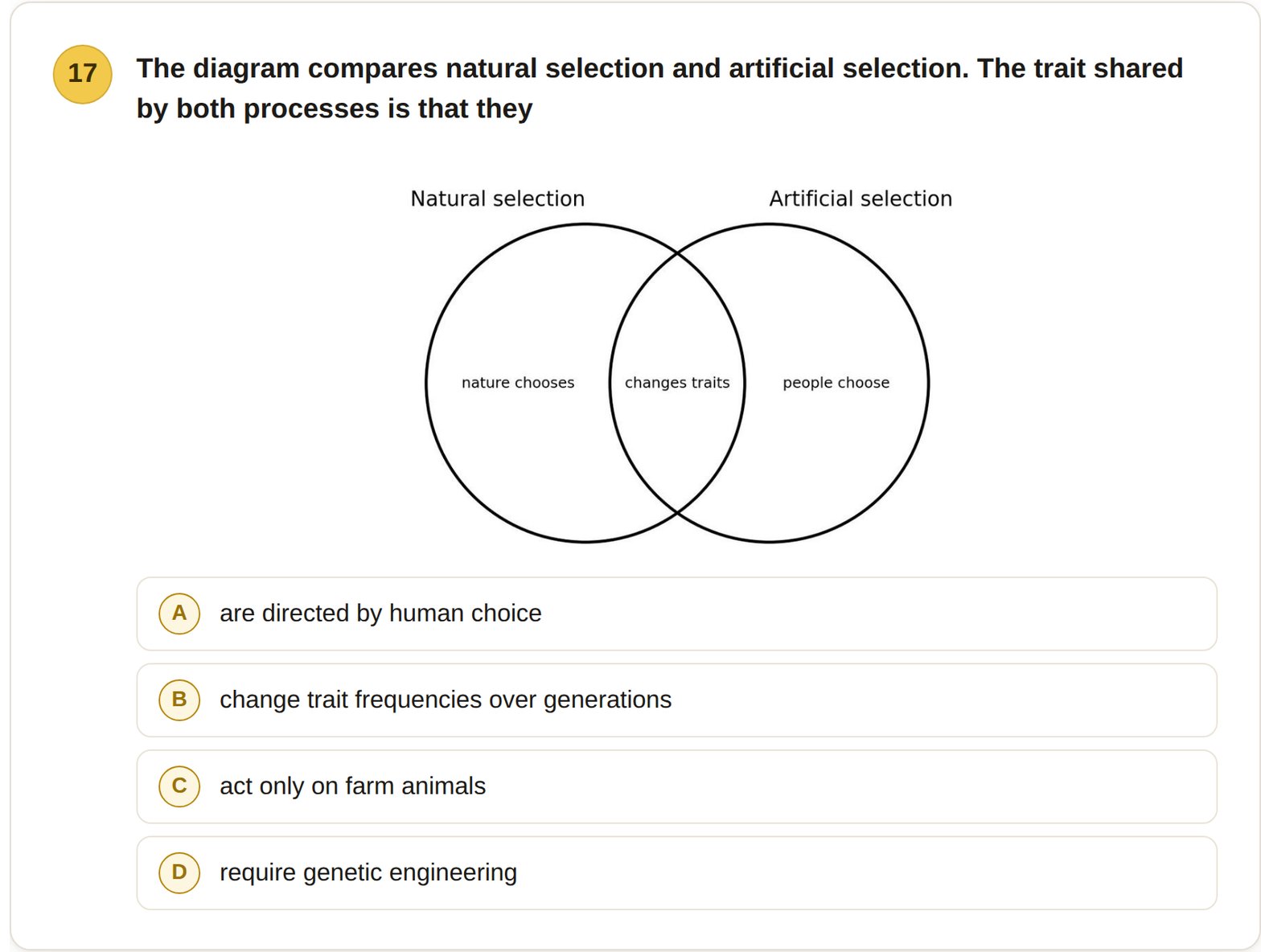
The diagram compares natural selection and artificial selection. The trait shared by both processes is that they
A are directed by human choice B change trait frequencies over generations C act only on farm animals D require genetic engineering
What looks wrong with Question 17?
Send anonymously
Cancel
18
Finches on different Galapagos islands evolved different beak shapes. The beaks suit different foods. This pattern is called
A artificial selection B cloning C adaptive radiation D gene therapy
What looks wrong with Question 18?
Send anonymously
Cancel
19
A farmer breeds only the wheat plants that produce the most grain each year. This is an example of
A artificial selection B natural selection C adaptive radiation D extinction
What looks wrong with Question 19?
Send anonymously
Cancel
20
An invasive species is most likely to harm a new ecosystem because it
A always eats only one kind of food B cannot reproduce outside its home range C increases the diversity of native species D has few predators and can outcompete native species
What looks wrong with Question 20?
Send anonymously
Cancel
21
A species becomes extinct when
A its population drops for one season B no living members of the species remain C it moves to a new habitat D a new predator arrives
What looks wrong with Question 21?
Send anonymously
Cancel
22
A genetically modified crop produces its own pest protection. It could benefit farmers by
A removing all insects from the region B making the crop grow without water C reducing the amount of pesticide sprayed D ending the need for soil
What looks wrong with Question 22?
Send anonymously
Cancel
23
Gene therapy aims to treat a genetic disorder by
A removing all genes from a cell B copying a whole organism C changing the diet of a patient D adding or replacing a faulty gene in cells
What looks wrong with Question 23?
Send anonymously
Cancel
24
A clone of an animal is
A genetically identical to the donor animal B a mix of two different species C always born as a twin D identical in learned behaviour too
What looks wrong with Question 24?
Send anonymously
Cancel
25
Forensic scientists use DNA evidence because a DNA profile is
A identical for all relatives B almost unique to each person C changed by every meal D the same for all humans
What looks wrong with Question 25?
Send anonymously
Cancel