Source I - A Letter Home, 1917
Use this reading for questions 1 to 3.
We have waited for days in tunnels under the ridge, listening to our own guns. This morning, for the first time, all four Canadian divisions attacked together, side by side. By nightfall we held the ridge, but the ground was covered with men who will not go home.
People at home will hear that Vimy was a victory. They should also know what it cost. I am proud of what we did together, and I grieve for the friends I lost doing it.
- A Canadian soldier, in a letter home, April 1917 (invented source)
1
The main idea of Source I is that the battle at Vimy Ridge was
A a defeat that ended Canadian fighting in the war B fought only by soldiers from one province C won without serious Canadian losses D a costly success won by all four Canadian divisions together
What looks wrong with Question 1?
Send anonymously
Cancel
2
Source I is most useful as evidence that Vimy Ridge became a symbol of
A opposition to the war in Canada B Canadian military failure C British control of Canada D Canadian achievement and shared sacrifice
What looks wrong with Question 2?
Send anonymously
Cancel
3
The writer of Source I combines pride in the attack with
A indifference to the outcome B support for ending the war at once C grief at the cost of the victory D anger at other Canadian divisions
What looks wrong with Question 3?
Send anonymously
Cancel
4
During the First World War, Canada entered the war in 1914 because
A the United States asked Canada to join B Canada had signed a treaty with Germany C Canada voted to declare war on its own D Britain declared war and Canada was part of the British Empire
What looks wrong with Question 4?
Send anonymously
Cancel
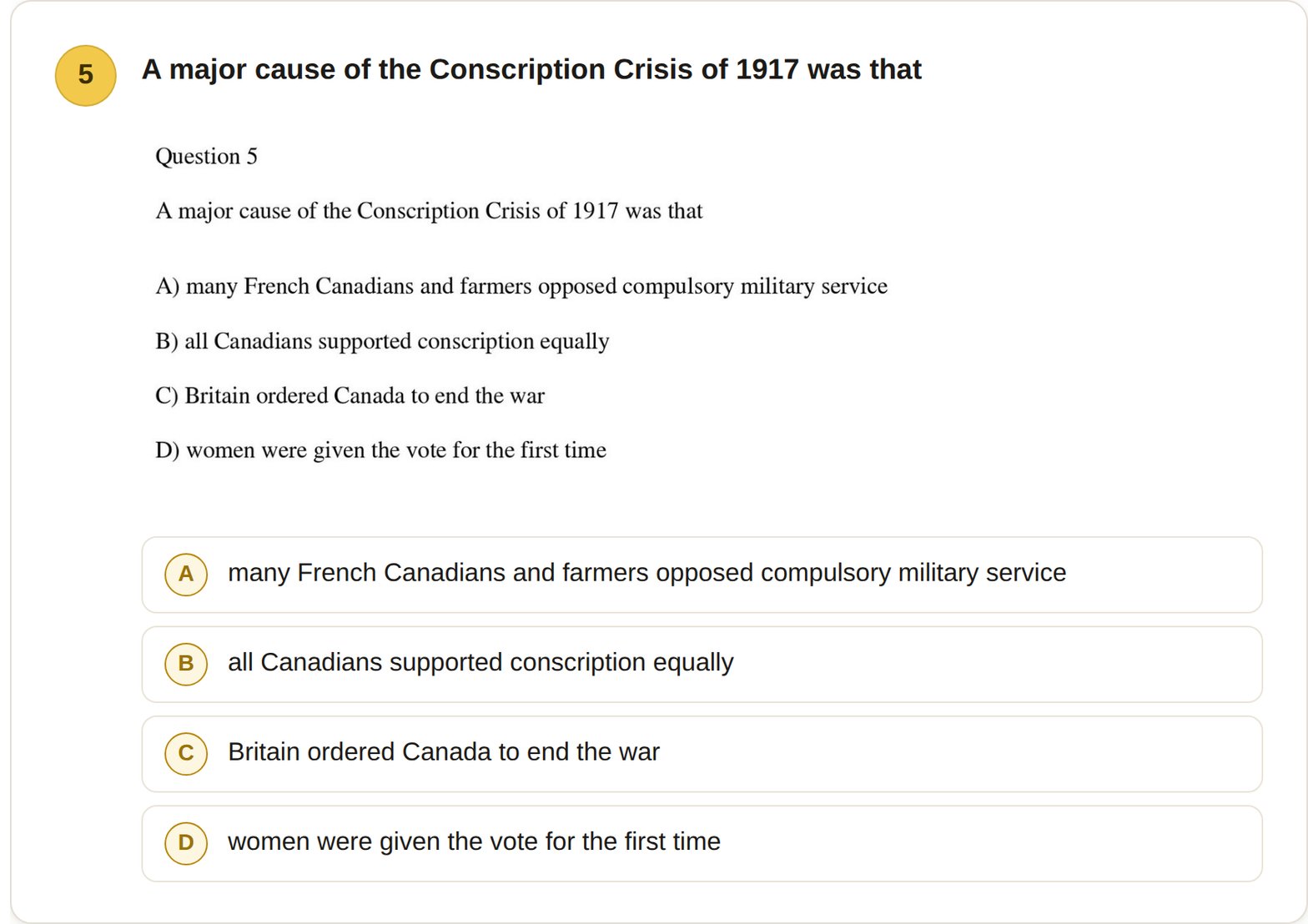
5
A major cause of the Conscription Crisis of 1917 was that
A many French Canadians and farmers opposed compulsory military service B all Canadians supported conscription equally C Britain ordered Canada to end the war D women were given the vote for the first time
What looks wrong with Question 5?
Send anonymously
Cancel
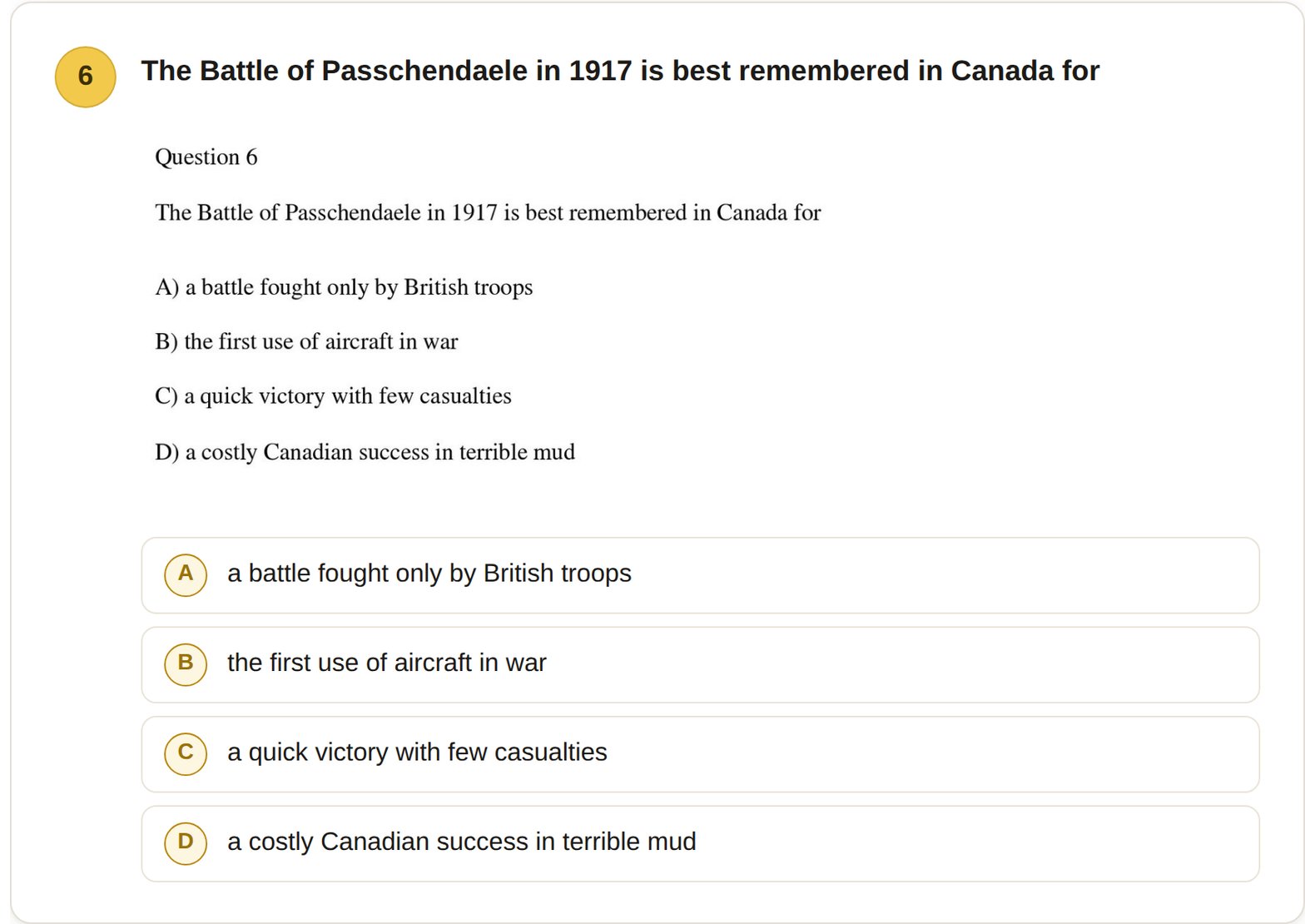
6
The Battle of Passchendaele in 1917 is best remembered in Canada for
A a battle fought only by British troops B the first use of aircraft in war C a quick victory with few casualties D a costly Canadian success in terrible mud
What looks wrong with Question 6?
Send anonymously
Cancel
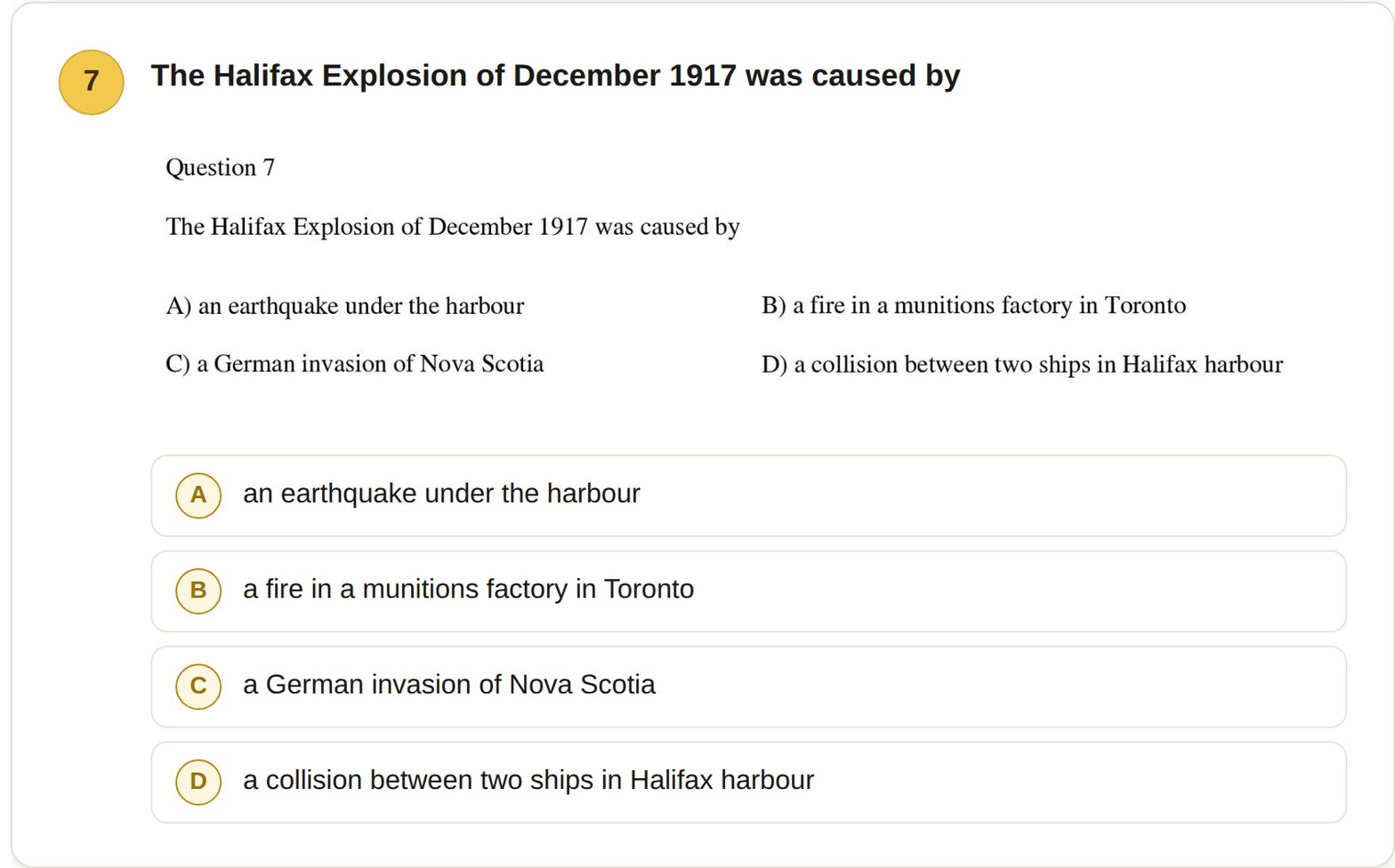
7
The Halifax Explosion of December 1917 was caused by
A an earthquake under the harbour B a fire in a munitions factory in Toronto C a German invasion of Nova Scotia D a collision between two ships in Halifax harbour
What looks wrong with Question 7?
Send anonymously
Cancel
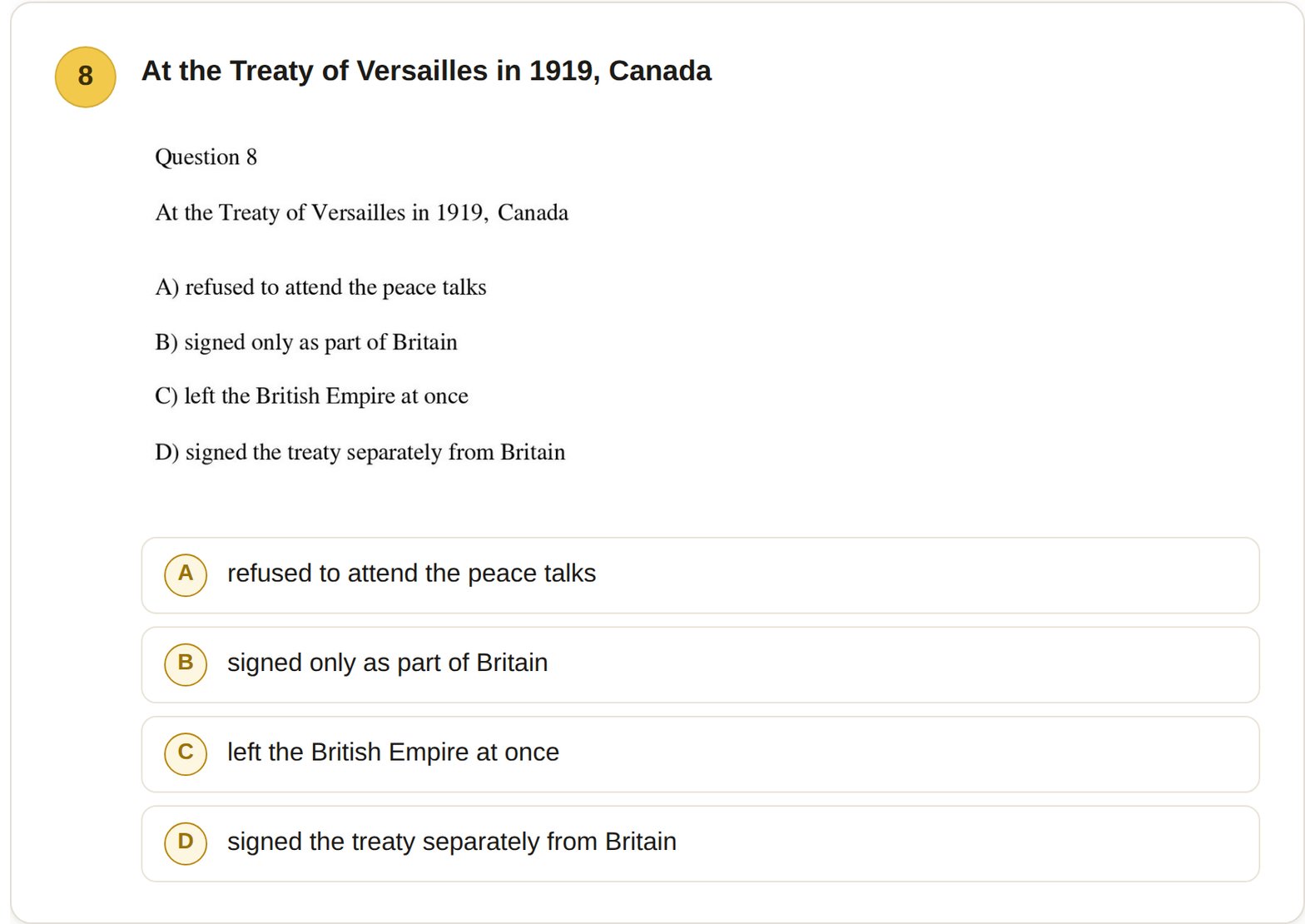
8
At the Treaty of Versailles in 1919, Canada
A refused to attend the peace talks B signed only as part of Britain C left the British Empire at once D signed the treaty separately from Britain
What looks wrong with Question 8?
Send anonymously
Cancel
9
The League of Nations was created after the First World War mainly to
A divide Europe among the winners B collect taxes from member states C prevent future wars through discussion and collective action D build a single world army
What looks wrong with Question 9?
Send anonymously
Cancel
10
A major reason the League of Nations was weak in the 1930s was that
A it met only once every ten years B it had no member states at all C it lacked an army of its own and the United States never joined D it banned all trade between members
What looks wrong with Question 10?
Send anonymously
Cancel
11
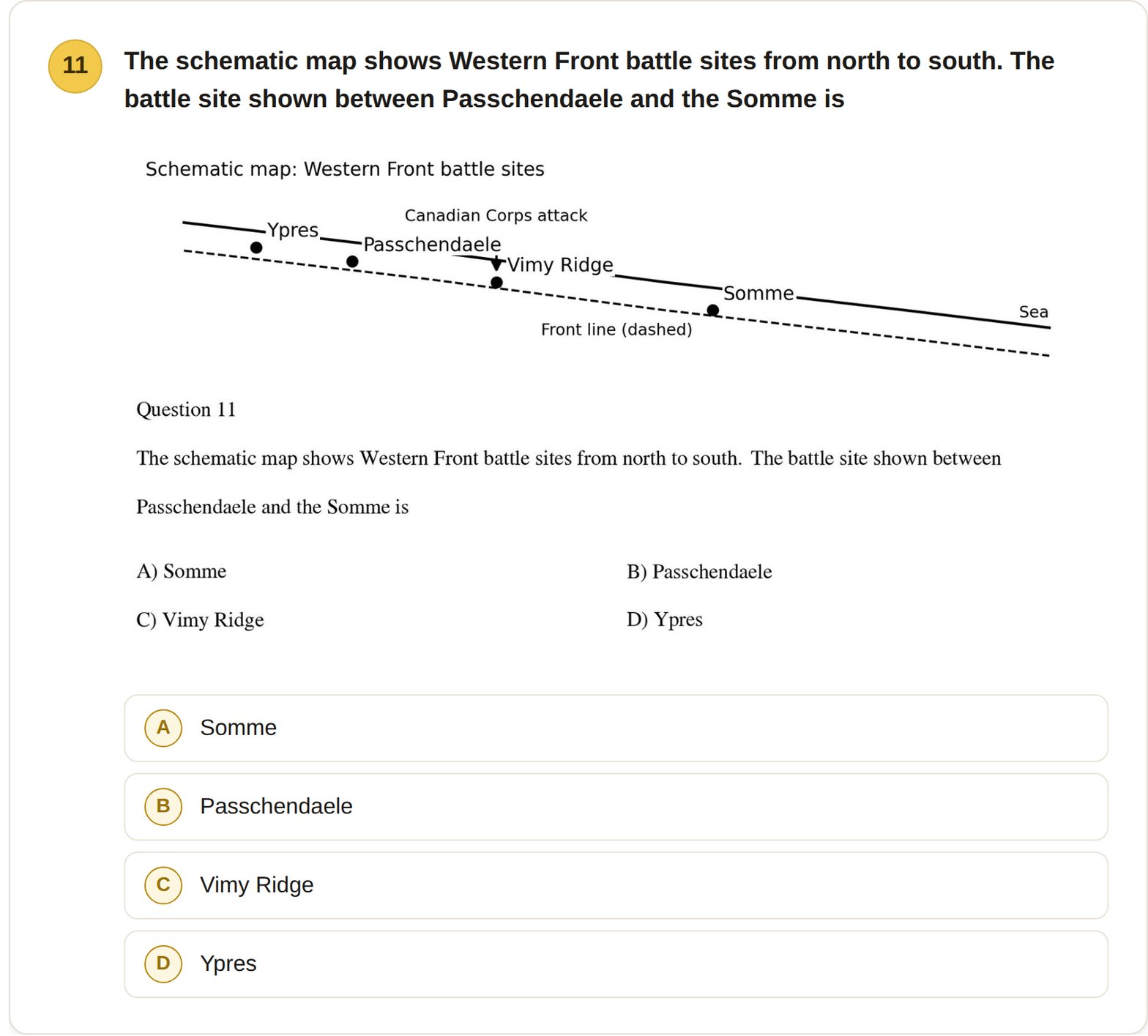
The schematic map shows Western Front battle sites from north to south. The battle site shown between Passchendaele and the Somme is
A Somme B Passchendaele C Vimy Ridge D Ypres
What looks wrong with Question 11?
Send anonymously
Cancel
12
The Dieppe Raid of 1942 is best described as
A a Canadian-led raid on the French coast that ended in heavy losses B a victory that opened the second front C a battle fought in Italy D a naval battle in the Pacific
What looks wrong with Question 12?
Send anonymously
Cancel
13
On D-Day, June 6, 1944, Canadian troops landed at
A Omaha Beach B Gold Beach C Juno Beach D Utah Beach
What looks wrong with Question 13?
Send anonymously
Cancel
14
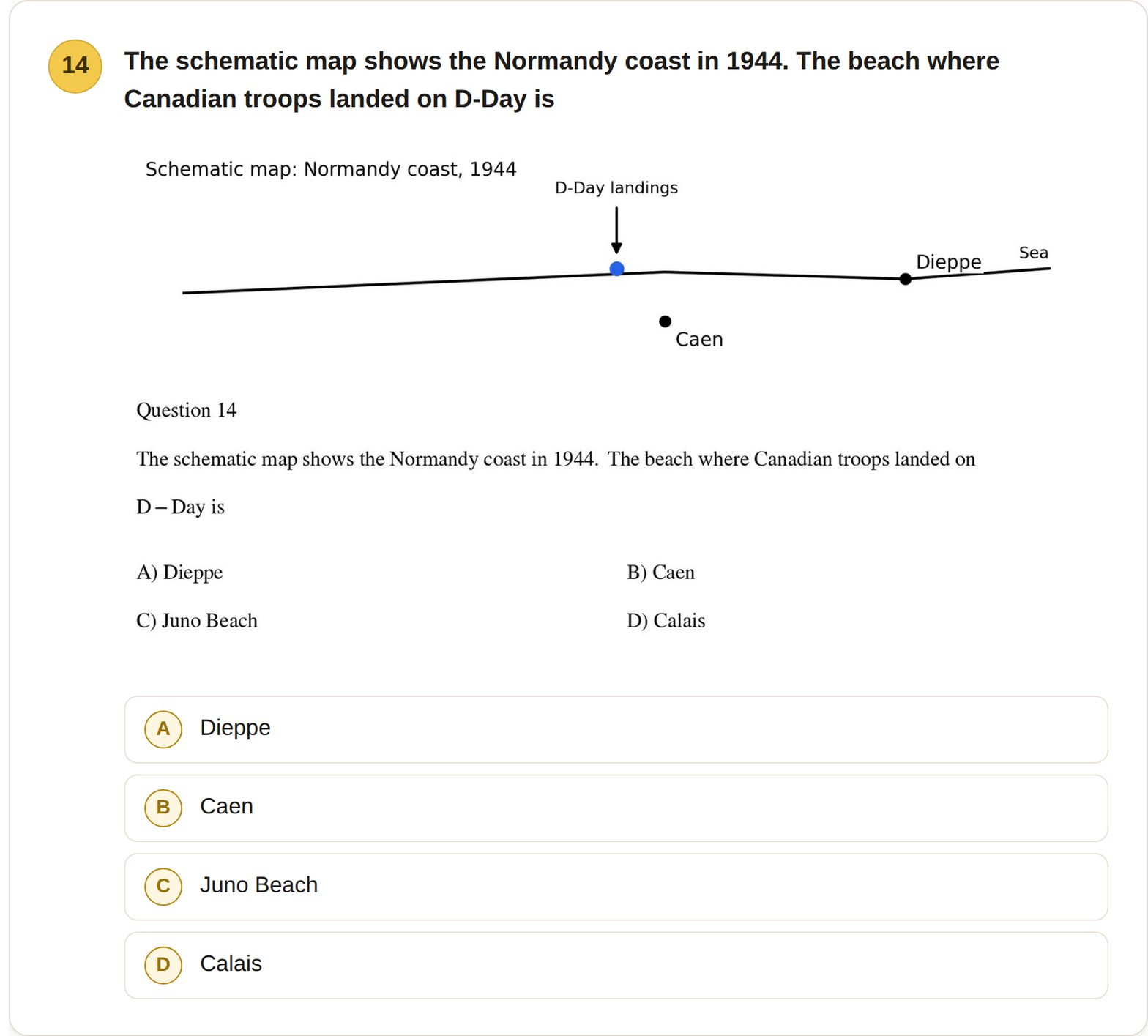
The schematic map shows the Normandy coast in 1944. The beach where Canadian troops landed on D-Day is
A Dieppe B Caen C Juno Beach D Calais
What looks wrong with Question 14?
Send anonymously
Cancel
15
During the Second World War, the Battle of the Atlantic was mainly a struggle over
A control of the skies over London B keeping supply ships moving across the Atlantic against submarines C the invasion of Japan D control of the Suez Canal
What looks wrong with Question 15?
Send anonymously
Cancel
Source II - A Peacekeeper Writes Home, 1957
Use this reading for questions 16 to 17.
We wear blue helmets now, not the uniforms of a battle. Our job is to stand between two armies that have stopped shooting but have not yet made peace. Some days we patrol a road. Other days we guard a food convoy so that families in a village can eat.
It is strange work. We carry rifles, but our best tool is patience. If we do our job well, nothing happens, and that quiet is the whole point.
- A Canadian peacekeeper, in a letter home, 1957 (invented source)
16
The main idea of Source II is that peacekeeping work depends most on
A winning battles quickly B patience and standing between former enemies C building new weapons D taking territory from one side
What looks wrong with Question 16?
Send anonymously
Cancel
17
Source II best illustrates a change in the Canadian military role after 1945 because it shows soldiers
A fighting a declared war against a single enemy B working to keep a fragile peace rather than win a battle C refusing to carry weapons of any kind D serving only inside Canada
What looks wrong with Question 17?
Send anonymously
Cancel
18
Canada first took a major peacekeeping role during the Suez Crisis of 1956, when Lester Pearson proposed
A a United Nations emergency force to separate the armies B a Canadian invasion of Egypt C a permanent Canadian base in the Middle East D an end to the United Nations
What looks wrong with Question 18?
Send anonymously
Cancel
19
The Korean War, 1950-1953, involved Canada as part of
A a United Nations force resisting the invasion of South Korea B a force fighting on the side of North Korea C a neutral observer mission only D a British force acting alone
What looks wrong with Question 19?
Send anonymously
Cancel
20
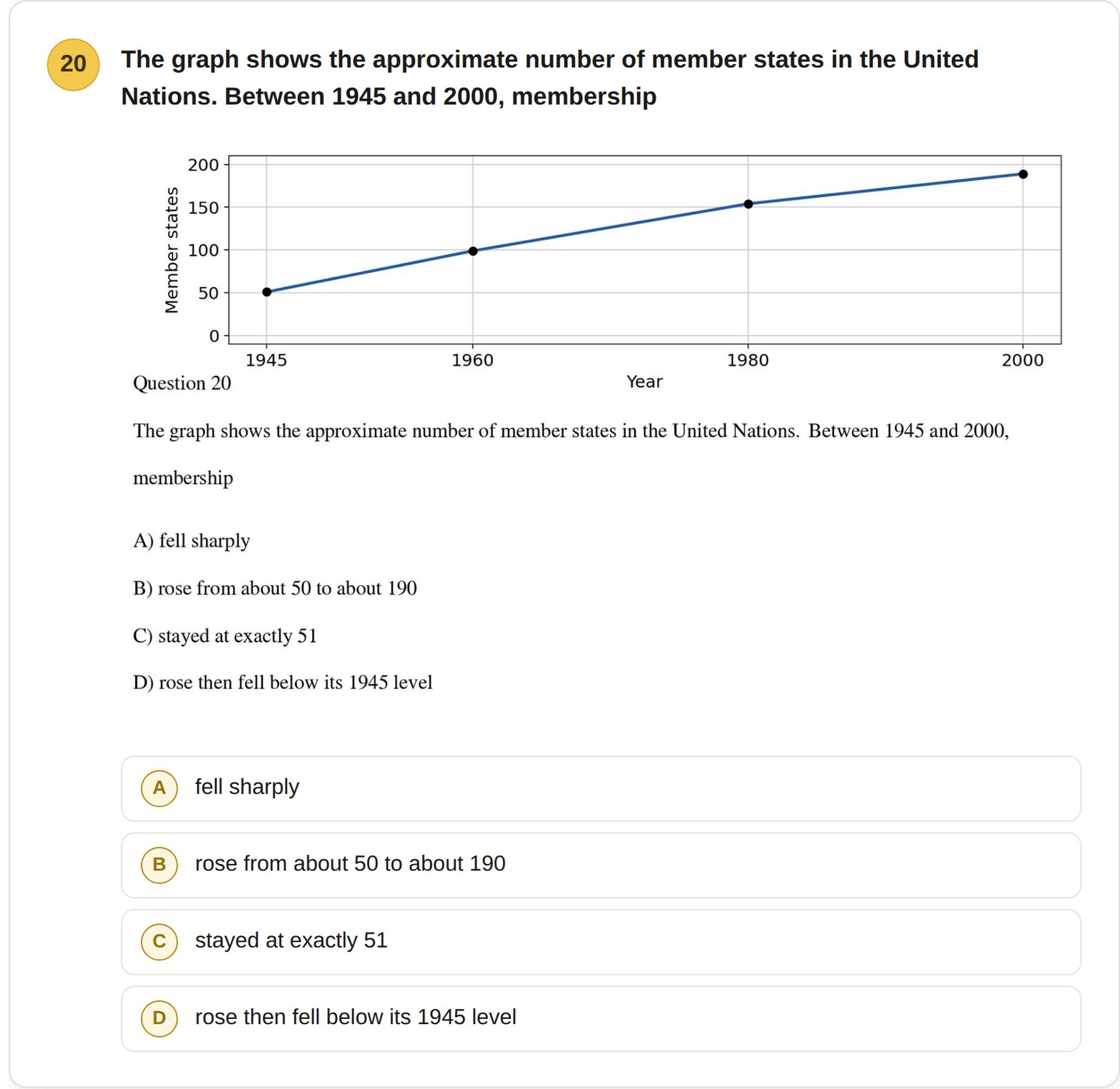
The graph shows the approximate number of member states in the United Nations. Between 1945 and 2000, membership
A fell sharply B rose from about 50 to about 190 C stayed at exactly 51 D rose then fell below its 1945 level
What looks wrong with Question 20?
Send anonymously
Cancel
21
During the Cold War, Canada was a member of the Western military alliance called
A the Warsaw Pact B the League of Nations C NATO D the Commonwealth of Nations
What looks wrong with Question 21?
Send anonymously
Cancel
22
The Cuban Missile Crisis of 1962 brought the world close to nuclear war because
A Soviet missiles were placed in Cuba, within range of the United States B Canada invaded Cuba C the United States left NATO D Cuba joined the Warsaw Pact
What looks wrong with Question 22?
Send anonymously
Cancel
23
The October Crisis of 1970 in Quebec involved
A a dispute over fishing rights B kidnappings by the FLQ and the use of the War Measures Act C a strike by railway workers D a referendum on joining the United States
What looks wrong with Question 23?
Send anonymously
Cancel
24
The Oka Crisis of 1990 arose from a dispute over
A land claimed by the Mohawk people at Kanehsatake and a proposed golf course expansion B oil pipelines in Alberta C fishing quotas in the Atlantic D a new provincial border
What looks wrong with Question 24?
Send anonymously
Cancel
25
Canada's role in Afghanistan after 2001 included combat operations in Kandahar province and later
A a permanent colony in Afghanistan B training Afghan security forces C annexing part of Afghanistan D withdrawing from all international organisations
What looks wrong with Question 25?
Send anonymously
Cancel