1
The biosphere is best described as
A the thin layer of Earth in which living organisms exist B all of the water on the surface of Earth C the layer of gases that surrounds Earth D all of the rock and soil that forms the crust of Earth
What looks wrong with Question 1?
Send anonymously
Cancel
2
Which process removes carbon dioxide from the atmosphere and stores the carbon in glucose?
A Cellular respiration B Photosynthesis C Combustion D Decomposition
What looks wrong with Question 2?
Send anonymously
Cancel
3
A deer feeds on grasses and shrubs. In this relationship, the deer is a
A producer B secondary consumer C primary consumer D decomposer
What looks wrong with Question 3?
Send anonymously
Cancel
4
Decomposers such as bacteria and fungi are essential to an ecosystem because they
A capture energy from sunlight for producers B convert nitrogen gas into usable nitrates C transfer energy from consumers back to producers D break down dead matter and release nutrients into the soil
What looks wrong with Question 4?
Send anonymously
Cancel
5
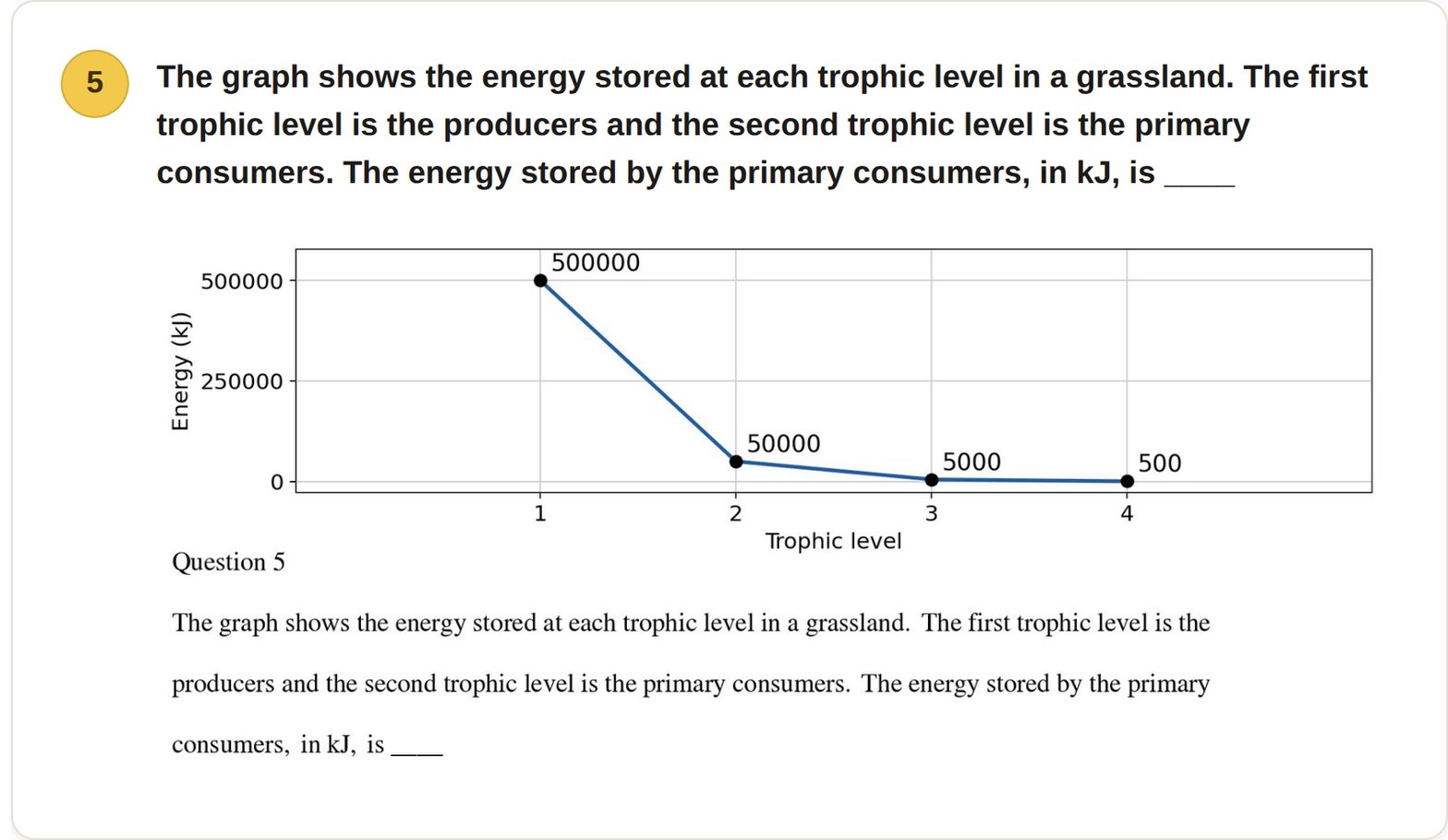
The graph shows the energy stored at each trophic level in a grassland. The first trophic level is the producers and the second trophic level is the primary consumers. The energy stored by the primary consumers, in kJ, is ____
What looks wrong with Question 5?
Send anonymously
Cancel
6
A food chain in a wetland is
A producer B primary consumer C tertiary consumer D secondary consumer
What looks wrong with Question 6?
Send anonymously
Cancel
7
As energy moves from one trophic level to the next, most of the energy is
A lost as heat to the surroundings B stored permanently in body tissues C converted into new producers D recycled back to the Sun
What looks wrong with Question 7?
Send anonymously
Cancel
8
Nitrogen gas in the atmosphere is converted into compounds that plants can use by the process of
A denitrification B nitrification C nitrogen fixation D decomposition
What looks wrong with Question 8?
Send anonymously
Cancel
9
Phytoplankton in a lake capture 2400000 kJ of energy. Using the 10% rule, the energy available to the tertiary consumers (the fourth trophic level), in kJ, is ____
What looks wrong with Question 9?
Send anonymously
Cancel
10
The phosphorus cycle differs from the carbon and nitrogen cycles because phosphorus
A cycles only through the atmosphere B has no important gas phase and moves mainly through rock, soil, and water C is not required by living organisms D is converted into a gas by bacteria in root nodules
What looks wrong with Question 10?
Send anonymously
Cancel
11
A pyramid of numbers can be inverted, with fewer organisms at the base than above it, when
A producers reproduce more quickly than consumers B one large producer, such as a tree, supports many small consumers C consumers are larger than the producers D energy is lost as heat at each transfer
What looks wrong with Question 11?
Send anonymously
Cancel
12
DDT sprayed on crops washed into a lake. Because of biomagnification, the organisms most seriously harmed by the DDT would be the
A algae in the lake B zooplankton C small fish D top predators, such as ospreys
What looks wrong with Question 12?
Send anonymously
Cancel
13
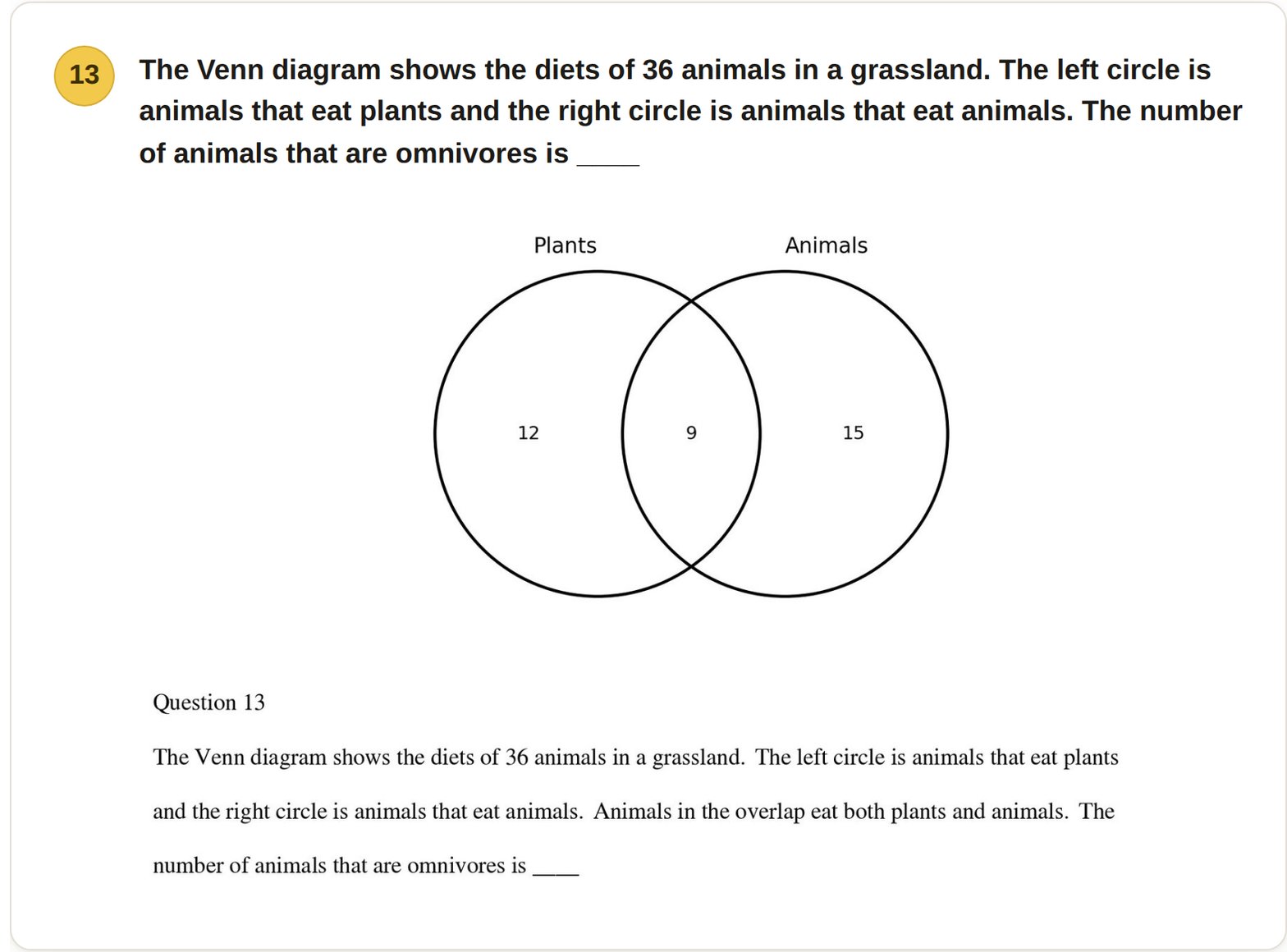
The Venn diagram shows the diets of 36 animals in a grassland. The left circle is animals that eat plants and the right circle is animals that eat animals. The number of animals that are omnivores is ____
What looks wrong with Question 13?
Send anonymously
Cancel
14
Carbon stored underground for millions of years is returned to the atmosphere most directly by
A photosynthesis in forests B the respiration of animals C the burning of fossil fuels D the weathering of limestone rock
What looks wrong with Question 14?
Send anonymously
Cancel
15
Denitrifying bacteria in the soil convert
A nitrogen gas into ammonia B nitrates into nitrogen gas C ammonia into nitrites D proteins into ammonia
What looks wrong with Question 15?
Send anonymously
Cancel
16
Bacteria living near deep-sea vents, where no sunlight reaches, produce food by
A photosynthesis B cellular respiration C fermentation D chemosynthesis
What looks wrong with Question 16?
Send anonymously
Cancel
17
An earthworm that feeds on dead leaves lying on the forest floor is classified as a
A detrivore B decomposer C producer D parasite
What looks wrong with Question 17?
Send anonymously
Cancel
18
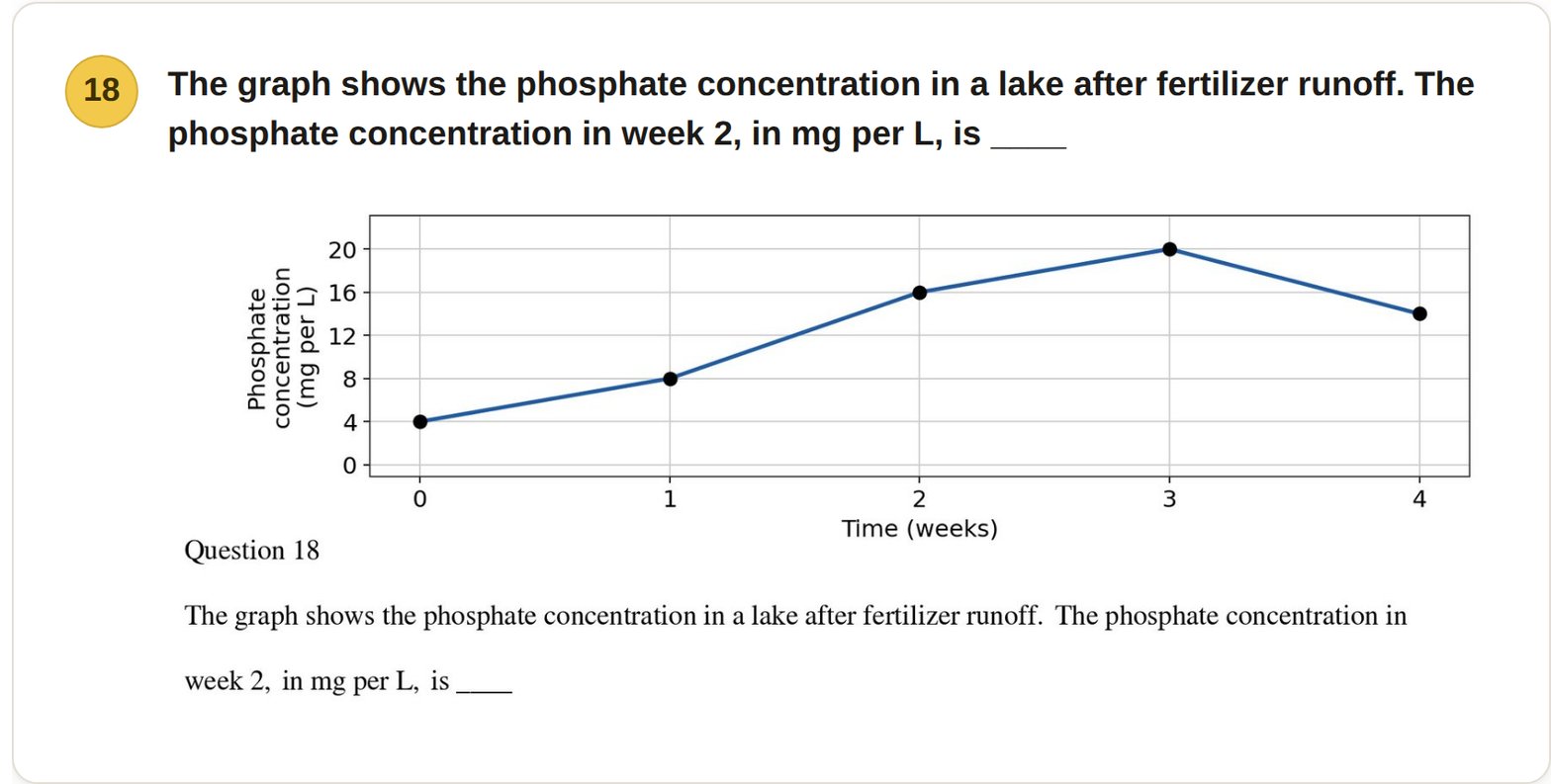
The graph shows the phosphate concentration in a lake after fertilizer runoff. The phosphate concentration in week 2, in mg per L, is ____
What looks wrong with Question 18?
Send anonymously
Cancel
19
Compared with a simple food chain, a food web usually makes an ecosystem more stable because
A producers create more energy in a web B each species feeds on only one other species C decomposers are no longer needed D if one species declines, most consumers have alternative food sources
What looks wrong with Question 19?
Send anonymously
Cancel
20
In the nitrogen cycle, nitrification is the conversion of
A nitrates into nitrogen gas by bacteria B ammonia into nitrites and then into nitrates by bacteria C nitrogen gas into ammonia by lightning D nitrates into proteins by plants
What looks wrong with Question 20?
Send anonymously
Cancel
21
Which sequence shows the correct direction of energy flow in an ecosystem?
A Sun → producer → herbivore → carnivore B Sun → herbivore → producer → carnivore C producer → Sun → herbivore → carnivore D herbivore → carnivore → producer → Sun
What looks wrong with Question 21?
Send anonymously
Cancel
22
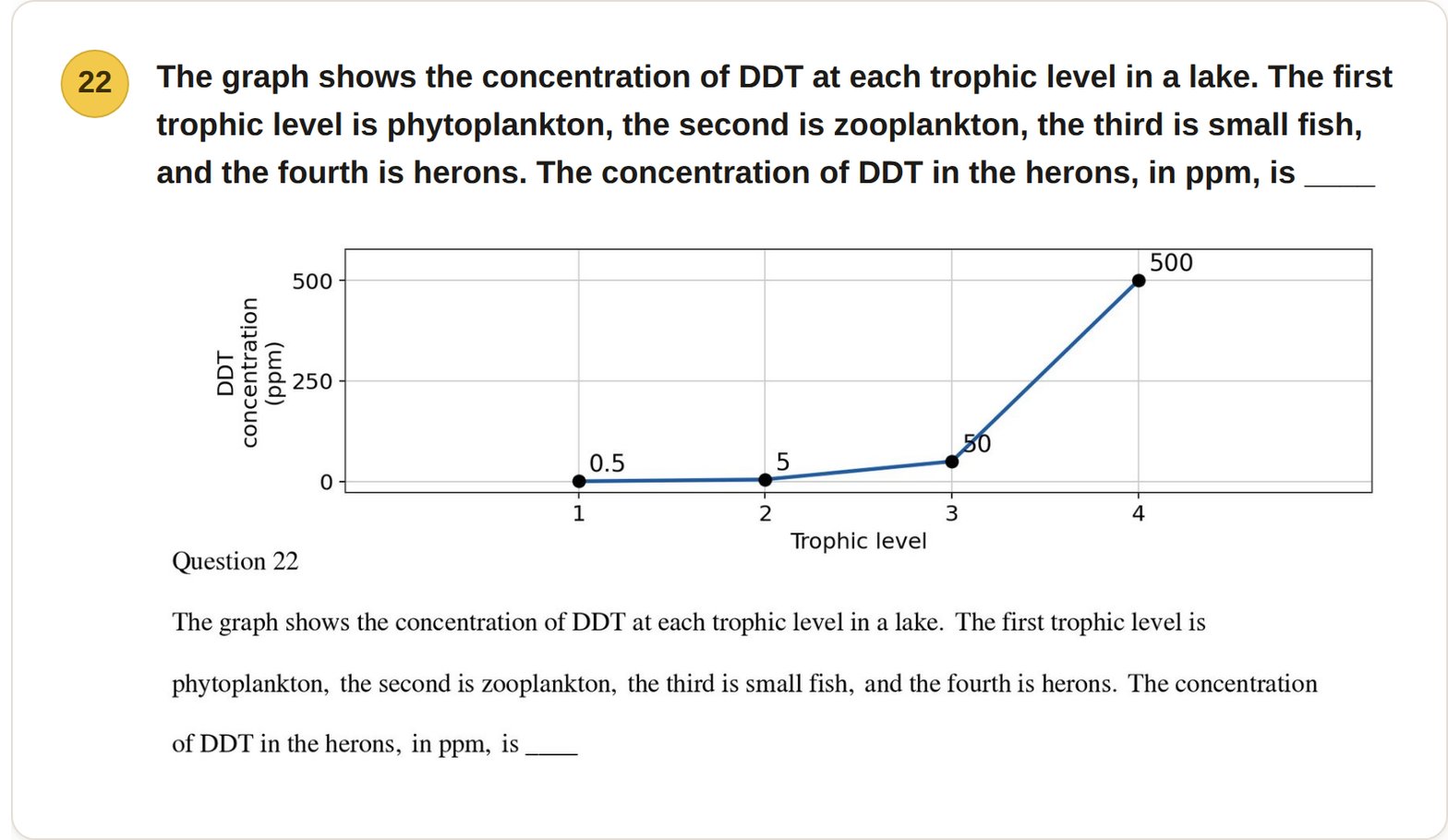
The graph shows the concentration of DDT at each trophic level in a lake. The first trophic level is phytoplankton, the second is zooplankton, the third is small fish, and the fourth is herons. The concentration of DDT in the herons, in ppm, is ____
What looks wrong with Question 22?
Send anonymously
Cancel
23
When nitrogen compounds are assimilated by a plant, the nitrogen is used mainly to build
A amino acids and proteins B glucose and starch C fats and oils D cellulose and lignin
What looks wrong with Question 23?
Send anonymously
Cancel
24
Phosphorus becomes available to plants in the soil mainly when
A lightning strikes the ground B bacteria take it in from the air C rocks containing phosphate weather and erode D animals die and decompose
What looks wrong with Question 24?
Send anonymously
Cancel
25
In a grassland food web, grass is eaten by mice. Mice are eaten by both snakes and owls, and owls also eat snakes. The number of different trophic levels at which the owl feeds is ____
What looks wrong with Question 25?
Send anonymously
Cancel