1
Copernicus proposed a heliocentric model in which Earth and the other planets revolve around the
California World History · Final Exam · 50 questions
This practice test was made by AI and there may be mistakes. If a question or answer looks wrong, use the Flag a mistake button to let Brett know so he can fix it.
Copernicus proposed a heliocentric model in which Earth and the other planets revolve around the
The steam engine, improved by James Watt, provided power for factories, mines, and later for trains and
The Schlieffen Plan was Germany's plan to defeat France quickly before turning to fight Russia, but it failed when the advance was halted at the Battle of the
The partition of British India in 1947 created the separate states of India and Pakistan and led to mass migration and communal
Isaac Newton explained the motion of planets and falling objects with his laws of motion and his law of universal
In the 1800s, factory workers formed unions. The main goal of these early unions was to improve
The Russian Revolution of 1917 overthrew the tsar and later brought the Bolsheviks under Vladimir Lenin to power, leading to the creation of the Soviet
The Algerian War of independence from France lasted from 1954 to 1962 and ended with Algerian independence after a long and violent
Francis Bacon argued that knowledge should come from careful observation and experiment rather than from accepted
The Bessemer process made steel cheaper and stronger, which helped build railways, bridges, and
Adolf Hitler and the Nazi Party rose to power in Germany in 1933, ended democratic government, persecuted Jews and other groups, and pursued aggressive
OPEC gained power in the 1970s when an oil embargo in 1973 raised oil prices sharply in many Western
During the French Revolution the storming of the Bastille became a symbol of the people's challenge to royal
Nationalism is a strong sense of pride in and loyalty to one's nation, and it helped drive the unification of Italy under leaders such as
Japan attacked the United States naval base at Pearl Harbor on December 7, 1941, bringing the United States into World War II the next
Globalization in the late 1900s and early 2000s meant closer connections through trade, investment, migration, and communications technology, including the spread of the
The Declaration of Independence, written mainly by Thomas Jefferson, stated that all men are created equal and have unalienable rights including life, liberty, and the pursuit of
The Berlin Conference of 1884 to 1885 set rules for European claims in Africa, but African leaders were not
The UN was founded in 1945 to promote peace, security, and cooperation, replacing the failed League of
The attacks of September 11, 2001, in the United States led to American led wars in Afghanistan and Iraq and to a long global campaign against
The Bill of Rights, the first ten amendments to the United States Constitution, protects freedoms such as speech, religion, and
The Opium Wars weakened China and forced it to open ports to foreign trade, which increased foreign influence over Chinese
The Berlin Airlift of 1948 to 1949 supplied the city by air after the Soviet Union blocked road and rail access to it, which was then divided between East and
Climate change in the contemporary world is driven mainly by human burning of fossil fuels, which increases greenhouse gases such as carbon dioxide in the
The Reign of Terror in France used executions to suppress enemies of the revolution and was led in part by Maximilien
The year in which the Suez Canal opened was
The Cuban Missile Crisis of 1962 brought the United States and the Soviet Union close to nuclear war after Soviet missiles were discovered in
Kenya gained independence from Britain in 1963 after a struggle that included the Mau Mau uprising of the
The Haitian Revolution, led in part by Toussaint Louverture, resulted in independence from France and the end of slavery in
A canal opened in 1914 connected the Atlantic and Pacific Oceans across the Isthmus of
The Battle of the Somme in 1916 was one of the bloodiest battles of World War I, showing the terrible cost of offensives against entrenched machine guns and
The Bandung Conference of 1955 brought together newly independent Asian and African countries to discuss cooperation outside the Cold War
Descartes stressed reason and systematic doubt, arguing that clear thinking could establish knowledge even when the senses might
The telegraph, developed in the 1800s, allowed messages to travel almost instantly along wires and helped coordinate railways, business, and
The Weimar Republic in Germany after World War I faced hyperinflation in the early 1920s, when prices rose so fast that money lost much of its
The Camp David Accords of 1978, brokered by American President Jimmy Carter, led to a peace treaty between Egypt and
John Locke argued that if the rulers violate the natural rights of the people, the people have the right to change or overthrow that
The Luddites in early 1800s England protested new machines by destroying textile machinery because they feared loss of jobs and
The Battle of Midway in 1942 was a major naval victory for the United States in the Pacific that weakened the Japanese carrier
The International Criminal Court, established in 2002, tries individuals for genocide, war crimes, and crimes against
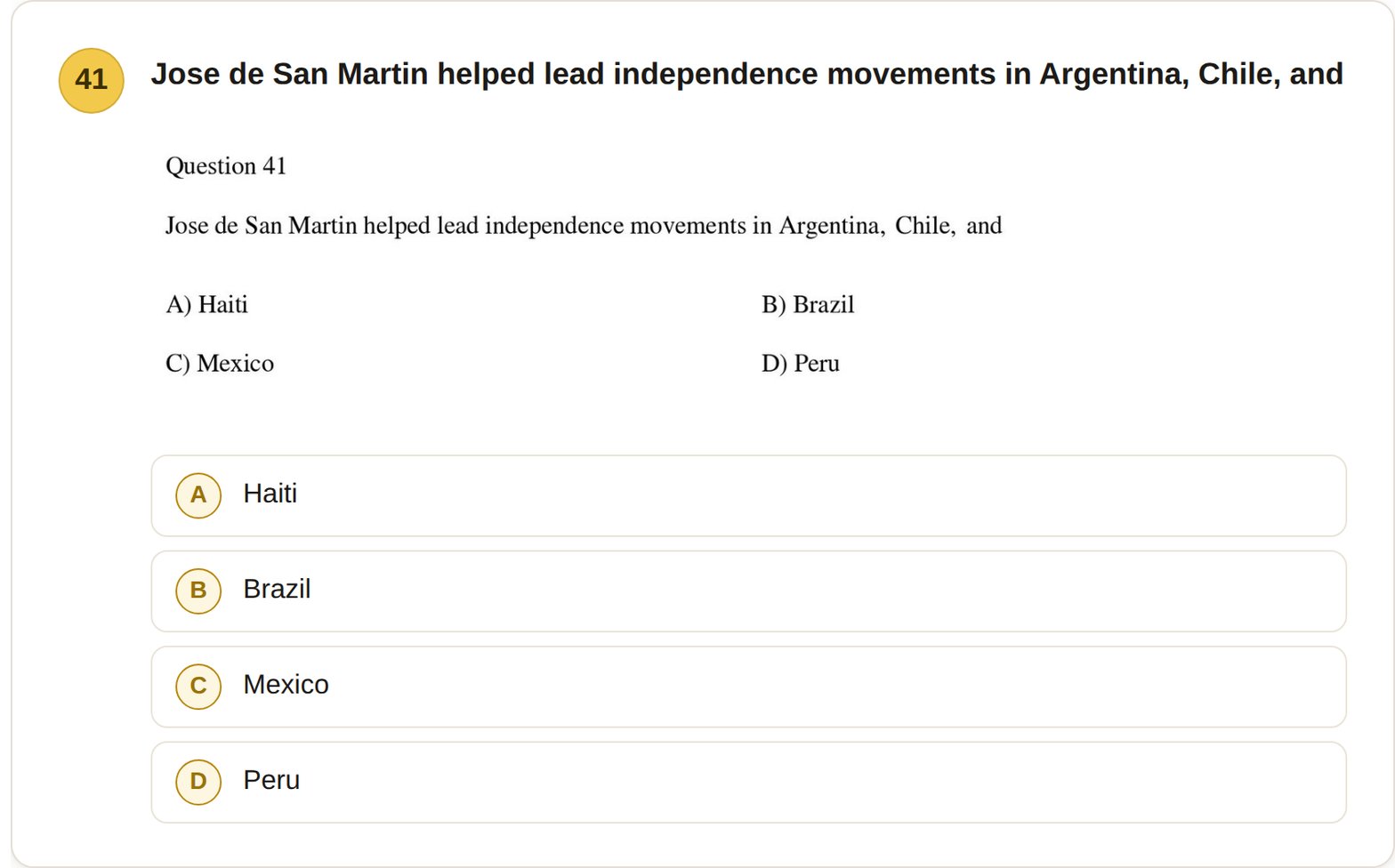
Jose de San Martin helped lead independence movements in Argentina, Chile, and
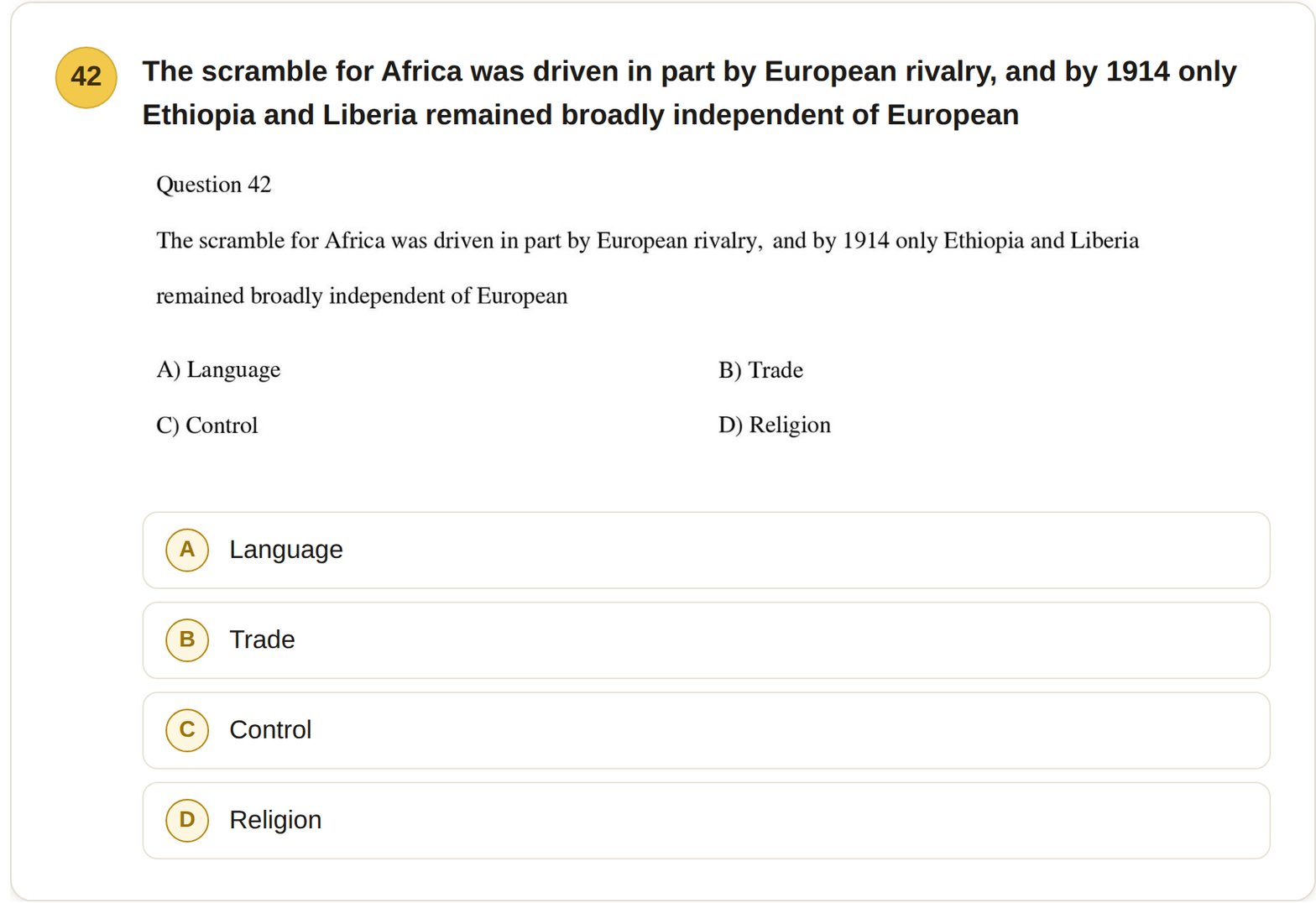
The scramble for Africa was driven in part by European rivalry, and by 1914 only Ethiopia and Liberia remained broadly independent of European
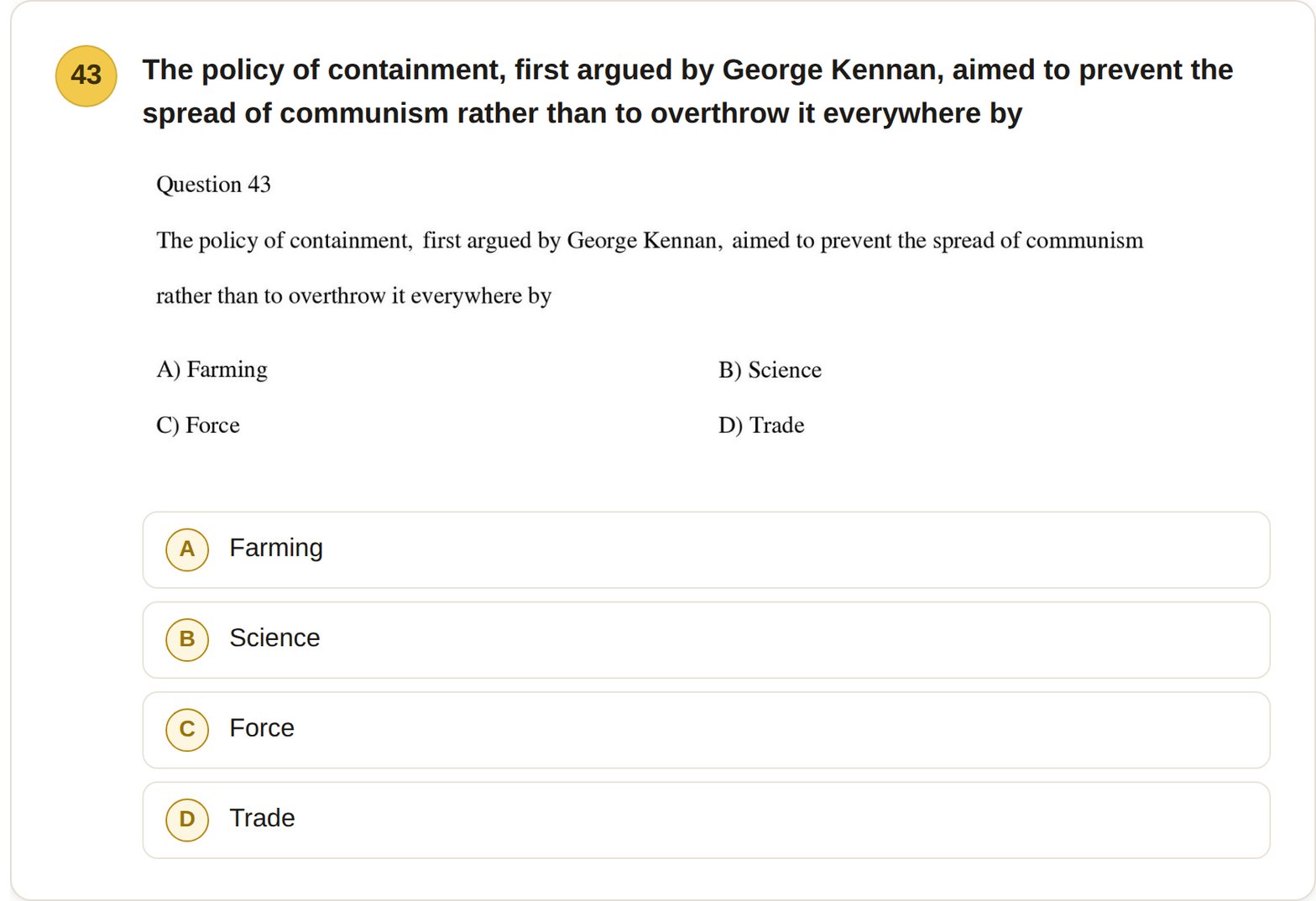
The policy of containment, first argued by George Kennan, aimed to prevent the spread of communism rather than to overthrow it everywhere by
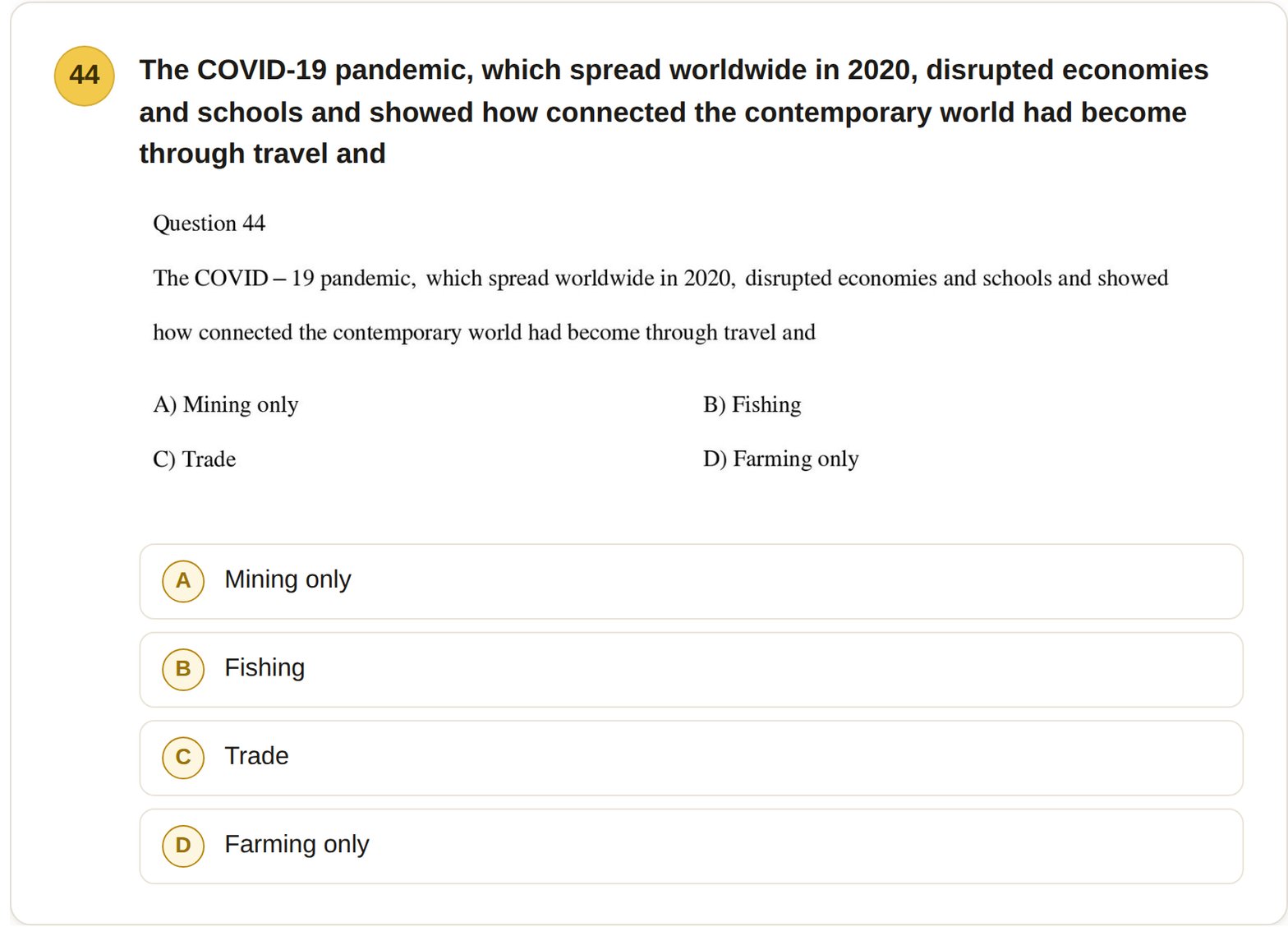
The COVID-19 pandemic, which spread worldwide in 2020, disrupted economies and schools and showed how connected the contemporary world had become through travel and
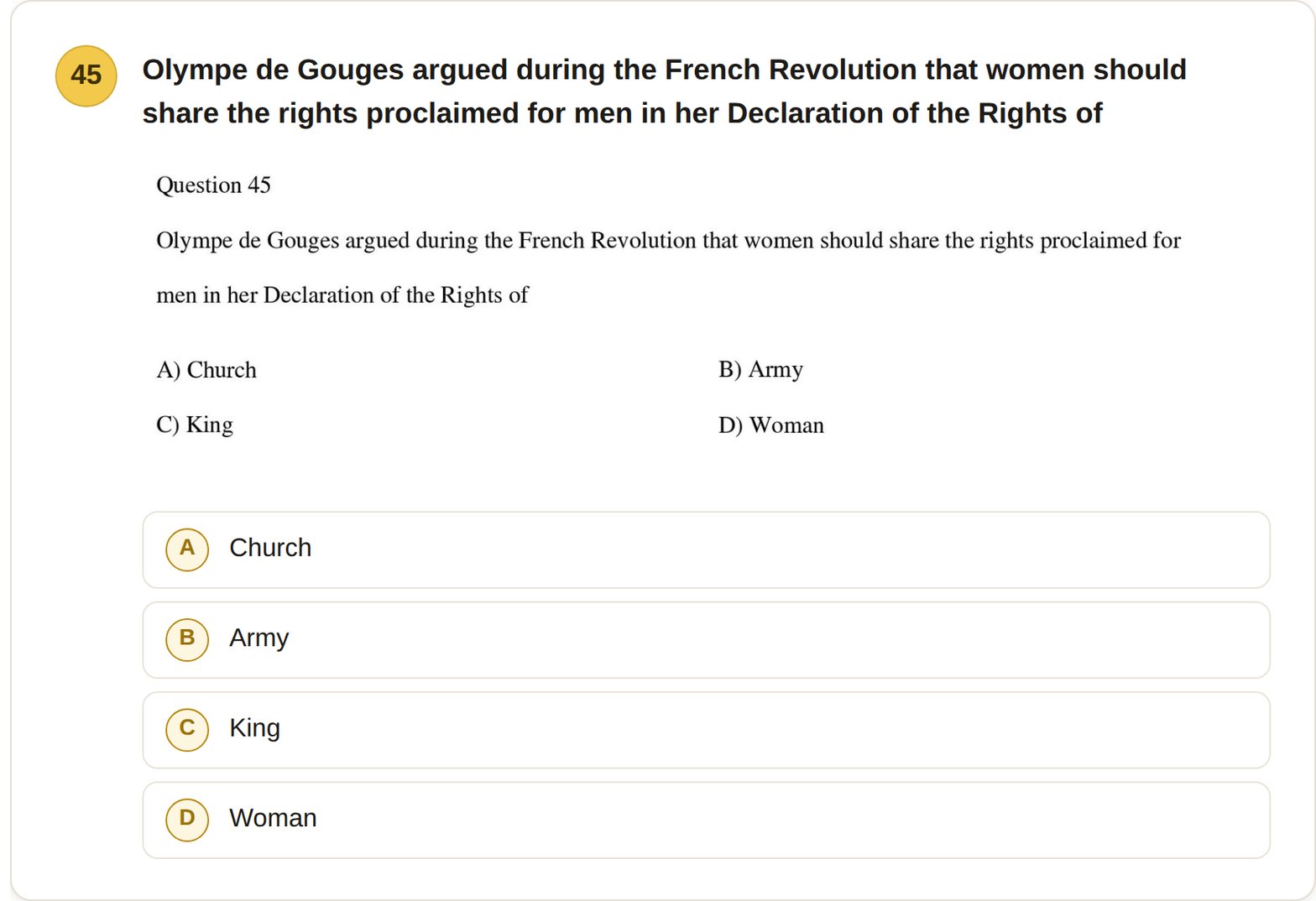
Olympe de Gouges argued during the French Revolution that women should share the rights proclaimed for men in her Declaration of the Rights of
The year in which the Berlin Conference began was
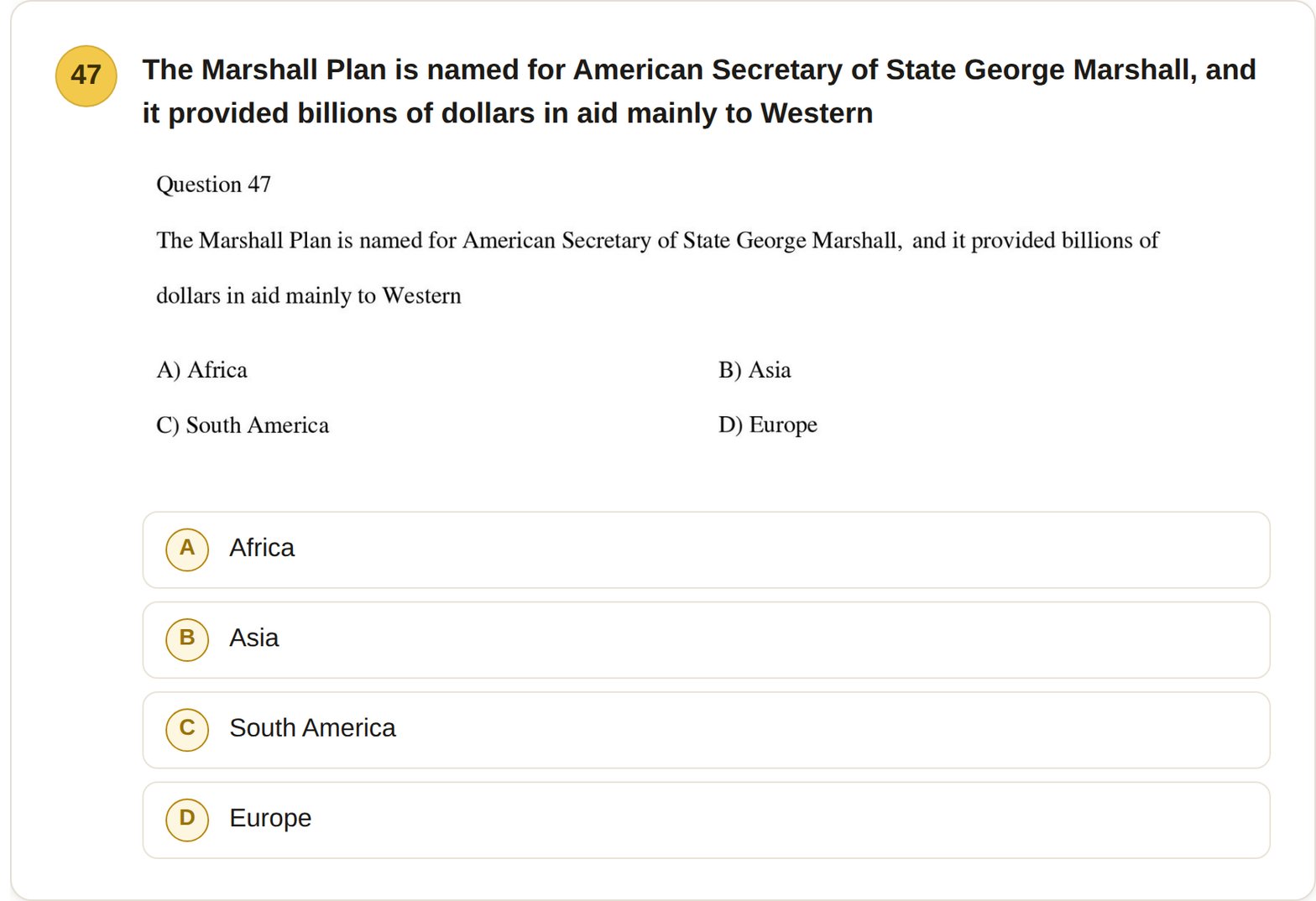
The Marshall Plan is named for American Secretary of State George Marshall, and it provided billions of dollars in aid mainly to Western
The year in which the Berlin Wall fell was
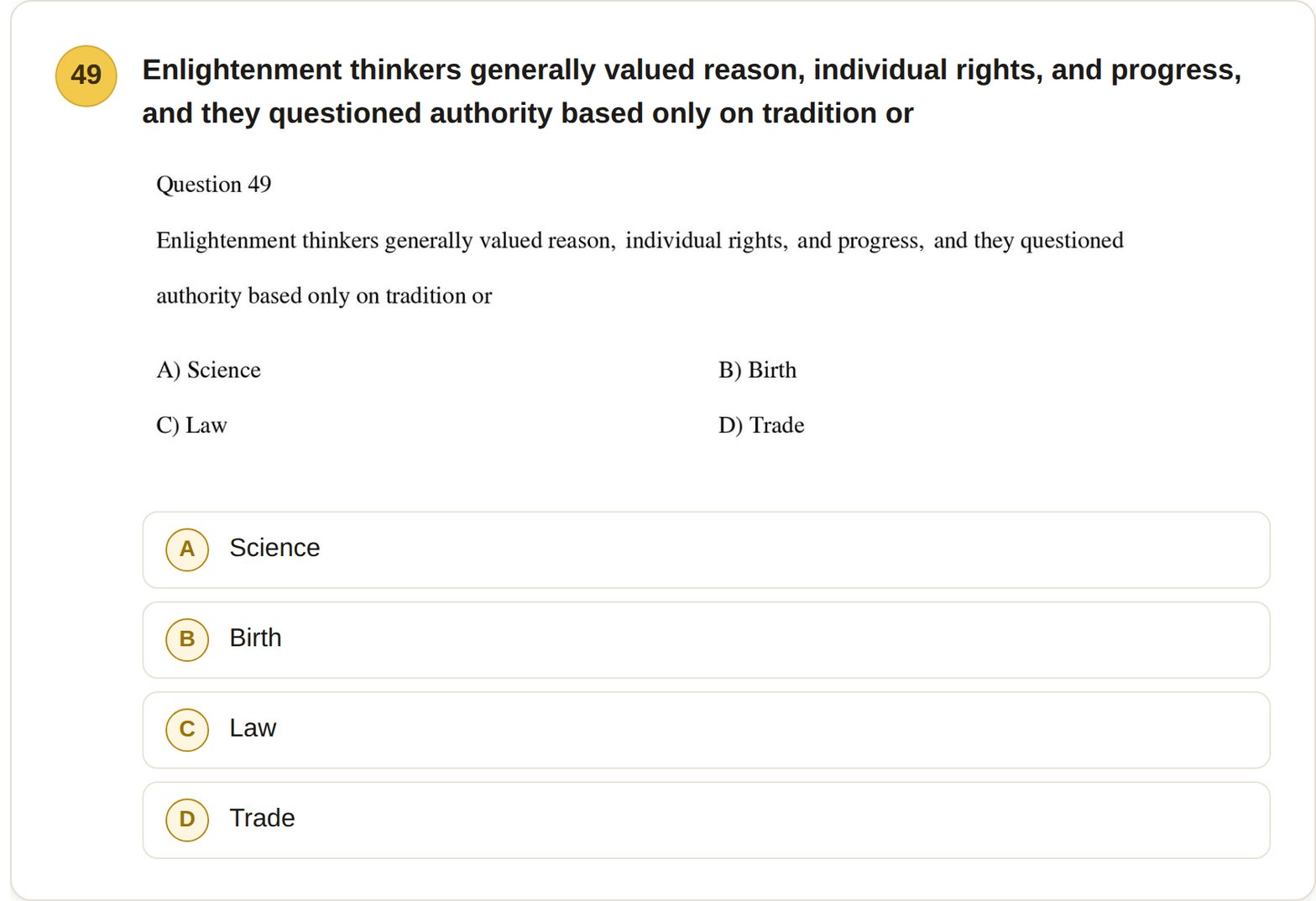
Enlightenment thinkers generally valued reason, individual rights, and progress, and they questioned authority based only on tradition or
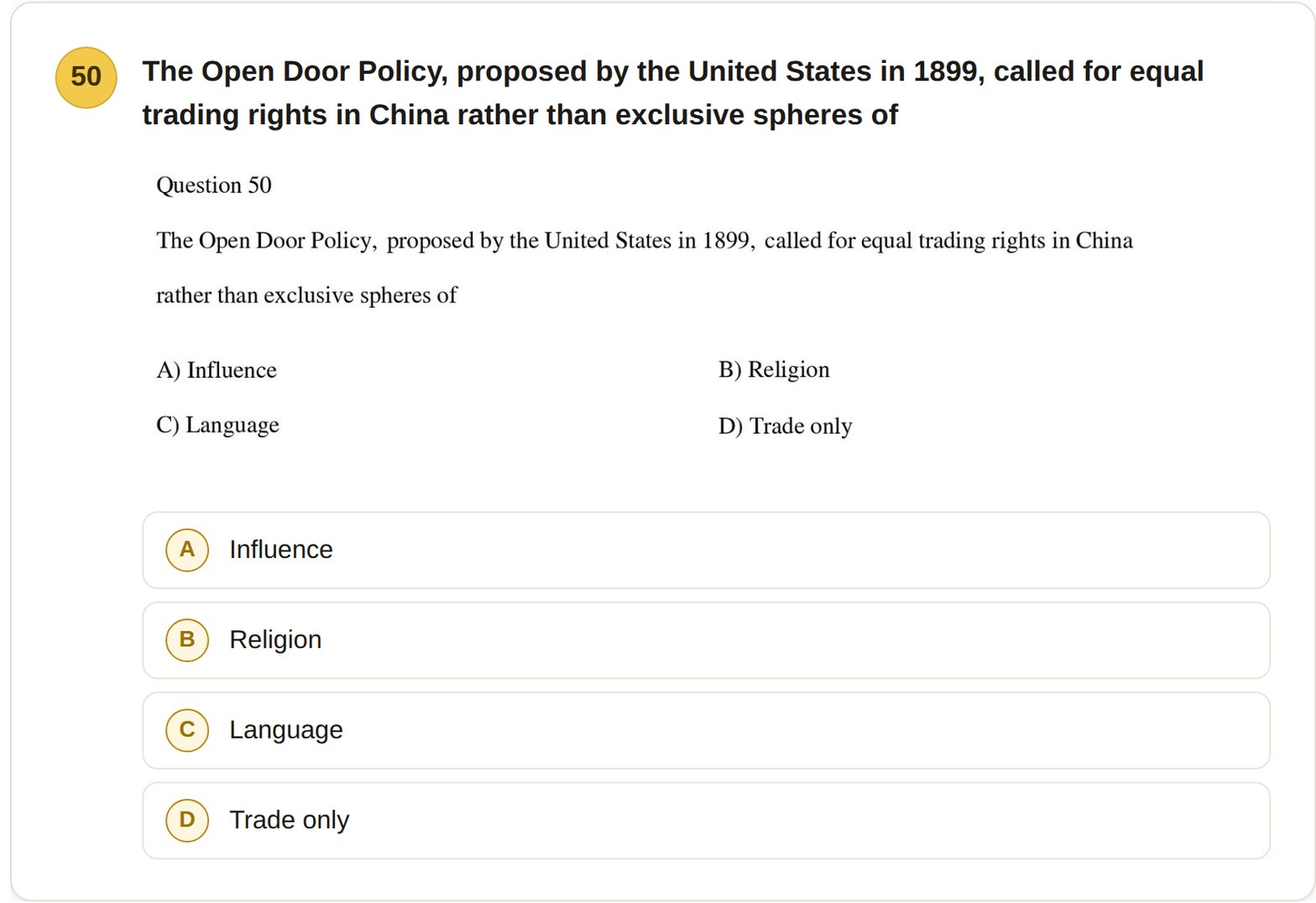
The Open Door Policy, proposed by the United States in 1899, called for equal trading rights in China rather than exclusive spheres of
Your score: 0 / 50