View as PDF

Alberta Chemistry 20 · Unit A · 25 questions

Diversity of Matter and Chemical Bonding — Practice Test

This practice test was made by AI and there may be mistakes. If a question or answer looks wrong, use the Flag a mistake button to let Brett know so he can fix it.

1

In the Venn diagram below, set A is substances that conduct electricity when molten and set B is substances with a high melting point. A substance is ionic if it is in both sets. How many of the substances in the diagram are ionic?

Diagram for Question 1
Understand It with Pulse
2

Calcium forms a Ca²⁺ ion and chlorine forms a Cl⁻ ion. The formula of calcium chloride is

Understand It with Pulse
3

The total number of atoms in one formula unit of Ca(OH)₂ is ____.

Understand It with Pulse
4

In the compound Fe₂O₃, each iron ion has a charge of 3+. The correct name of this compound is

Understand It with Pulse
5

The number of sulfur atoms in one formula unit of Al₂(SO₄)₃ is

Understand It with Pulse
6

The Lewis diagram below shows ammonia, NH₃. The number of bonding pairs of electrons around the nitrogen atom is

Diagram for Question 6
Understand It with Pulse
7

Which of the following compounds contains a polyatomic ion?

Understand It with Pulse
8

The total number of atoms in one formula unit of ammonium nitrate, NH₄NO₃, is ____.

Understand It with Pulse
9

The shape of a methane molecule, CH₄, is

Understand It with Pulse
10

A substance does not conduct electricity as a solid, but does conduct electricity when molten. The substance is most likely

Understand It with Pulse
11

Aluminum forms an Al³⁺ ion, and the sulfate ion is SO₄²⁻. In the formula of aluminum sulfate, the total number of oxygen atoms is ____.

Understand It with Pulse
12

The electronegativity of hydrogen is 2.20 and the electronegativity of chlorine is 3.16. The bond between hydrogen and chlorine in HCl is best described as

Understand It with Pulse
13

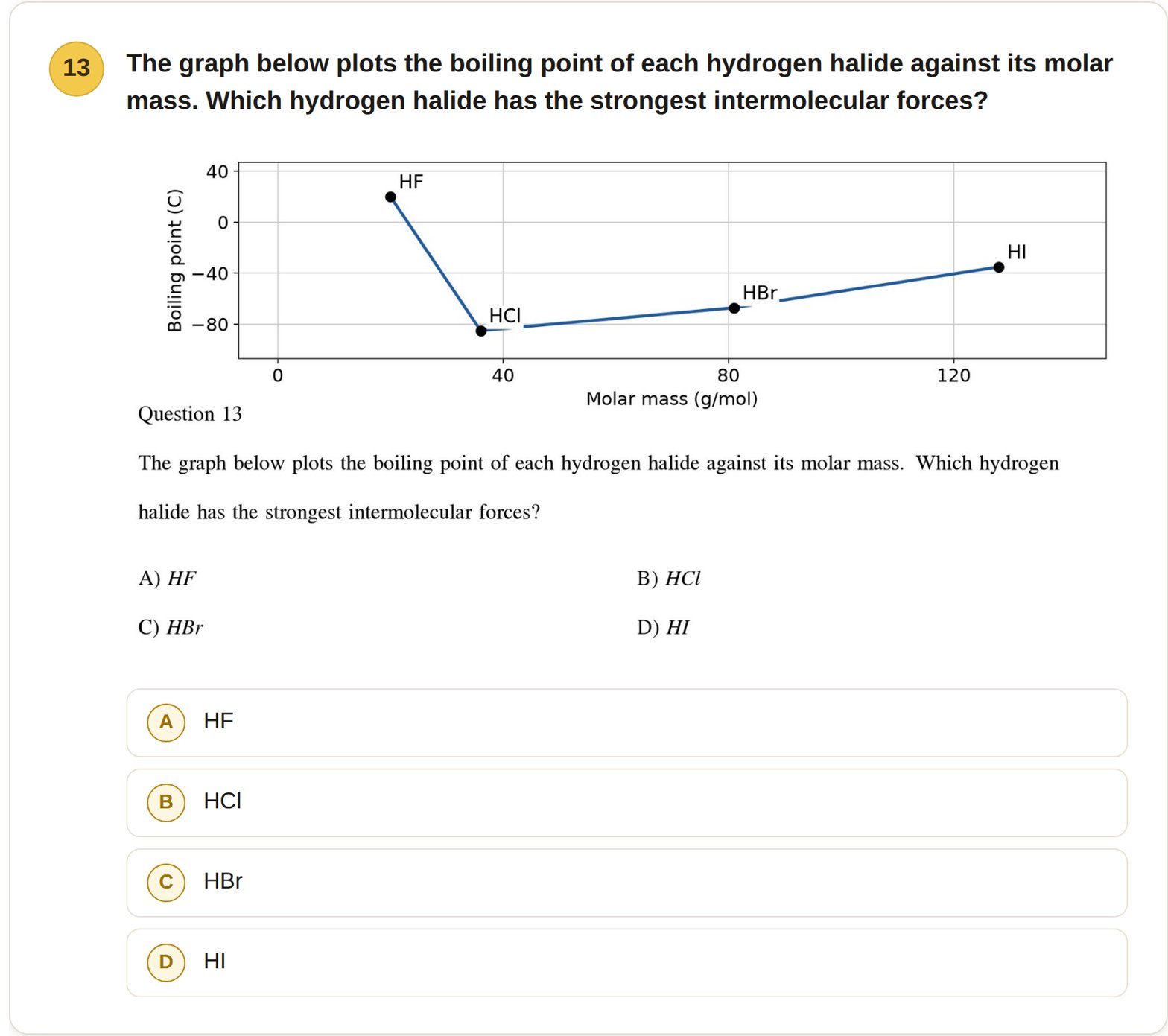
The graph below plots the boiling point of each hydrogen halide against its molar mass. Which hydrogen halide has the strongest intermolecular forces?

Diagram for Question 13
Understand It with Pulse
14

The total number of valence electrons in a molecule of carbon dioxide, CO₂, is ____.

Understand It with Pulse
15

Copper forms a Cu²⁺ ion, and the phosphate ion is PO₄³⁻. The formula of copper(II) phosphate is

Understand It with Pulse
16

A substance has a melting point of 801°C, does not conduct electricity as a solid, and conducts electricity when molten or dissolved in water. This substance is best classified as

Understand It with Pulse
17

A sulfur atom has 6 valence electrons. The number of electrons a sulfur atom gains when it forms its most common ion is ____.

Understand It with Pulse
18

The correct name of NH₄Cl is

Understand It with Pulse
19

The hydrate CuSO₄· 5H₂O has water molecules trapped in its crystal. The total number of hydrogen atoms in one formula unit of this hydrate is ____.

Understand It with Pulse
20

Which of the following molecules is nonpolar?

Understand It with Pulse
21

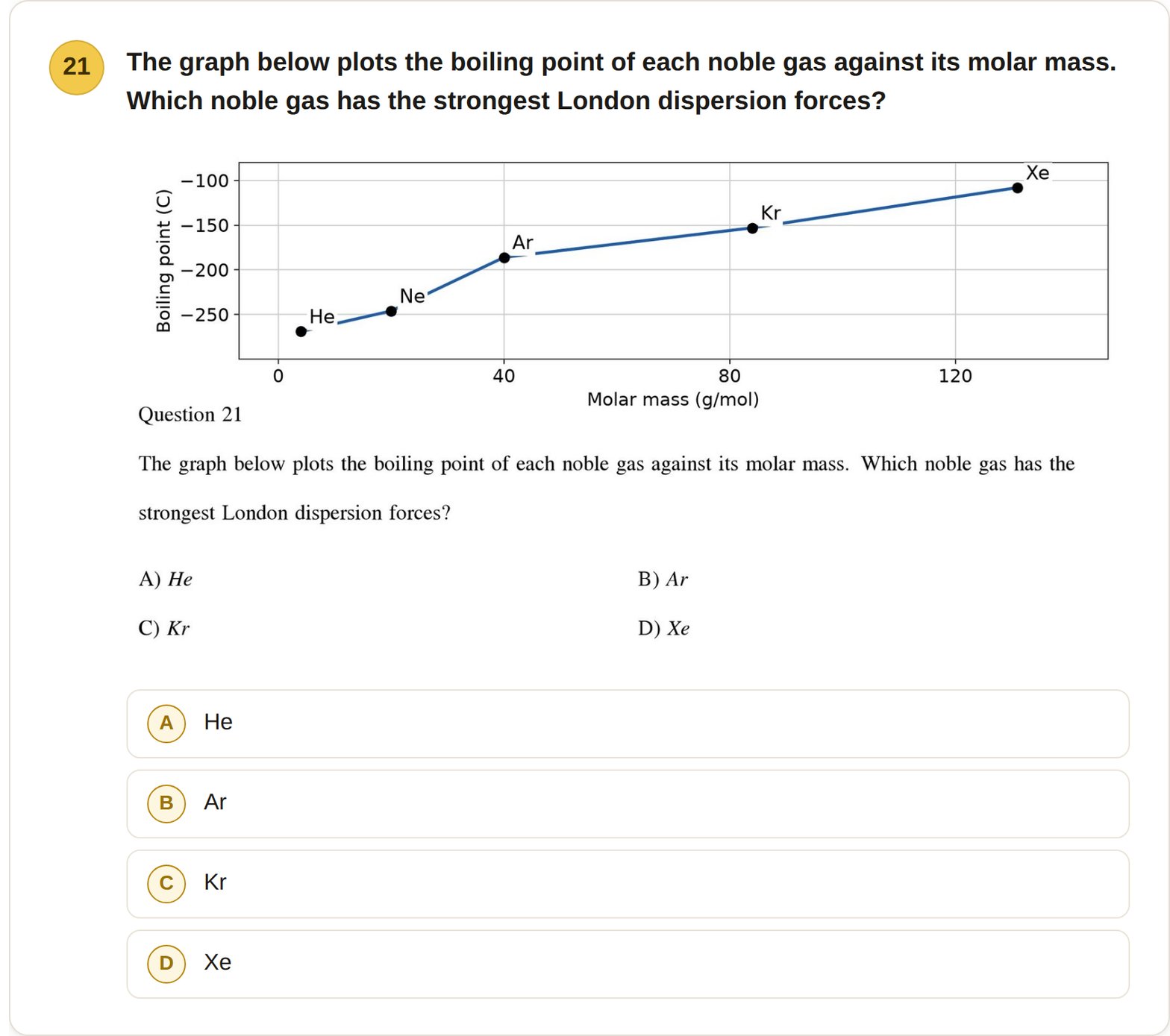
The graph below plots the boiling point of each noble gas against its molar mass. Which noble gas has the strongest London dispersion forces?

Diagram for Question 21
Understand It with Pulse
22

In a molecule of nitrogen gas, N₂, the two nitrogen atoms are joined by a triple covalent bond. The total number of electrons shared between the two atoms is ____.

Understand It with Pulse
23

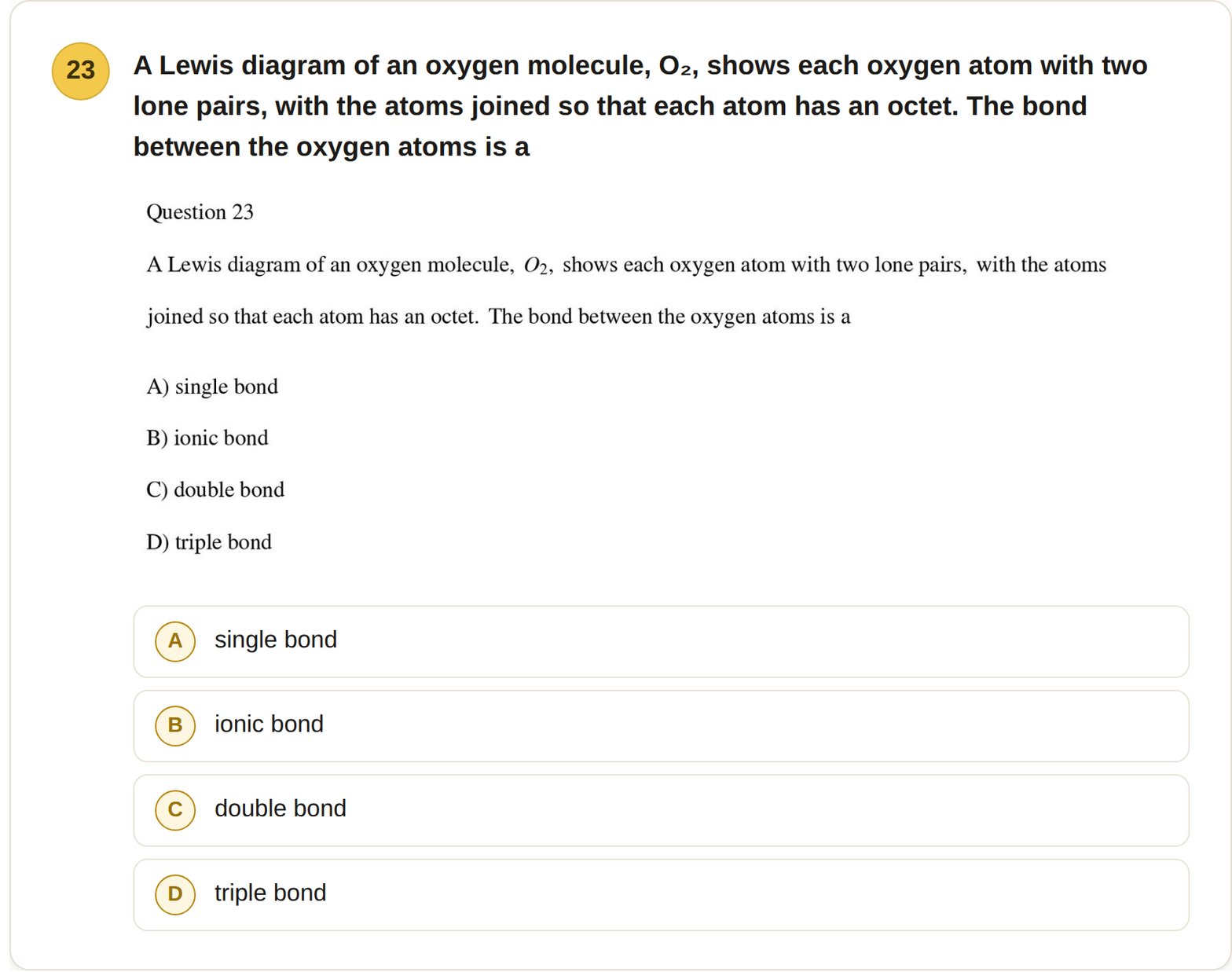
A Lewis diagram of an oxygen molecule, O₂, shows each oxygen atom with two lone pairs, with the atoms joined so that each atom has an octet. The bond between the oxygen atoms is a

Diagram for Question 23
Understand It with Pulse
24

In the compound SnF₂, each tin ion has a charge of 2+. The correct name of this compound is

Understand It with Pulse
25

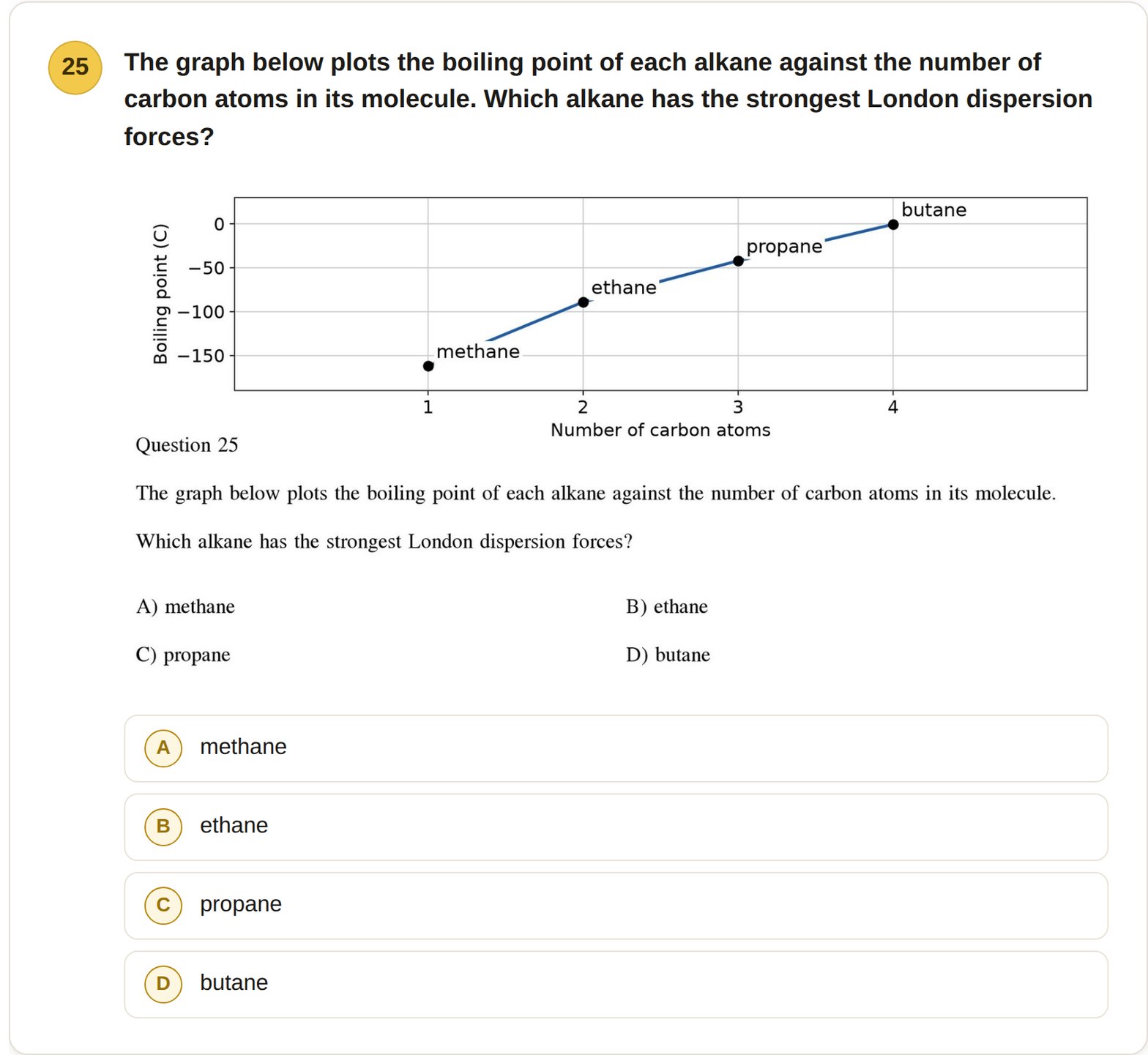
The graph below plots the boiling point of each alkane against the number of carbon atoms in its molecule. Which alkane has the strongest London dispersion forces?
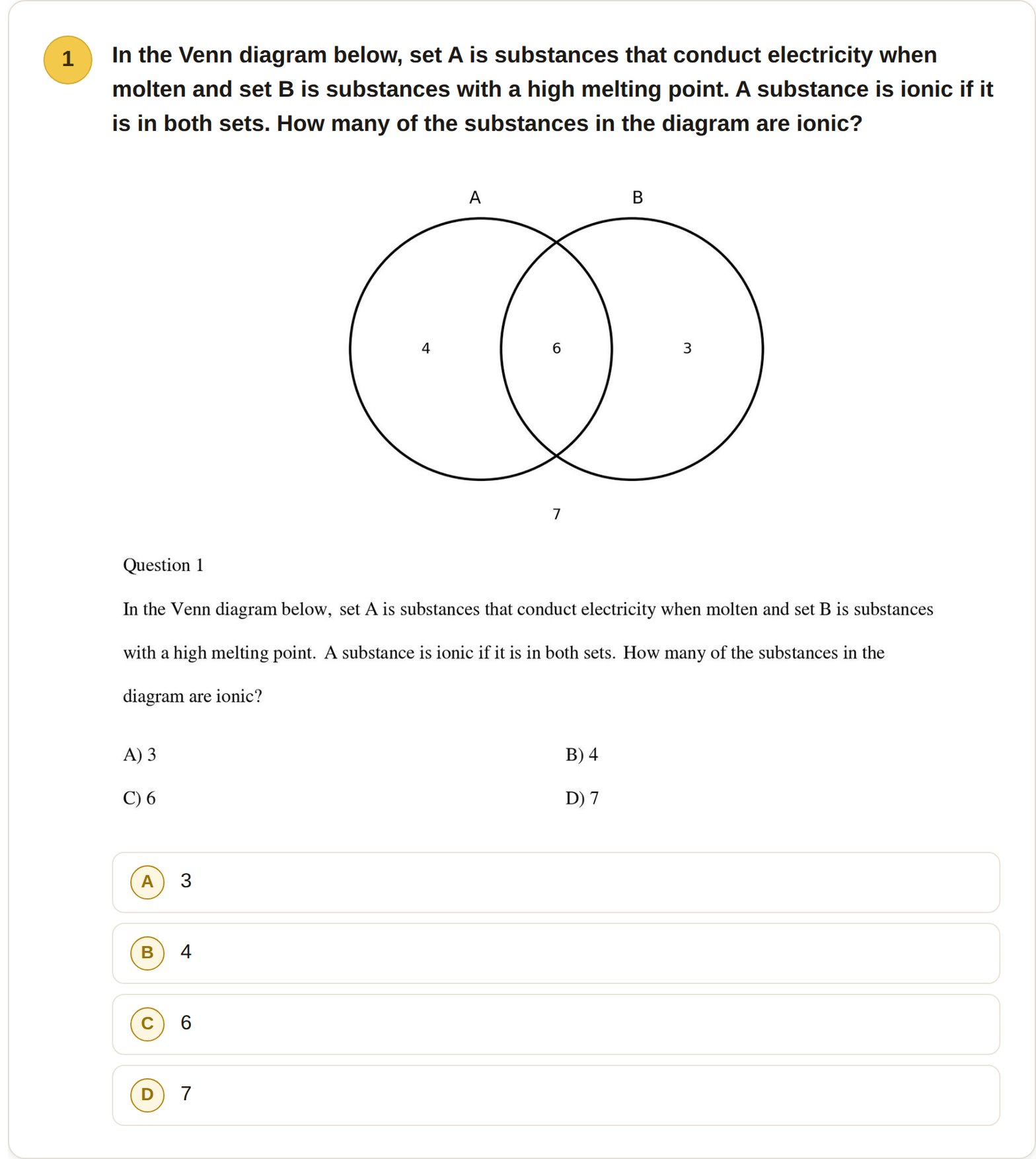
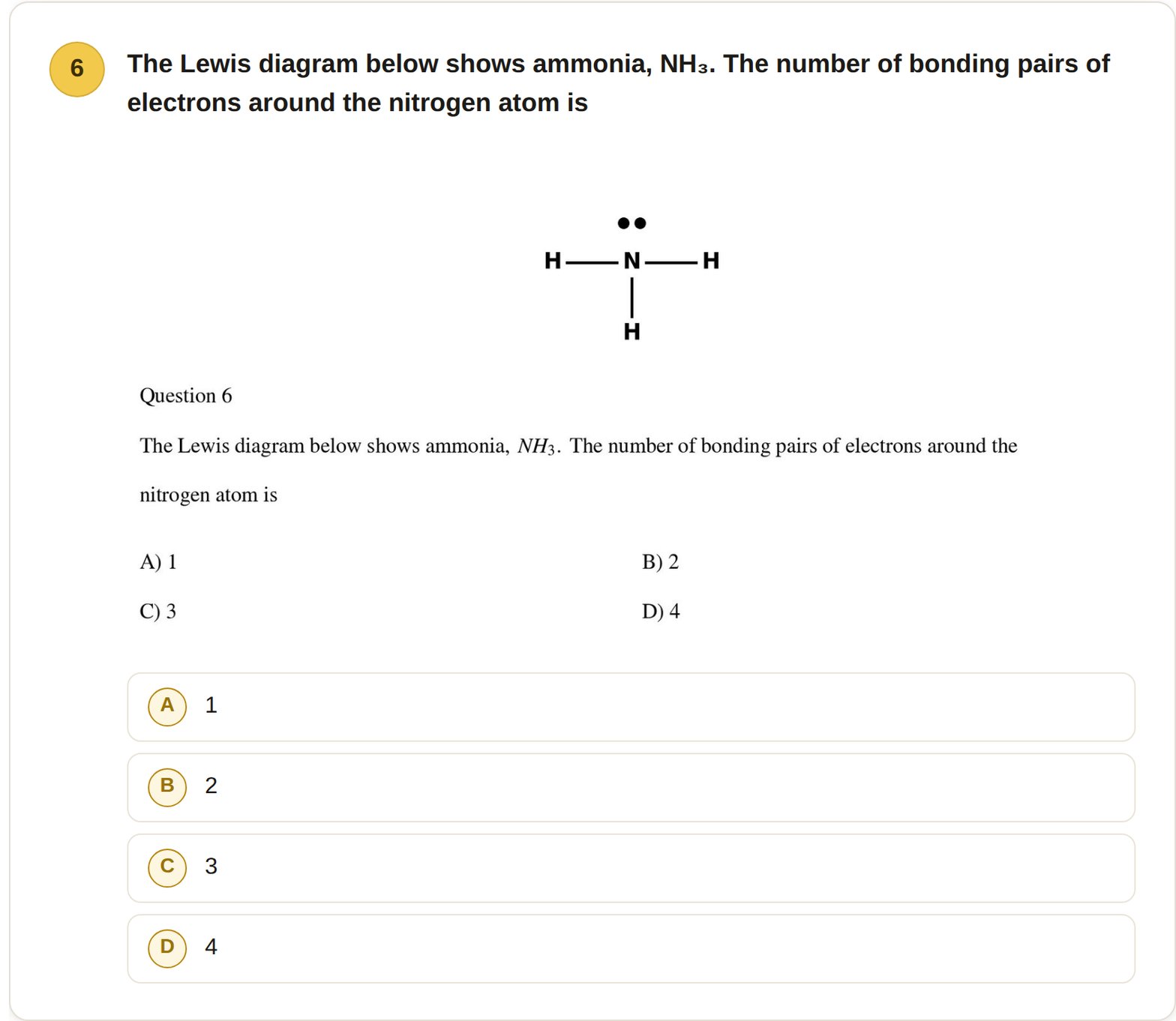
Diagram for Question 25
Understand It with Pulse