1
Which of the following statements correctly compares photosynthesis and cellular respiration?
Alberta Chemistry 30 · Unit A · 25 questions
This practice test was made by AI and there may be mistakes. If a question or answer looks wrong, use the Flag a mistake button to let Brett know so he can fix it.
Which of the following statements correctly compares photosynthesis and cellular respiration?
The reaction of nitrogen gas with oxygen gas to form nitrogen monoxide gas is represented by the following equation.
N₂(g) + O₂(g) → 2 NO(g) Δ H = +180.6 kJ
Which of the following statements about this reaction is correct?
A chemical reaction occurring in a calorimeter releases energy that is absorbed by 250.0 g of water, raising the temperature of the water by 8.0°C. The energy transferred to the water, in kJ, is ____.
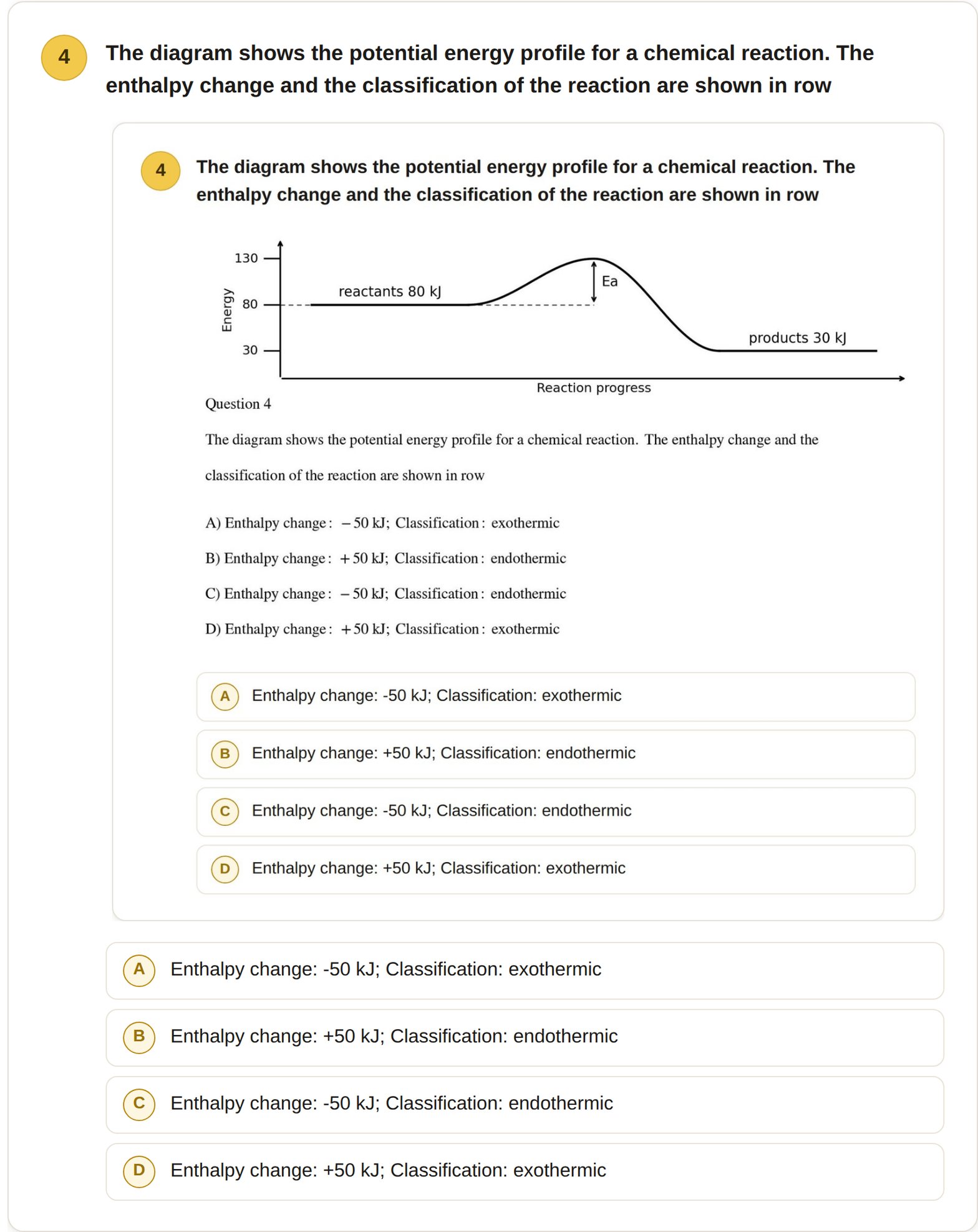
The diagram shows the potential energy profile for a chemical reaction. The enthalpy change and the classification of the reaction are shown in row
A catalyst increases the rate of a chemical reaction by
The graph shows the temperature of water in a calorimeter as energy is transferred to the water. The water has a mass of 200.0 g, and c = 4.184 J/(g· ° C). The energy transferred to the water, in kJ, is ____.

Use the following equations to answer this question.
I C(s) + O₂(g) → CO₂(g) Δ H = -393.5 kJ
II CO(g) + 12O₂(g) → CO₂(g) Δ H = -283.0 kJ
The enthalpy change for the reaction C(s) + 12O₂(g) → CO(g) is
The complete combustion of propane gas is represented by the following equation.
C₃H₈(g) + 5 O₂(g) → 3 CO₂(g) + 4 H₂O(g)
The molar enthalpy of formation for C₃H₈(g): -103.8 kJ/mol, for CO₂(g): -393.5 kJ/mol, and for H₂O(g): -241.8 kJ/mol. The enthalpy change for the reaction is
A student burns 0.500 g of ethanol, C₂H₅OH(l), (molar mass 46.08 g/mol) in a calorimeter containing 100.0 g of water. The temperature of the water increases by 12.4°C. The energy released per mole of ethanol burned, in kJ/mol, is ____.
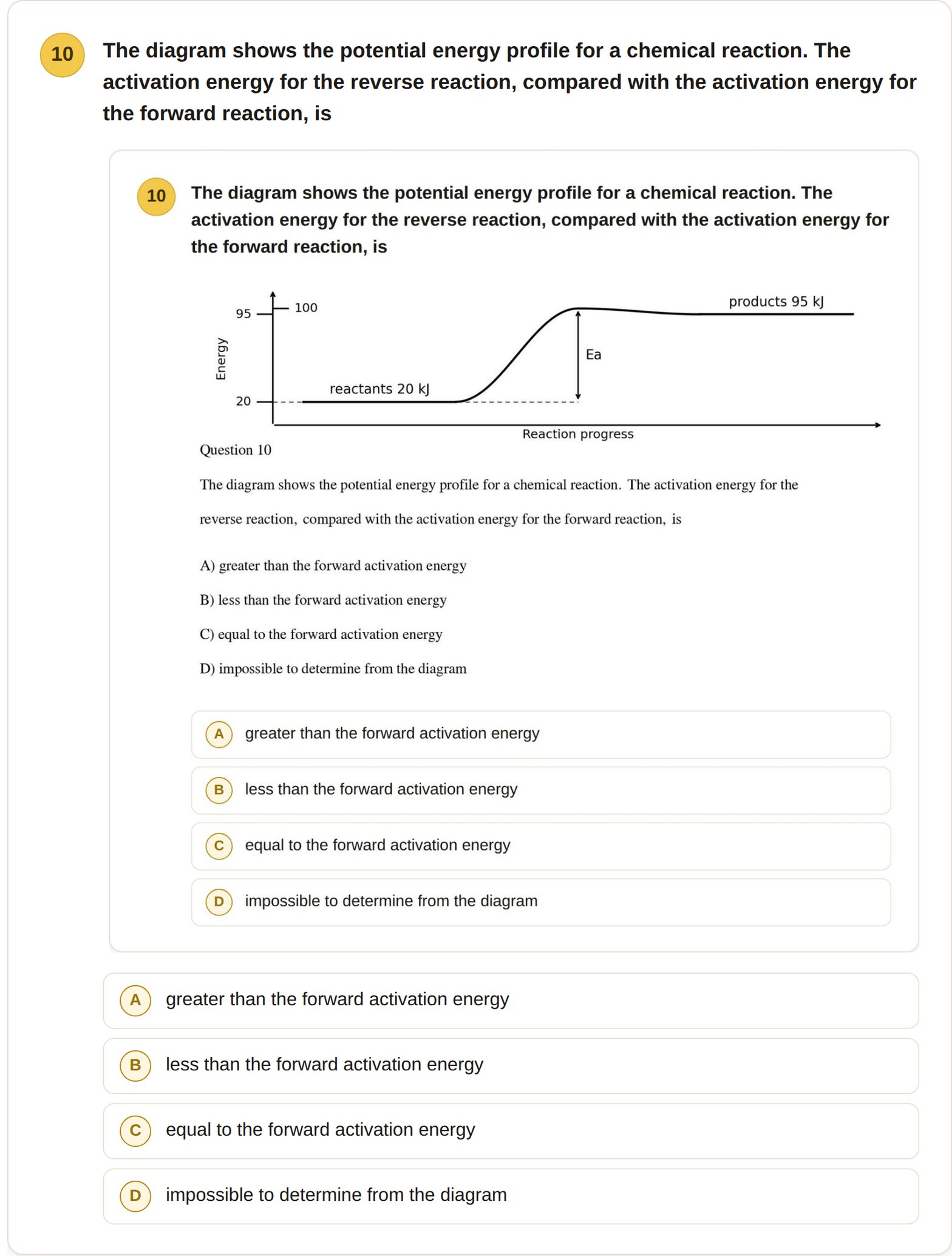
The diagram shows the potential energy profile for a chemical reaction. The activation energy for the reverse reaction, compared with the activation energy for the forward reaction, is
Use the following equations to answer this question.
I C(s) + O₂(g) → CO₂(g) Δ H = -393.5 kJ
II H₂(g) + 12O₂(g) → H₂O(l) Δ H = -285.8 kJ
III CH₄(g) + 2 O₂(g) → CO₂(g) + 2 H₂O(l) Δ H = -890.3 kJ
The molar enthalpy of formation of methane, CH₄(g), is
The combustion of acetylene gas is represented by the following equation.
2 C₂H₂(g) + 5 O₂(g) → 4 CO₂(g) + 2 H₂O(g) Δ H = -2511.6 kJ
The energy released when one mole of C₂H₂(g) burns completely, in kJ, is ____.
Methanol can be produced by the following reaction.
CO(g) + 2 H₂(g) → CH₃OH(l) Δ H = -128.1 kJ
If the molar enthalpy of formation of CO(g) is -110.5 kJ/mol, then the molar enthalpy of formation of CH₃OH(l) is
A student designs an experiment to compare the molar enthalpies of combustion of three different fuels. In each trial, a sample of fuel is burned to heat the same mass of water in the same calorimeter. The variables in this experiment are shown in row
A student mixes 50.0 mL of 1.00 mol/L HCl(aq) with 50.0 mL of 1.00 mol/L NaOH(aq) in a calorimeter. The total mass of the resulting solution is 100.0 g, and its temperature increases by 6.6°C. The energy released per mole of water formed in this neutralization, in kJ/mol, is ____.
Which of the following equations represents the formation reaction for carbon dioxide gas?
The balanced equation for the complete combustion of butane, C₄H₁₀(g), and the sign of the enthalpy change for the reaction are shown in row
The graph shows the temperature of water in a calorimeter during a combustion reaction. The water has a mass of 400.0 g, and c = 4.184 J/(g· ° C). The energy transferred to the water, in kJ, is ____.

Ammonia gas reacts with oxygen gas as represented by the following equation.
4 NH₃(g) + 5 O₂(g) → 4 NO(g) + 6 H₂O(g)
The molar enthalpy of formation for NH₃(g): -45.9 kJ/mol, for NO(g): +90.3 kJ/mol, and for H₂O(g): -241.8 kJ/mol. The enthalpy change for the reaction is
Photosynthesis is represented by the following equation.
6 CO₂(g) + 6 H₂O(l) → C₆H₁₂O₆(s) + 6 O₂(g) Δ H = +2803 kJ
The energy absorbed when 36.0 g of glucose (molar mass 180.16 g/mol) is produced by this process is
Use the following equations to answer this question.
I H₂(g) + 12O₂(g) → H₂O(l) Δ H = -285.8 kJ
II H₂O₂(l) → H₂O(l) + 12O₂(g) Δ H = -98.0 kJ
The enthalpy change for the formation of hydrogen peroxide, H₂(g) + O₂(g) →
H₂O₂(l), is
When methane is burned in a calorimeter, the temperature of the water increases. The water gains i energy, and the reacting methane system loses ii energy. The types of energy are shown in row
Ethanol, C₂H₅OH(l), has a molar enthalpy of combustion of -1367 kJ/mol and a molar mass of 46.08 g/mol. A 2.30 g sample of ethanol is burned completely to heat 750.0 g of water in a calorimeter. The increase in the temperature of the water, in °C, is ____.
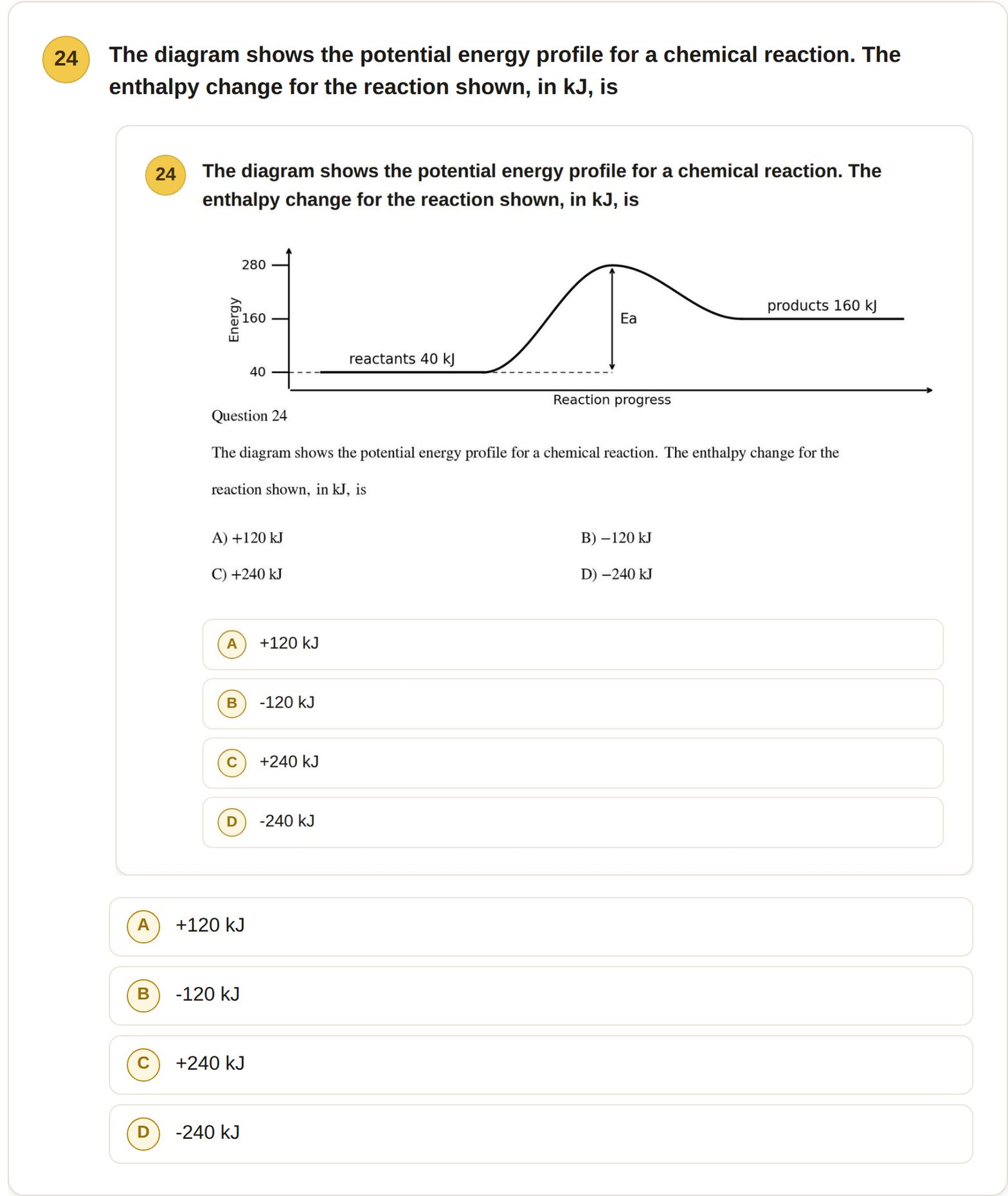
The diagram shows the potential energy profile for a chemical reaction. The enthalpy change for the reaction shown, in kJ, is
A chemical reaction has an enthalpy change of +120 kJ and an activation energy of 240 kJ for the forward reaction. The activation energy for the reverse reaction is
Your score: 0 / 25