This practice test was made by AI and there may be mistakes. If a question or answer looks wrong, use the Flag a mistake button to let Brett know so he can fix it.
Source I - The Lighthouse Keeper
Use this reading for questions 1, 5, and 17.
Mara lived alone in a lighthouse on a rocky point. Each evening she climbed the iron stairs, polished the great lens, and lit the lamp before dark. The sea was often rough, and the wind rattled the small windows of her tower room.
One November night a fishing boat lost its way in thick fog. Mara saw its faint light moving in circles far below. She turned the lamp slowly toward the boat, again and again, until the captain saw the beam and steered toward the harbor.
By morning the boat was safe at anchor. Mara never met the captain, but she kept a small stone from the shore on her windowsill to remember the night her lamp had mattered.
1
According to Source I - The Lighthouse Keeper, what is the main idea of the passage?
Honeybees leave the hive to gather nectar from flowers, sometimes flying more than a mile away. To return, they use the position of the sun, landmarks they have learned, and a sense of direction that scientists are still studying.
When a bee finds a rich patch of flowers, it returns to the hive and performs a dance on the comb. The dance tells other bees the direction and distance of the flowers, so the colony can gather food efficiently.
Researchers have tested bees by moving landmarks and shifting light, and the bees still find their way in most trials. The results suggest that bees combine several kinds of information rather than relying on a single cue.
2
According to Source I - How Bees Find Home, which word best describes the author?
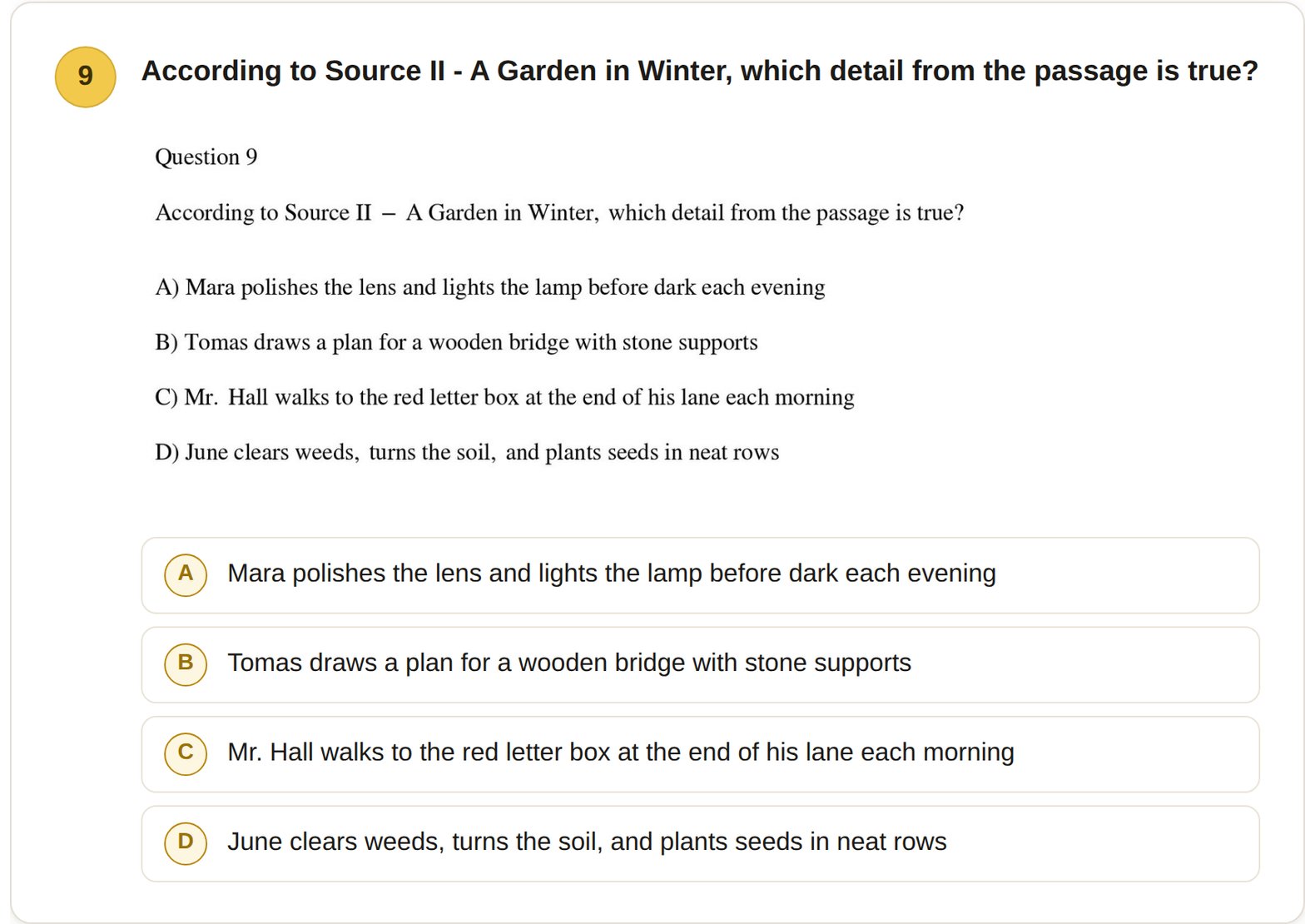
When June moved to a new town, she found a small garden behind her house, full of weeds and broken pots. Her neighbors told her nothing would grow there, but June spent her Saturdays clearing the ground and turning the soil.
She planted seeds in neat rows and watered them after school. Some seeds never sprouted, and a late frost killed the first green shoots. June planted again, this time covering the rows with old cloth at night.
By spring the garden was full of lettuce, carrots, and bright flowers. June shared the first harvest with the neighbors who had doubted her, and they asked her to help them start gardens of their own.
9
According to Source II - A Garden in Winter, which detail from the passage is true?
Rain that falls on a town does not simply disappear. Some of it soaks into the ground, some runs off roofs and roads into drains, and some evaporates back into the air on warm days.
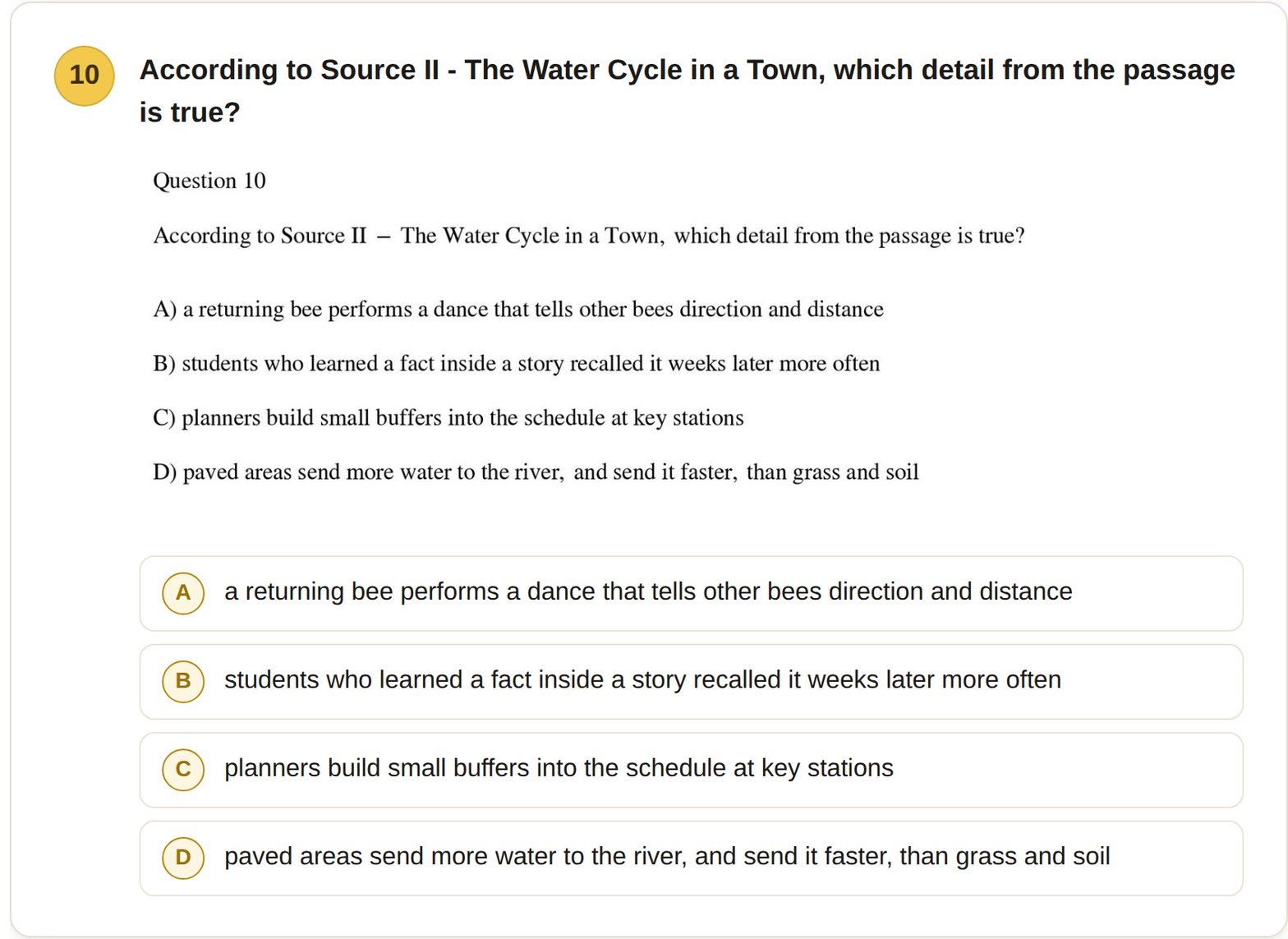
Engineers in one town measured how much rain reached the river after storms of different sizes. They found that paved areas sent far more water to the river, and sent it faster, than grass and soil did.
The town responded by building rain gardens and porous paths that let water soak in slowly. After two years, flooding after ordinary storms had fallen, and the river ran clearer.
10
According to Source II - The Water Cycle in a Town, which detail from the passage is true?
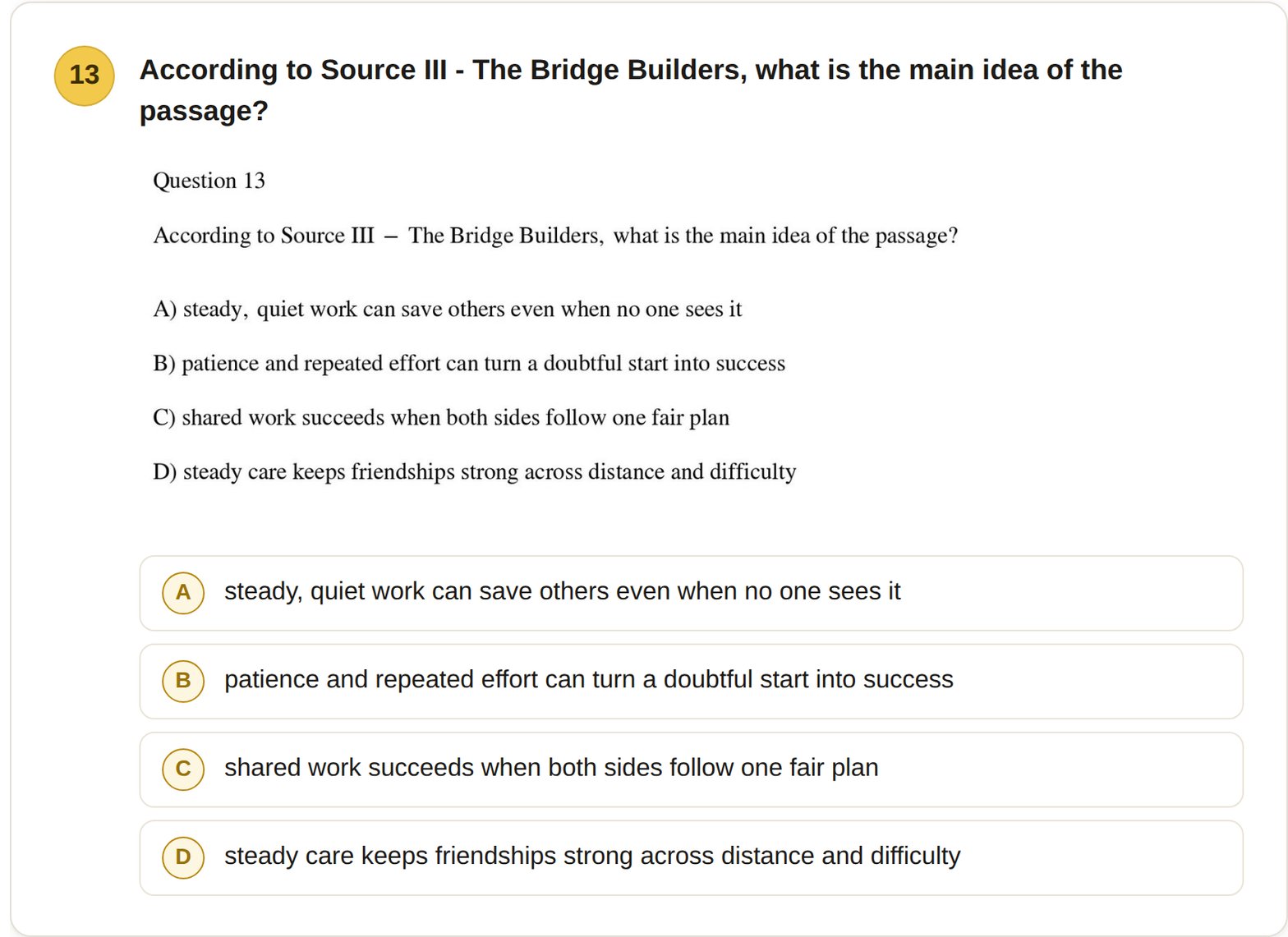
Two villages stood on opposite banks of a wide river. For years the villagers crossed by ferry, but the ferry ran only in daylight and often stopped in storms. The elders of both villages agreed that a bridge was needed, yet no one could agree on how to build it.
A young carpenter named Tomas drew a plan for a wooden bridge with stone supports. He asked builders from both villages to work together, each side building toward the middle. At first the two crews argued about measurements, but Tomas measured every joint himself and kept both sides to the same plan.
When the two halves met in the middle, the villages held a feast on the bridge itself. Children ran across it the next morning, and the ferry was kept only for visitors who wanted a slow ride.
13
According to Source III - The Bridge Builders, what is the main idea of the passage?
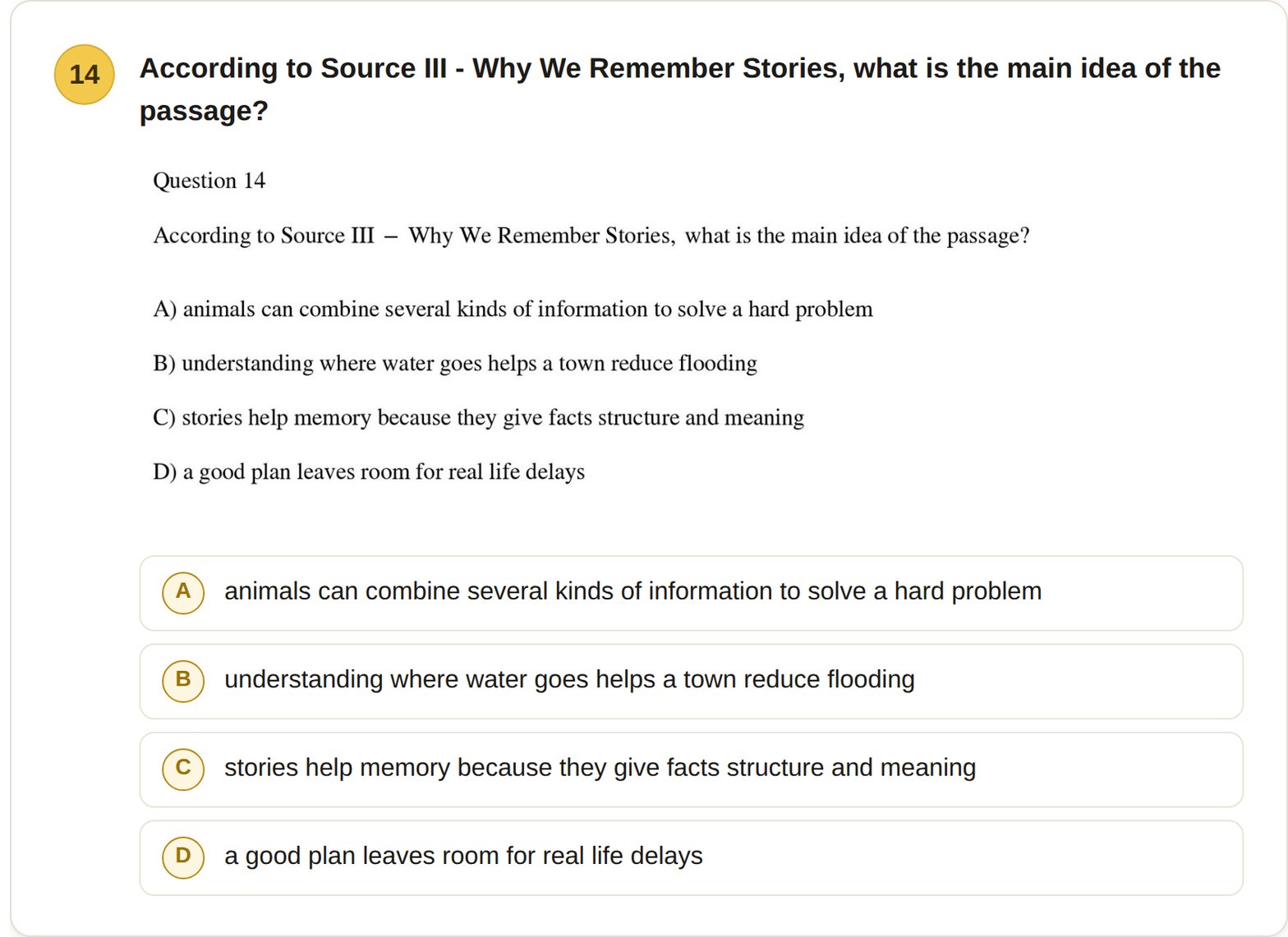
People remember stories far better than lists of facts. A story gives facts a setting, a character, and a problem to solve, and the brain holds on to that structure.
In one study, students who learned a fact inside a short story recalled it weeks later more often than students who learned the same fact alone. The story group also explained the fact in their own words more clearly.
Teachers use this finding when they open a lesson with a real example. The example does not replace the fact, but it gives students a place to store it and a reason to return to it.
14
According to Source III - Why We Remember Stories, what is the main idea of the passage?
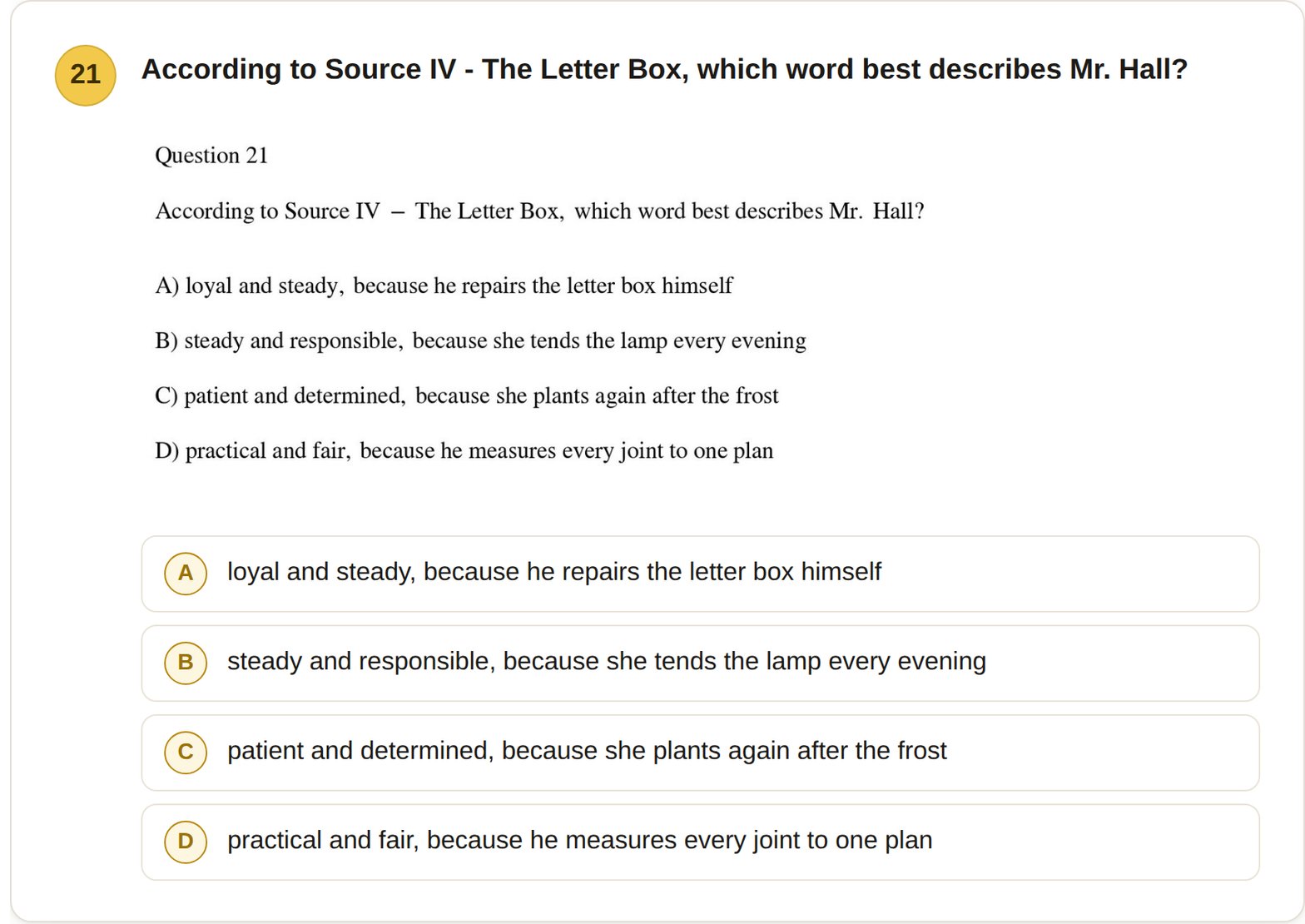
Every morning, old Mr. Hall walked to the red letter box at the end of his lane. He posted letters to his sister, who lived in a city far away, and he waited for her replies. The walk took him past the school, the bakery, and the park where children played.
One winter the letter box was damaged in a storm, and no mail came for two weeks. Mr. Hall fixed the box himself with wood from his shed, painted it red again, and nailed it firm to its post.
When the first letter arrived after the repair, Mr. Hall read it at his kitchen table and smiled. He wrote back at once, telling his sister that the letter box, like their friendship, only needed steady care.
21
According to Source IV - The Letter Box, which word best describes Mr. Hall?
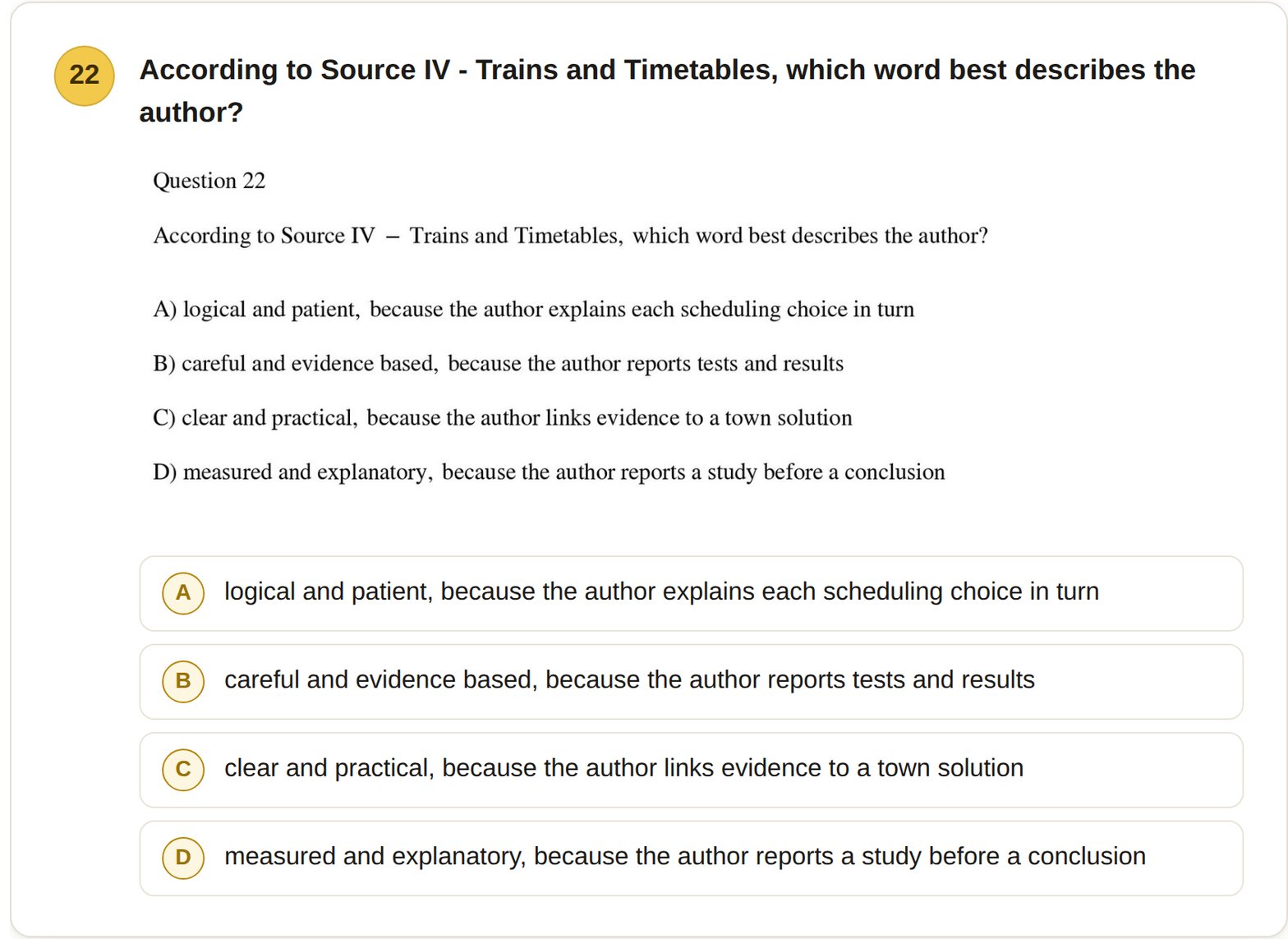
A train timetable looks simple, but it is built from many decisions. Planners must allow time for trains to stop, for passengers to board, and for delays at busy junctions, while keeping trains evenly spaced through the day.
If one train runs late, later trains can bunch together, leaving long gaps before them. To prevent this, planners build small buffers into the schedule at key stations, so a late train can recover a few minutes without delaying every train behind it.
Passengers rarely notice these buffers, but they notice when they are missing. A timetable that looks tight on paper often fails in practice, while a timetable with room to recover feels reliable.
22
According to Source IV - Trains and Timetables, which word best describes the author?