1
Glass marbles in a tray are used as a model for particles in a solid. What do the marbles show?
2
Potatoes are placed in pure water. What happens to the potato cells?
3
A thermometer is placed in hot water. What happens to the liquid inside the thermometer?
4
A sunflower leaf cell contains chloroplasts. What is the job of the chloroplasts?
5
A peach is a fruit. Which part of the flower does it develop from?
6
Hens' eggs have a large yolk. The yolk is one very large cell. Which part of the cell is the yolk?
7
A cell is 6 mm long in a photograph. Its real length is 0.03 mm. What is the magnification?
8
Two antibiotic discs give zones of inhibition of 8 mm and 14 mm. Which antibiotic is more effective?
9
A single bacterium divides every 20 minutes. How many bacteria are there after 3 divisions?
10
Why are embryonic stem cells useful in medicine?
11
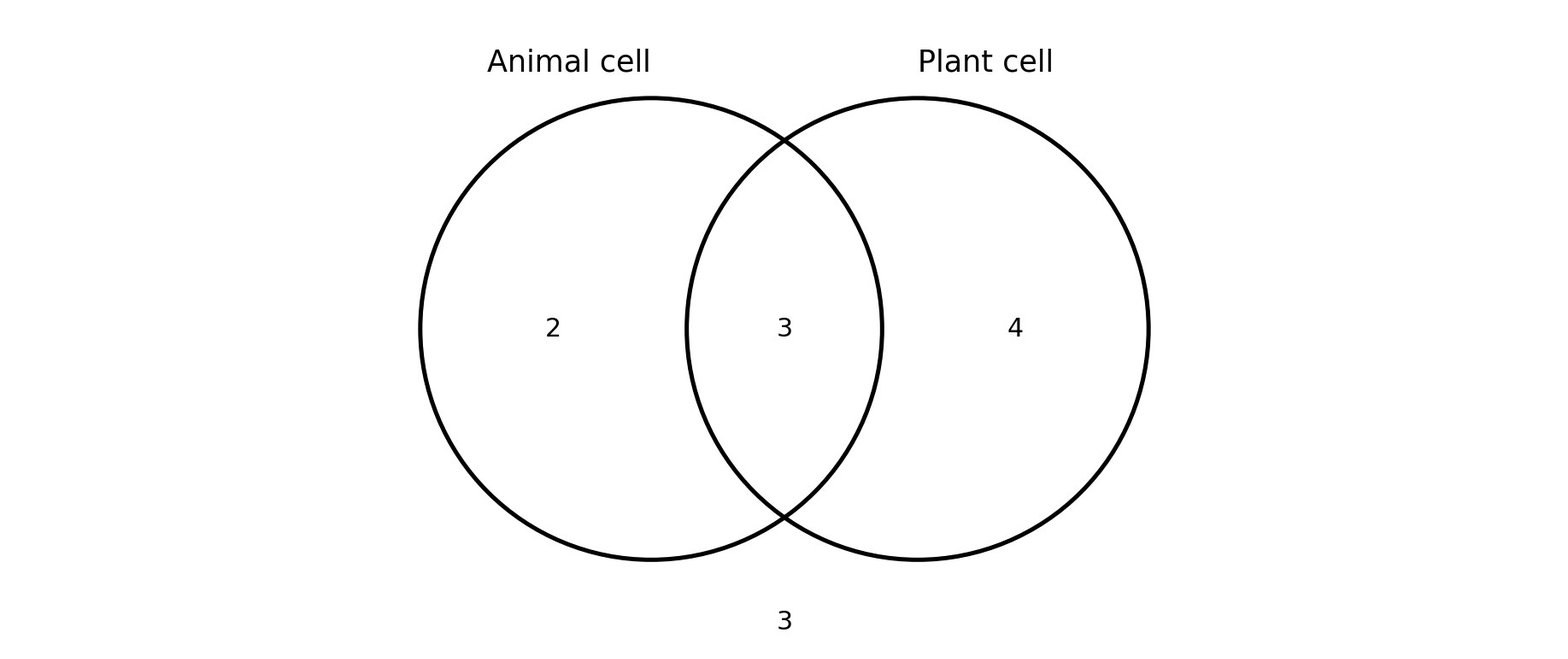
The Venn diagram shows features of animal cells and plant cells. How many features are found in both types of cell?
12
A microscope has an eyepiece lens of 10 times and an objective lens of 40 times. What is the total magnification?
13
Which cell contains chloroplasts?
14
Which part of a cell is where most of the chemical reactions happen?
15
A red blood cell in pure water will do what?
16
A cell of real length 0.02 mm is viewed at a magnification of 1000 times. How long is the image of the cell?
17
A piece of potato weighs 8 g. After soaking in pure water it weighs 8.5 g. What is the percentage increase in mass?
18
A body cell with 46 chromosomes divides by mitosis. How many chromosomes does each daughter cell have?
19
Why is a coverslip lowered carefully onto a slide?
21
A cell is 24 mm long in a photograph. Its real length is 0.03 mm. What is the magnification?
22
Why are cultures grown near a Bunsen burner flame?
23
A single bacterium divides every 20 minutes. How many bacteria are there after 6 divisions?
24
Which cell has a cell wall made of cellulose?
25
Which part of a plant cell contains cell sap?