1
A peach is a fruit. Which part of the flower does it develop from?
2
Hens' eggs have a large yolk. The yolk is one very large cell. Which part of the cell is the yolk?
3
A thermometer measures temperature in degrees Celsius. What is the freezing point of water on this scale?
4
Glass marbles are shaken in a tray. What does this model?
5
A sunflower leaf cell contains chloroplasts. What is the job of the chloroplasts?
6
Potatoes left in salty water go soft. Why?
7
What is differentiation?
8
Which cell contains chloroplasts?
9
Why are school cultures incubated at 25 degrees Celsius, not 37 degrees Celsius?
10
A single bacterium divides every 20 minutes. How many bacteria are there after 2 divisions?
11
In which part of the cell cycle does the DNA copy itself?
12
A cell is 12 mm long in a photograph. Its real length is 60 micrometres. What is the magnification?
13
A piece of potato weighs 6 g. After soaking in pure water it weighs 6.4 g. What is the percentage increase in mass?
14
A cell of real length 0.01 mm is viewed at a magnification of 400 times. How long is the image of the cell?
15
Which part of a light microscope holds the slide?
16
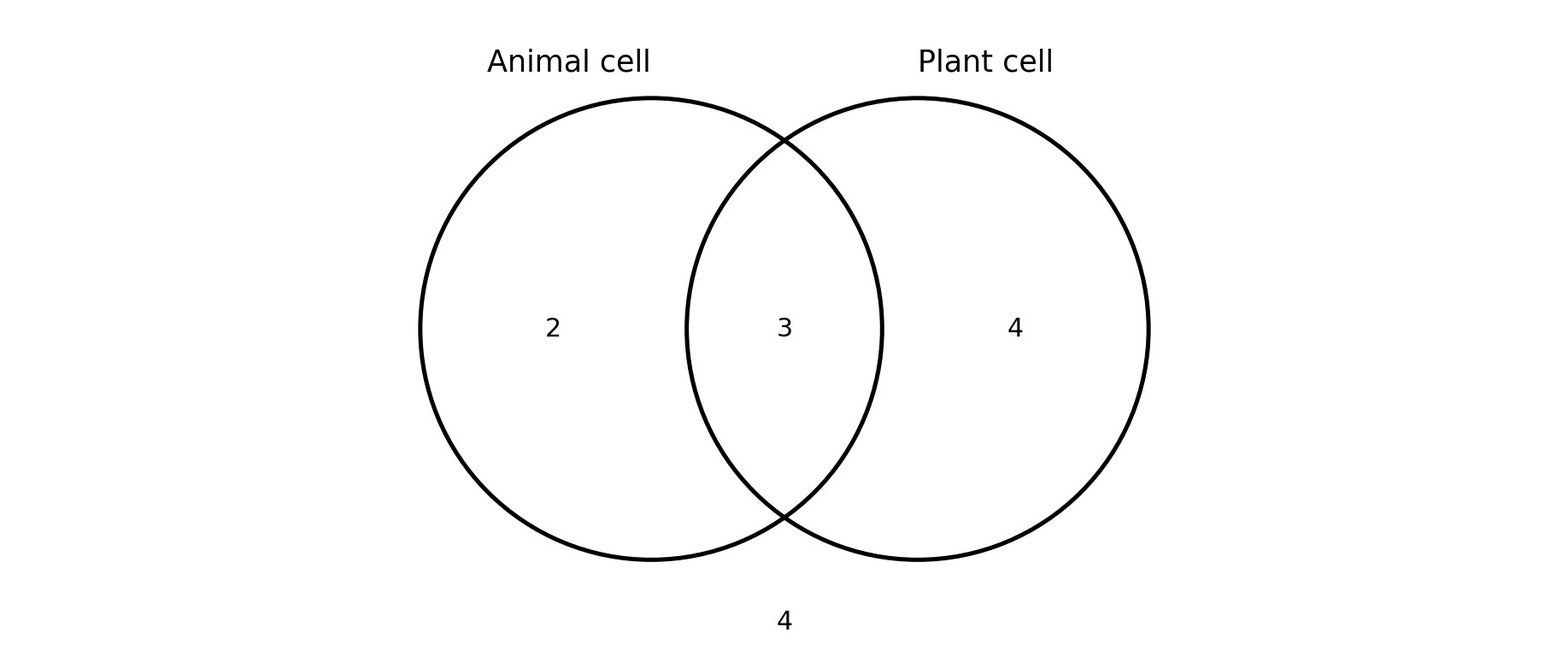
The Venn diagram shows features of animal cells and plant cells. How many features are found in both types of cell?
17
A cheek cell has no cell wall and no chloroplasts. What does this show?
18
Which process moves oxygen into a cell from the air?
19
Why are embryonic stem cells useful in medicine?
20
Which cell has a cell wall made of cellulose?
21
What does agar provide for bacteria in a culture?
22
A single bacterium divides every 20 minutes. How many bacteria are there after 5 divisions?
23
A cell is 12 mm long in a photograph. Its real length is 20 micrometres. What is the magnification?
24
A piece of potato weighs 4 g. After soaking in pure water it weighs 4.5 g. What is the percentage increase in mass?
25
Which part of a plant cell contains cell sap?