1
In the microscopy required practical, why is iodine stain added to onion cells?
A to magnify the cells B to make the nucleus easy to see C to kill the onion cells D to keep the cells alive for longer
What looks wrong with Question 1?
Send anonymously
Cancel
2
Red apples are cut and left in the air. They turn brown because an enzyme in the apple reacts with oxygen. What would slow this browning down?
A putting them in a fridge B warming them up C leaving them in sunlight all day D cutting them smaller
What looks wrong with Question 2?
Send anonymously
Cancel
3
Hardcover books have mass. What is mass measured in?
A kilograms B newtons, the unit of force C joules D watts
What looks wrong with Question 3?
Send anonymously
Cancel
4
A peach tree flowers in spring. What do bees carry between flowers?
A leaves B water C pollen D seeds
What looks wrong with Question 4?
Send anonymously
Cancel
5
A sunflower makes glucose in its leaves. Which gas does it take in for photosynthesis?
A nitrogen gas from the air B carbon dioxide C hydrogen gas from the air D oxygen gas from the air
What looks wrong with Question 5?
Send anonymously
Cancel
6
A forest absorbs carbon dioxide. Which process does this?
A photosynthesis B combustion of the wood C decomposition in the soil D respiration in the trees
What looks wrong with Question 6?
Send anonymously
Cancel
7
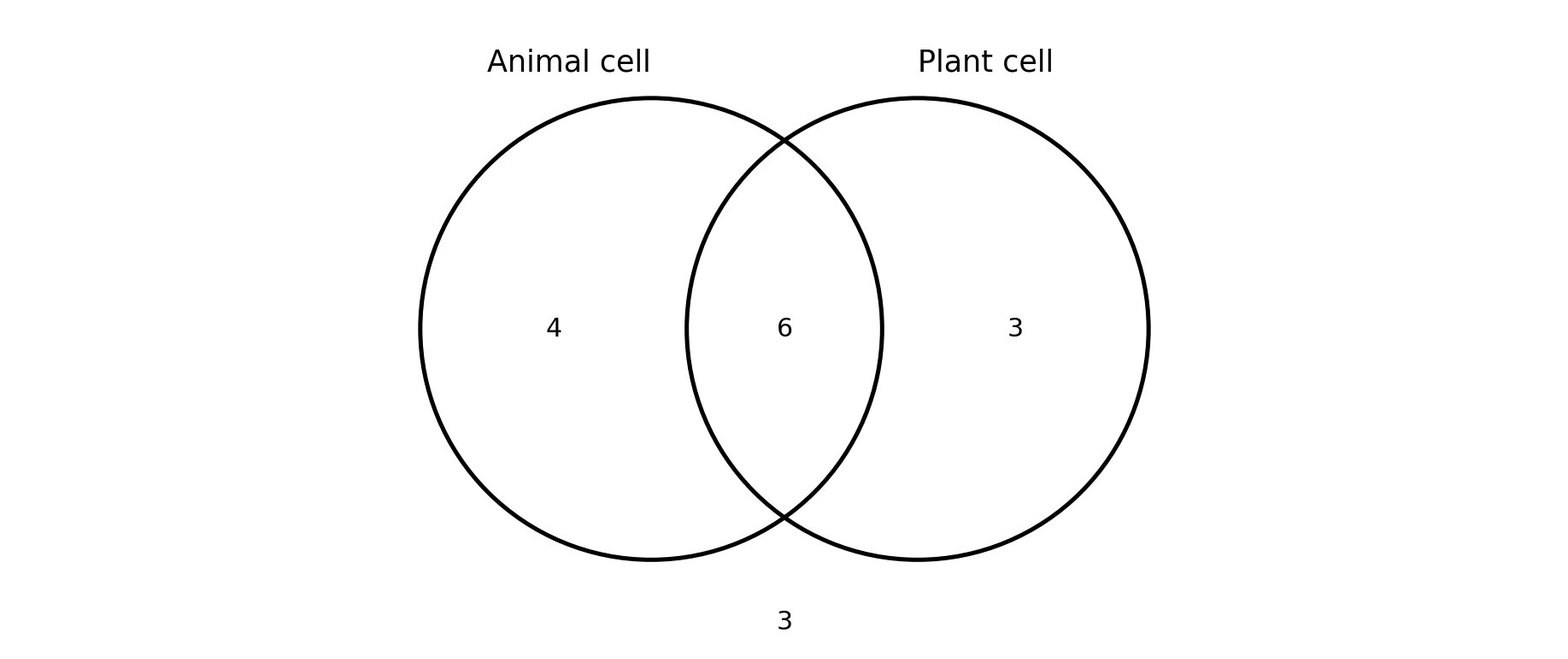
The Venn diagram shows features of animal cells and plant cells. How many features are found in both types of cell?
A 7 B 6 C 8 D 5
What looks wrong with Question 7?
Send anonymously
Cancel
8
What is the pH of bile?
A alkaline B strongly acidic C acidic D neutral
What looks wrong with Question 8?
Send anonymously
Cancel
9
Why does a shoot bend towards light?
A more auxin on the shaded side B the lit side grows faster C auxin builds up on the lit side D the roots pull the shoot over
What looks wrong with Question 9?
Send anonymously
Cancel
10
Why are quadrats placed randomly?
A to avoid counting B to find the most organisms C to save time D to get a fair sample
What looks wrong with Question 10?
Send anonymously
Cancel
A a change in the number of cells B a change in the number of chromosomes C a change in the DNA base order D a change in the size of a cell
What looks wrong with Question 11?
Send anonymously
Cancel
12
Which disease is now prevented by the MMR vaccine?
A tuberculosis B malaria C athlete's foot D measles
What looks wrong with Question 12?
Send anonymously
Cancel
13
One glucose molecule releases 30 molecules of ATP in respiration. How many ATP molecules are released from 3 glucose molecules?
A 120 B 90 C 180 D 60
What looks wrong with Question 13?
Send anonymously
Cancel
14
Why do guard cells close the stomata at night?
A to let oxygen out B to absorb more minerals C to reduce water loss D to stop photosynthesis
What looks wrong with Question 14?
Send anonymously
Cancel
15
Which plant hormone makes shoots bend towards light?
A auxin B gibberellin C ethene D insulin
What looks wrong with Question 15?
Send anonymously
Cancel
A green plants and algae B worms and insects only C bacteria and fungi D animals that eat dead plants
What looks wrong with Question 16?
Send anonymously
Cancel
17
The diagram shows a short section of DNA. How many base pairs are there in total?
A 5 B 7 C 4 D 6
What looks wrong with Question 17?
Send anonymously
Cancel
18
A person is exposed to a disease on day 5. The incubation period is 7 days. On which day do symptoms start?
A 14 B 13 C 11 D 12
What looks wrong with Question 18?
Send anonymously
Cancel
19
What gas is released by photosynthesis?
A carbon dioxide B oxygen C hydrogen D nitrogen
What looks wrong with Question 19?
Send anonymously
Cancel
20
What does amylase break down?
A cellulose to glucose B proteins to amino acids C lipids to fatty acids and glycerol D starch to sugars
What looks wrong with Question 20?
Send anonymously
Cancel
21
Which neurone carries the impulse from the CNS to the effector?
A a sensory neurone B a receptor neurone C a relay neurone D a motor neurone
What looks wrong with Question 21?
Send anonymously
Cancel
22
Producers in a food chain hold 10000 kJ of energy. About 10 percent passes to the primary consumers. How much energy reaches them?
A 10000 kJ B 2000 kJ C 500 kJ D 1000 kJ
What looks wrong with Question 22?
Send anonymously
Cancel
23
What are the three domains of life?
A Animals, Plants and Fungi B Prokaryotes, Eukaryotes and Viruses C Archaea, Bacteria and Eukaryota D Bacteria, Viruses and Fungi
What looks wrong with Question 23?
Send anonymously
Cancel
24
Which pathogen causes HIV?
A a fungus B a protist C a virus D a bacterium
What looks wrong with Question 24?
Send anonymously
Cancel
25
Why can plant cells keep differentiating throughout life, but most animal cells cannot?
A plant cells divide more slowly B plants have no DNA in their cells C plants keep meristem tissue D animal cells have no nucleus
What looks wrong with Question 25?
Send anonymously
Cancel
26
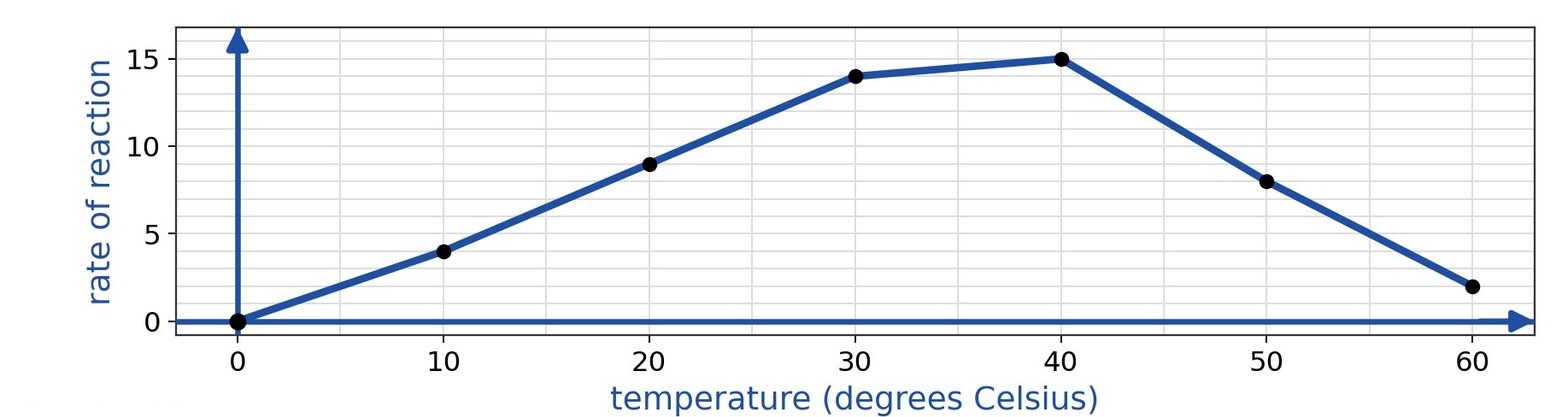
The graph shows the rate of an enzyme reaction at different temperatures. At which temperature is the rate highest?
A 20 B 30 C 40 D 60
What looks wrong with Question 26?
Send anonymously
Cancel
27
Blood glucose falls from 8 mmol per litre to 5 mmol per litre. What is the fall?
A 4 mmol/L B 5 mmol/L C 2 mmol/L D 3 mmol/L
What looks wrong with Question 27?
Send anonymously
Cancel
28
Producers in a food chain have a biomass of 1000 kg. About 10 per cent of biomass passes to each level. What is the biomass of the secondary consumers?
A 1 B 100 C 20 D 10
What looks wrong with Question 28?
Send anonymously
Cancel
29
In a DNA sample, 25 percent of the bases are adenine. What percent are thymine?
A 15% B 75% C 35% D 25%
What looks wrong with Question 29?
Send anonymously
Cancel
30
Which is a physical defence of a plant?
A an antimicrobial chemical B a waxy cuticle C antibodies in the sap D white blood cells
What looks wrong with Question 30?
Send anonymously
Cancel
31
Why is the lid of a Petri dish taped on, but not sealed all the way round?
A to let the bacteria escape when they grow B to keep the dish warm C to let oxygen in and keep microbes out D to stop the agar from drying out completely
What looks wrong with Question 31?
Send anonymously
Cancel
32
Which component of blood helps blood to clot?
A plasma B white blood cells C platelets D red blood cells
What looks wrong with Question 32?
Send anonymously
Cancel
33
Eggs are produced by hens. What is the female reproductive cell called?
A an egg cell B a zygote C a sperm cell D an embryo
What looks wrong with Question 33?
Send anonymously
Cancel
34
What do decomposers return to the soil?
A nutrients B carbon dioxide C oxygen D water
What looks wrong with Question 34?
Send anonymously
Cancel
A a hospital for genetic disorders B a store of seeds or genes C a laboratory for cloning D a bank that stores money
What looks wrong with Question 35?
Send anonymously
Cancel
36
A yellow school bus stops at a station. What happens to its speed?
A it becomes zero B it becomes negative C it increases D it stays the same
What looks wrong with Question 36?
Send anonymously
Cancel
37
One glucose molecule releases 30 molecules of ATP in respiration. How many ATP molecules are released from 5 glucose molecules?
A 180 B 120 C 150 D 300
What looks wrong with Question 37?
Send anonymously
Cancel
38
A heart beats 60 times per minute and pumps 70 mL per beat. What is the cardiac output in mL per minute?
A 4200 mL/min B 3700 mL/min C 8400 mL/min D 4700 mL/min
What looks wrong with Question 38?
Send anonymously
Cancel
39
How does the body lose heat when it is too hot?
A by shivering B by vasoconstriction C by growing hair D by sweating
What looks wrong with Question 39?
Send anonymously
Cancel
A oxygen released by plants B nitrogen from the air C carbon dioxide from burning D methane made without oxygen
What looks wrong with Question 40?
Send anonymously
Cancel
41
What is the order of the Linnaean groups, largest first?
A a list of all living things B kingdom to species in order C species to kingdom in order D genus to family in order
What looks wrong with Question 41?
Send anonymously
Cancel
42
What is herd immunity?
A everyone in the population catches the disease at once B animals protect humans C most people are immune so disease cannot spread D vaccines work on animals
What looks wrong with Question 42?
Send anonymously
Cancel
43
Where does aerobic respiration happen?
A in the chloroplasts B in the mitochondria C in the vacuole D in the nucleus
What looks wrong with Question 43?
Send anonymously
Cancel
44
Red apples provide energy. Which nutrient in apples provides most energy?
A fat, for insulation B protein, for growth C fibre, for digestion D carbohydrates
What looks wrong with Question 44?
Send anonymously
Cancel
45
In a reflex, where does the impulse go after the receptor?
A to a relay neurone B straight to the effector C to a hormone D to the brain first
What looks wrong with Question 45?
Send anonymously
Cancel
46
A forest provides a habitat. What does habitat mean?
A when an organism sleeps B where an organism lives C what an organism eats D how an organism breeds
What looks wrong with Question 46?
Send anonymously
Cancel
47
Which animal was the first cloned from an adult cell?
A a farm cow B Dolly the sheep C a laboratory mouse D a pet dog
What looks wrong with Question 47?
Send anonymously
Cancel
48
A vaccine is given to 19 out of every 20 people in a school of 400 pupils. How many pupils receive the vaccine?
A 380 B 399 C 20 D 38
What looks wrong with Question 48?
Send anonymously
Cancel
49
During mitosis, how many daughter cells are produced from one cell?
A 4 B 2 C 1 D 3
What looks wrong with Question 49?
Send anonymously
Cancel
50
A heart beats 60 times per minute and pumps 80 mL per beat. What is the cardiac output in mL per minute?
A 5300 mL/min B 4300 mL/min C 9600 mL/min D 4800 mL/min
What looks wrong with Question 50?
Send anonymously
Cancel