1
Seabirds are affected by plastic pollution. How does plastic harm them?
A they eat it by mistake B it helps them fly C it makes them stronger and healthier D it keeps them warm
What looks wrong with Question 1?
Send anonymously
Cancel
2
A honeybee collects nectar. What is nectar?
A a mineral solution B a fatty substance C a sugary liquid D a protein-rich food
What looks wrong with Question 2?
Send anonymously
Cancel
3
A sunflower makes glucose in its leaves. Which gas does it take in for photosynthesis?
A hydrogen gas from the air B carbon dioxide C oxygen gas from the air D nitrogen gas from the air
What looks wrong with Question 3?
Send anonymously
Cancel
4
Red apples are cut and left in air. Why do they turn brown?
A they dry out in the air B enzymes react with oxygen C they ferment into alcohol D they freeze in the cold
What looks wrong with Question 4?
Send anonymously
Cancel
5
A forest is cut down. What happens to the carbon stored in the trees?
A it is released B it is stored forever C it disappears D it turns to oxygen
What looks wrong with Question 5?
Send anonymously
Cancel
6
A peach is a fruit. Which part of the flower does it develop from?
A the ovary B the stigma C the anther D the petal
What looks wrong with Question 6?
Send anonymously
Cancel
7
How does photosynthesis affect carbon dioxide in the air?
A it removes carbon dioxide B it turns carbon dioxide into oxygen C it stores carbon dioxide in soil D it releases carbon dioxide
What looks wrong with Question 7?
Send anonymously
Cancel
8
A field has 2000 kg of grass. If 5 percent of the energy passes to the rabbits, how much grass biomass supports the rabbits?
A 50 kg B 100 kg C 1000 kg D 200 kg
What looks wrong with Question 8?
Send anonymously
Cancel
9
Producers in a food chain have a biomass of 10000 kg. About 10 per cent of biomass passes to each level. What is the biomass of the secondary consumers?
A 10 B 200 C 100 D 1000
What looks wrong with Question 9?
Send anonymously
Cancel
10
A pondweed plant releases 24 bubbles of oxygen in 4 minutes. How many bubbles does it release per minute?
A 7 B 5 C 12 D 6
What looks wrong with Question 10?
Send anonymously
Cancel
A where an organism lives B all the organisms in an area C a food web D a population
What looks wrong with Question 11?
Send anonymously
Cancel
12
What shape is a pyramid of biomass?
A the same width all the way up B narrow at the bottom, wide at the top C wide at the bottom, narrow at the top D a circle
What looks wrong with Question 12?
Send anonymously
Cancel
13
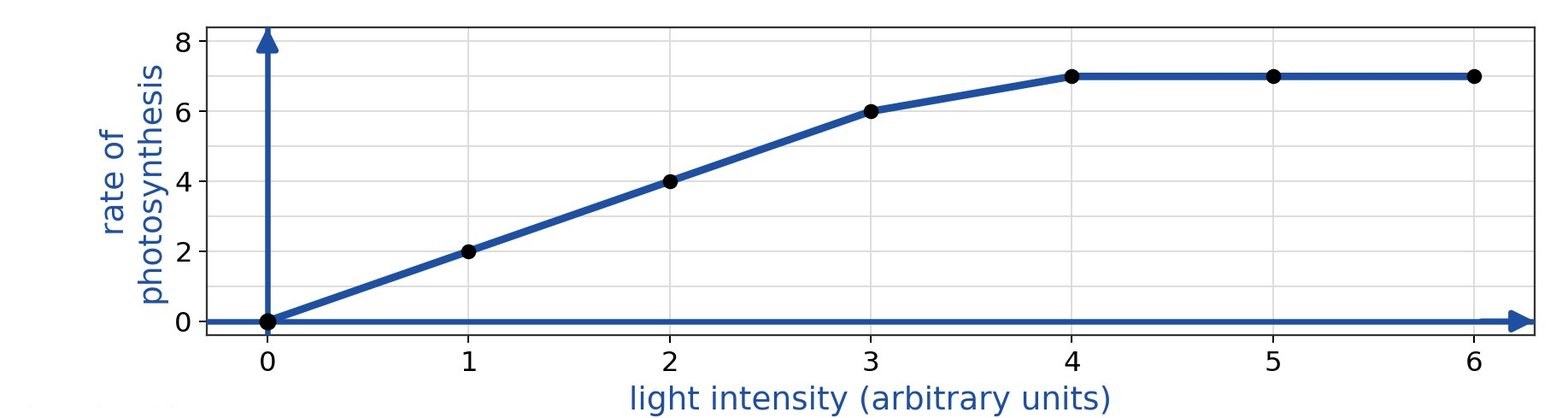
The graph shows the rate of photosynthesis at different light intensities. At which light intensity does the rate first reach its maximum?
A 6 B 2 C 4 D 3
What looks wrong with Question 13?
Send anonymously
Cancel
14
What is glucose used to make in cell walls?
A glycogen B amino acids C starch D cellulose
What looks wrong with Question 14?
Send anonymously
Cancel
15
Why is decay important in an ecosystem?
A it stops plants growing B it makes the soil warmer C it recycles nutrients D it removes carbon dioxide
What looks wrong with Question 15?
Send anonymously
Cancel
16
What happens to light intensity when the distance from a lamp doubles?
A it halves B it falls to a quarter C it stays exactly the same D it doubles
What looks wrong with Question 16?
Send anonymously
Cancel
17
Why repeat a quadrat sample and take a mean?
A to use up the time available B to find more species C for a reliable result D to practise using the quadrat
What looks wrong with Question 17?
Send anonymously
Cancel
18
Producers in a food chain hold 100000 kJ of energy. About 10 percent passes to the primary consumers. How much energy reaches them?
A 100000 kJ B 10000 kJ C 20000 kJ D 5000 kJ
What looks wrong with Question 18?
Send anonymously
Cancel
19
What is glucose made into for storage in a plant?
A protein B chlorophyll C cellulose D starch
What looks wrong with Question 19?
Send anonymously
Cancel
20
A quadrat of area 50 square metres contains on average 4 daisies. Estimate the number of daisies in a field of 500 square metres.
A 20 B 80 C 40 D 400
What looks wrong with Question 20?
Send anonymously
Cancel
21
Where in a leaf does photosynthesis happen?
A in the chloroplasts B in the vacuole C in the nucleus D in the mitochondria
What looks wrong with Question 21?
Send anonymously
Cancel
22
How does combustion affect carbon dioxide in the air?
A it removes carbon dioxide B it turns carbon dioxide into oxygen C it releases carbon dioxide D it stores carbon dioxide in rock
What looks wrong with Question 22?
Send anonymously
Cancel
23
A field has 2000 kg of grass. If 10 percent of the energy passes to the rabbits, how much grass biomass supports the rabbits?
A 100 kg B 2000 kg C 400 kg D 200 kg
What looks wrong with Question 23?
Send anonymously
Cancel
24
A pondweed plant releases 24 bubbles of oxygen in 2 minutes. How many bubbles does it release per minute?
A 12 B 11 C 13 D 24
What looks wrong with Question 24?
Send anonymously
Cancel
25
What is the water cycle driven by?
A energy from the Sun B wind only C gravity only D energy from the soil
What looks wrong with Question 25?
Send anonymously
Cancel