1
A peach tree flowers in spring. What do bees carry between flowers?
A seeds B pollen C water D leaves
What looks wrong with Question 1?
Send anonymously
Cancel
2
A peach is a fruit. Which part of the flower does it develop from?
A the petal B the stigma C the anther D the ovary
What looks wrong with Question 2?
Send anonymously
Cancel
3
A sunflower makes glucose in its leaves. Which gas does it take in for photosynthesis?
A hydrogen gas from the air B carbon dioxide C oxygen gas from the air D nitrogen gas from the air
What looks wrong with Question 3?
Send anonymously
Cancel
4
A school lunch tray holds a bread roll, cheese and an apple. Which food test would show starch in the bread roll?
A Benedict's turns brick red B Biuret turns purple C Sudan III turns red D iodine turns blue-black
What looks wrong with Question 4?
Send anonymously
Cancel
5
A basketball is thrown up. What happens to its speed as it rises?
A it becomes zero B it stays the same C it decreases D it increases
What looks wrong with Question 5?
Send anonymously
Cancel
6
Rabbits in a meadow show variation in fur colour. What causes this variation?
A the rabbits' diet only B the number of rabbits C natural selection only, acting over time D different alleles and the environment
What looks wrong with Question 6?
Send anonymously
Cancel
7
In a DNA sample, 20 percent of the bases are adenine. What percent are thymine?
A 80% B 30% C 10% D 20%
What looks wrong with Question 7?
Send anonymously
Cancel
8
A yellow school bus stops at a station. What happens to its speed?
A it becomes negative B it increases C it stays the same D it becomes zero
What looks wrong with Question 8?
Send anonymously
Cancel
9
A field has 2000 kg of grass. If 5 percent of the energy passes to the rabbits, how much grass biomass supports the rabbits?
A 50 kg B 100 kg C 1000 kg D 200 kg
What looks wrong with Question 9?
Send anonymously
Cancel
10
One glucose molecule releases 30 molecules of ATP in respiration. How many ATP molecules are released from 10 glucose molecules?
A 330 B 270 C 600 D 300
What looks wrong with Question 10?
Send anonymously
Cancel
11
In which direction do particles move by diffusion?
A from high to low concentration B from large to small C from cold to hot D from low to high concentration
What looks wrong with Question 11?
Send anonymously
Cancel
12
What is carbon dioxide?
A a gas we breathe in B a gas in fizzy drinks C a gas from the Sun D a greenhouse gas
What looks wrong with Question 12?
Send anonymously
Cancel
13
Which bases pair together in DNA?
A A pairs with A, T pairs with T B A pairs with C, T pairs with G C A pairs with G, C pairs with T D A pairs with T, C pairs with G
What looks wrong with Question 13?
Send anonymously
Cancel
14
Why does a plant with a viral disease photosynthesise less?
A leaves have less chlorophyll B the stem stops growing C the flowers fall off first D the roots stop taking in water
What looks wrong with Question 14?
Send anonymously
Cancel
15
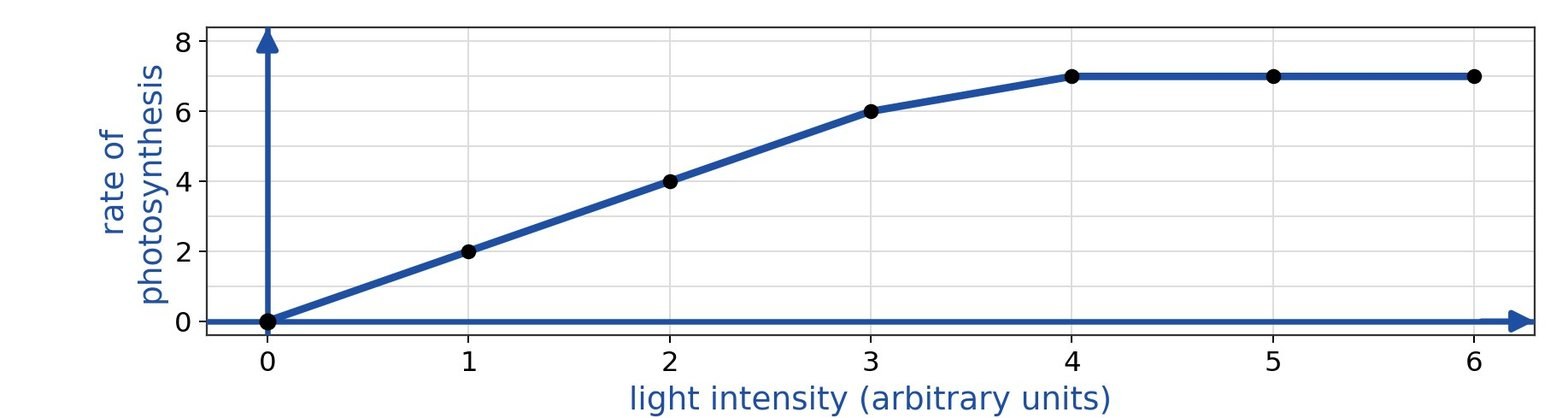
The graph shows the rate of photosynthesis at different light intensities. At which light intensity does the rate first reach its maximum?
A 6 B 2 C 4 D 3
What looks wrong with Question 15?
Send anonymously
Cancel
16
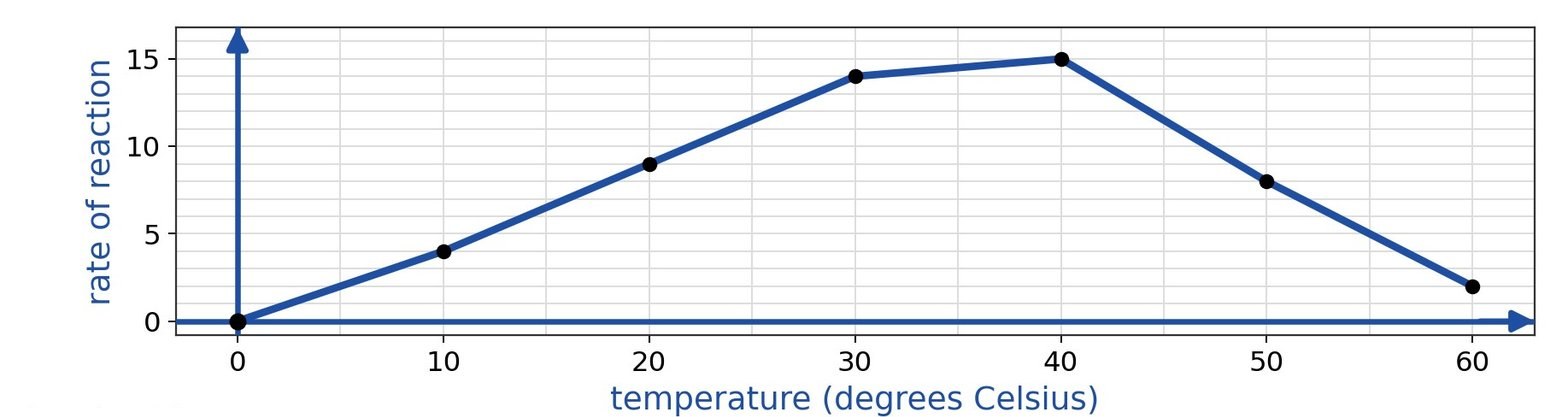
The graph shows the rate of an enzyme reaction at different temperatures. At which temperature is the rate highest?
A 20 B 40 C 60 D 30
What looks wrong with Question 16?
Send anonymously
Cancel
17
Why do red blood cells have no nucleus?
A to fight infection better B to live for longer C to carry more haemoglobin D to divide more quickly in the bone marrow
What looks wrong with Question 17?
Send anonymously
Cancel
18
Why is biodiversity important?
A it gives us more food B it makes places much prettier to visit C it keeps ecosystems stable D it stops all disease
What looks wrong with Question 18?
Send anonymously
Cancel
19
Which disorder is caused by a dominant allele?
A cystic fibrosis B sickle cell anaemia C haemophilia D polydactyly
What looks wrong with Question 19?
Send anonymously
Cancel
20
A vaccine is given to 17 out of every 20 people in a school of 2000 pupils. How many pupils receive the vaccine?
A 300 B 170 C 1700 D 1717
What looks wrong with Question 20?
Send anonymously
Cancel
21
Producers in a food chain hold 100000 kJ of energy. About 10 percent passes to the primary consumers. How much energy reaches them?
A 100000 kJ B 10000 kJ C 20000 kJ D 5000 kJ
What looks wrong with Question 21?
Send anonymously
Cancel
22
Lipase breaks lipids down into fatty acids and what else?
A starch B glycerol C amino acids D sugars
What looks wrong with Question 22?
Send anonymously
Cancel
23
What happens to blood vessels in the skin when the body is hot?
A they widen to lose heat B they narrow to keep heat in C they move deeper into the skin D they close completely
What looks wrong with Question 23?
Send anonymously
Cancel
24
Carbon dioxide is 315 parts per million in the air. How many carbon dioxide molecules are there per million air molecules?
A 295 B 315 C 3150 D 31
What looks wrong with Question 24?
Send anonymously
Cancel
25
A brown dog is vaccinated. What does the vaccine contain?
A an antibiotic B a dead or weakened pathogen C white blood cells D a live dangerous pathogen that causes disease
What looks wrong with Question 25?
Send anonymously
Cancel
26
What are memory cells?
A cells that digest food B cells that make red blood cells C cells that remember a pathogen D cells that store memories in the brain
What looks wrong with Question 26?
Send anonymously
Cancel
27
A field has 2000 kg of grass. If 10 percent of the energy passes to the rabbits, how much grass biomass supports the rabbits?
A 100 kg B 2000 kg C 400 kg D 200 kg
What looks wrong with Question 27?
Send anonymously
Cancel
28
What happens to an enzyme at a very high temperature?
A it dissolves in the water B it works faster and faster C it denatures and stops working D it changes into a different enzyme
What looks wrong with Question 28?
Send anonymously
Cancel
29
What does oestrogen do?
A it triggers ovulation B it maintains the lining after ovulation C it thickens the uterus lining D it stimulates eggs to mature
What looks wrong with Question 29?
Send anonymously
Cancel
30
Who reached the same ideas as Darwin, working separately?
A Wallace B Lamarck C Woese D Mendel
What looks wrong with Question 30?
Send anonymously
Cancel
31
What does dominant mean in genetics?
A the allele shows only with two copies B the allele shows even with one copy C the allele never shows D the allele is on the X chromosome
What looks wrong with Question 31?
Send anonymously
Cancel
32
How does antibiotic resistance spread in bacteria?
A resistant bacteria survive and reproduce B viruses carry resistance to bacteria C antibiotics change the bacteria genes directly D bacteria learn to avoid antibiotics
What looks wrong with Question 32?
Send anonymously
Cancel
A the breakdown of food in the gut only B the release of energy in respiration C all the chemical reactions in the body D the building of proteins only
What looks wrong with Question 33?
Send anonymously
Cancel
34
A school lunch tray holds a meal. Why do we need food?
A for fun only, not for health B to stay awake at night C for energy and growth D to feel full after eating
What looks wrong with Question 34?
Send anonymously
Cancel
35
What causes type 1 diabetes?
A too much sugar in the diet B no insulin is made C the body cells resist insulin D the liver stores too much glycogen
What looks wrong with Question 35?
Send anonymously
Cancel
36
Which of these is a greenhouse gas?
A methane B argon C nitrogen D oxygen
What looks wrong with Question 36?
Send anonymously
Cancel
37
In a DNA sample, 25 percent of the bases are adenine. What percent are thymine?
A 75% B 25% C 35% D 15%
What looks wrong with Question 37?
Send anonymously
Cancel
38
A thermometer measures temperature in degrees Celsius. What is the freezing point of water on this scale?
A 100 B 32 C 0 D 10
What looks wrong with Question 38?
Send anonymously
Cancel
39
Where is carbon stored long term?
A in fossil fuels B in living organisms only C in rain water D in the air as oxygen
What looks wrong with Question 39?
Send anonymously
Cancel
40
A school lunch tray holds a meal with bread, cheese and an apple. Which food group is the bread from?
A proteins, for growth B vitamins, for health C carbohydrates D fats, for insulation
What looks wrong with Question 40?
Send anonymously
Cancel
41
Which of these uses active transport?
A oxygen entering the lungs B water entering a root C taking in minerals from soil D carbon dioxide leaving a leaf
What looks wrong with Question 41?
Send anonymously
Cancel
42
What is the correct order of classification, from largest to smallest?
A species, genus, family, order, class, phylum, kingdom B kingdom, class, phylum, order, genus, family, species C phylum, kingdom, class, family, order, genus, species D kingdom, phylum, class, order, family, genus, species
What looks wrong with Question 42?
Send anonymously
Cancel
43
A brown dog is bitten by a tick. Ticks can spread disease. How is the disease spread?
A by a vector B through water C by touch D through the air
What looks wrong with Question 43?
Send anonymously
Cancel
44
Why should a course of antibiotics be finished?
A to kill all the bacteria B to stop side effects C to prevent an allergic reaction D to save money on medicine
What looks wrong with Question 44?
Send anonymously
Cancel
45
Red apples provide energy. Which nutrient in apples provides most energy?
A carbohydrates B protein, for growth C fibre, for digestion D fat, for insulation
What looks wrong with Question 45?
Send anonymously
Cancel
46
A single bacterium divides every 20 minutes. How many bacteria are there after 2 divisions?
A 2 B 4 C 8 D 6
What looks wrong with Question 46?
Send anonymously
Cancel
47
A piece of potato weighs 5 g. After soaking in pure water it weighs 5.4 g. What is the percentage increase in mass?
A 8% B 16% C 4% D 13%
What looks wrong with Question 47?
Send anonymously
Cancel
48
How does deforestation affect the atmosphere?
A less carbon dioxide is absorbed B more carbon dioxide is absorbed C more oxygen is made D the air gets cleaner
What looks wrong with Question 48?
Send anonymously
Cancel
A a change in the number of chromosomes B a change in the number of cells C a change in the size of a cell D a change in the DNA base order
What looks wrong with Question 49?
Send anonymously
Cancel
50
A vaccine is given to 19 out of every 20 people in a school of 2000 pupils. How many pupils receive the vaccine?
A 1900 B 100 C 190 D 1919
What looks wrong with Question 50?
Send anonymously
Cancel