1
Red apples contain vitamin C. What is vitamin C needed for?
A making red blood cells B good eyesight at night C healthy skin and gums D strong bones and teeth
What looks wrong with Question 1?
Send anonymously
Cancel
2
A forest absorbs carbon dioxide from the air. Which process is responsible?
A photosynthesis B combustion C decomposition in the soil D respiration
What looks wrong with Question 2?
Send anonymously
Cancel
3
A sunflower is left in bright light. Its leaves photosynthesise faster than in dim light. What else would increase the rate?
A more carbon dioxide in the air B less water in the soil C a lower temperature D less chlorophyll in the leaves of the plant
What looks wrong with Question 3?
Send anonymously
Cancel
4
Seabirds eat fish. What trophic level are the seabirds?
A secondary consumers B primary consumers, eating producers C decomposers, breaking down dead matter D producers, making their own food
What looks wrong with Question 4?
Send anonymously
Cancel
5
A honeybee is an insect. How many legs does it have?
A 6 B 8 C 10 D 4
What looks wrong with Question 5?
Send anonymously
Cancel
6
A peach tree flowers in spring. What do bees carry between flowers?
A leaves B seeds C pollen D water
What looks wrong with Question 6?
Send anonymously
Cancel
7
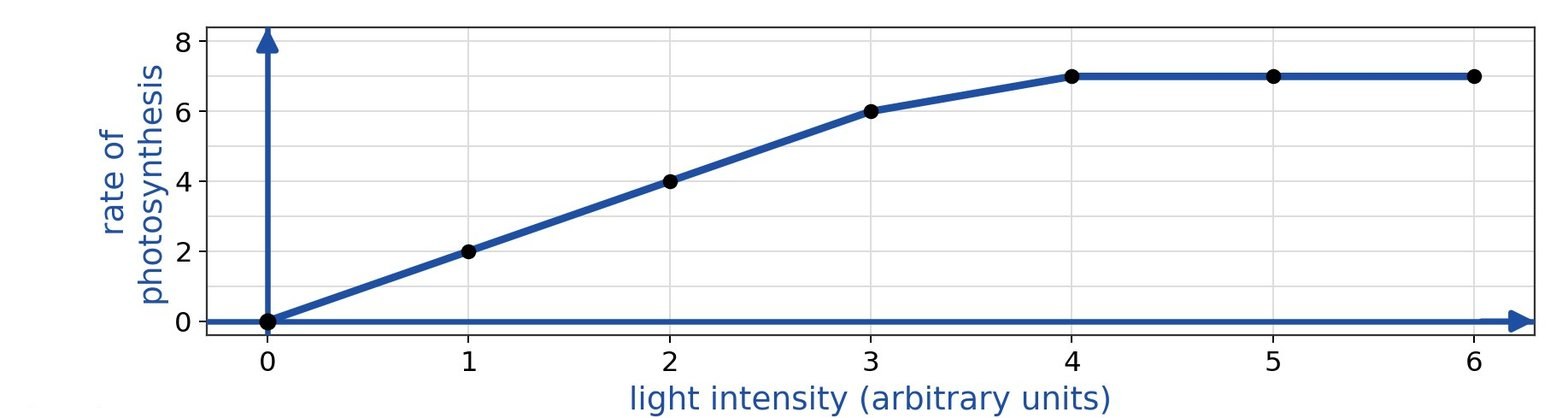
The graph shows the rate of photosynthesis at different light intensities. At which light intensity does the rate first reach its maximum?
A 4 B 3 C 2 D 6
What looks wrong with Question 7?
Send anonymously
Cancel
8
What is a biotic factor?
A a physical factor, like light B a non-living factor, like temperature C a living factor, like a predator D a chemical factor, like pH
What looks wrong with Question 8?
Send anonymously
Cancel
9
A quadrat of area 10 square metres contains on average 8 daisies. Estimate the number of daisies in a field of 100 square metres.
A 40 B 160 C 80 D 800
What looks wrong with Question 9?
Send anonymously
Cancel
10
Where is carbon stored long term?
A in the air as oxygen B in fossil fuels C in rain water D in living organisms only
What looks wrong with Question 10?
Send anonymously
Cancel
11
Why is biodiversity important?
A it makes farming cheaper B it stops all disease C stable ecosystems D it increases crop yields at once
What looks wrong with Question 11?
Send anonymously
Cancel
12
A pondweed plant releases 36 bubbles of oxygen in 3 minutes. How many bubbles does it release per minute?
A 12 B 13 C 24 D 11
What looks wrong with Question 12?
Send anonymously
Cancel
13
A field has 5000 kg of grass. If 10 percent of the energy passes to the rabbits, how much grass biomass supports the rabbits?
A 500 kg B 5000 kg C 1000 kg D 250 kg
What looks wrong with Question 13?
Send anonymously
Cancel
14
What shape is a pyramid of biomass?
A wide at the bottom, narrow at the top B narrow at the bottom, wide at the top C a circle D the same width all the way up
What looks wrong with Question 14?
Send anonymously
Cancel
15
What happens to excess amino acids in the body?
A they are breathed out B they become urea C they are turned into glucose D they are stored as glycogen
What looks wrong with Question 15?
Send anonymously
Cancel
16
Why does increasing temperature increase the rate of photosynthesis, up to a point?
A stomata open wider in the heat B chlorophyll absorbs more light C the plant takes in more water D enzymes work faster
What looks wrong with Question 16?
Send anonymously
Cancel
17
Which factors affect the rate of decay?
A rain, snow and frost only B light, temperature and carbon dioxide C temperature, water and oxygen D soil type, light and wind
What looks wrong with Question 17?
Send anonymously
Cancel
18
What is glucose made into for storage in a plant?
A starch B chlorophyll C cellulose D protein
What looks wrong with Question 18?
Send anonymously
Cancel
19
Producers in a food chain hold 10000 kJ of energy. About 10 percent passes to the primary consumers. How much energy reaches them?
A 2000 kJ B 10000 kJ C 1000 kJ D 500 kJ
What looks wrong with Question 19?
Send anonymously
Cancel
20
What is a quadrat used for?
A to estimate a population B to count every plant exactly C to measure the height of trees D to catch small animals
What looks wrong with Question 20?
Send anonymously
Cancel
21
Producers in a food chain have a biomass of 5000 kg. About 10 per cent of biomass passes to each level. What is the biomass of the secondary consumers?
A 5 B 50 C 500 D 100
What looks wrong with Question 21?
Send anonymously
Cancel
22
A quadrat of area 20 square metres contains on average 8 daisies. Estimate the number of daisies in a field of 200 square metres.
A 80 B 800 C 160 D 40
What looks wrong with Question 22?
Send anonymously
Cancel
23
What is evaporation in the water cycle?
A water freezing on mountains B rain falling on the sea C water running off the land into rivers D water evaporating from seas
What looks wrong with Question 23?
Send anonymously
Cancel
24
What gas is released by photosynthesis?
A hydrogen B nitrogen C carbon dioxide D oxygen
What looks wrong with Question 24?
Send anonymously
Cancel
25
What is a genetically modified crop?
A a crop grown in a greenhouse B a crop grown without any fertiliser C a crop that needs no water D a crop with a useful new gene
What looks wrong with Question 25?
Send anonymously
Cancel