1
A passenger train brakes. What force slows it down?
2
A cup of coffee is hot. How is energy transferred to the air?
3
A wristwatch measures time. What is the unit of time?
4
A thermometer shows a patient's temperature is 39 degrees Celsius. Is this above or below normal body temperature?
5
A yellow school bus is full of children. What is its mass like?
6
A kite is held by a string. What force does the string exert?
7
What is the minimum energy particles need to react called?
8
What is the pressure used in the Haber process?
9
In the disappearing cross experiment, what is timed?
10
A reaction should make 200 g of product but only makes 180 g. What is the percentage yield?
11
In a second experiment, 90 cm cubed of gas are made in 15 seconds. What is the rate of the reaction?
12
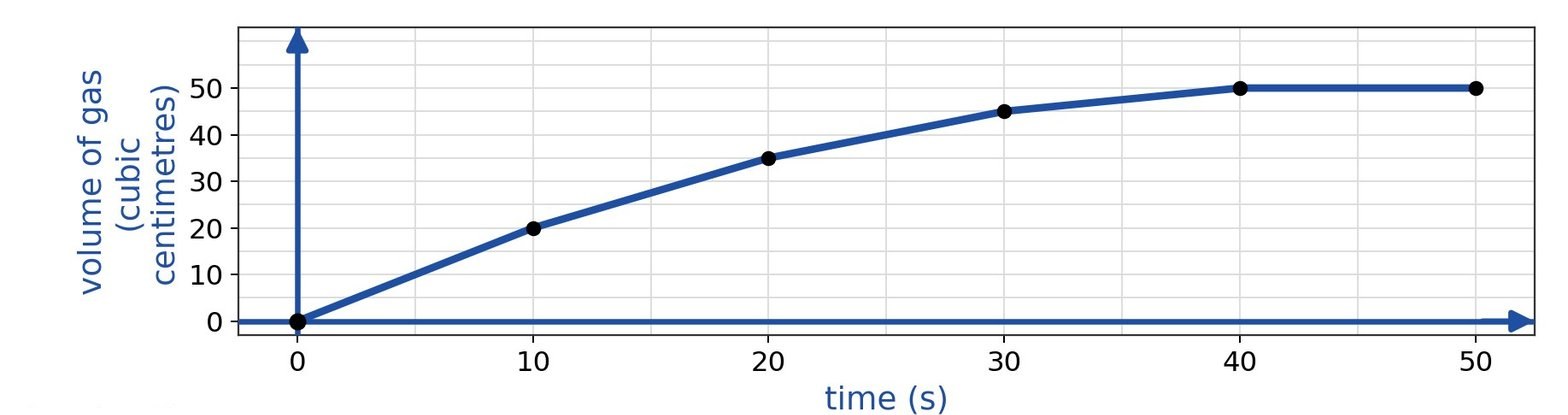
The graph shows the volume of gas made in a reaction. After how many seconds does the reaction finish?
13
In an experiment, 40 cubic centimetres of gas are made in 10 seconds. What is the rate of the reaction?
14
A reaction makes 2 moles of gas. What volume does the gas occupy at room temperature and pressure?
15
A solution has a concentration of 1 mol per cubic decimetre. How many moles are in 2 cubic decimetres of the solution?
16
A reaction produces 20 cm cubed of gas in 20 seconds. What is the mean rate of reaction?
17
Why does a larger surface area increase the rate?
18
Why is iron used as the catalyst in the Haber process?
19
How can the rate of a reaction be measured using a gas syringe?
20
A reaction should make 200 g of product but only makes 100 g. What is the percentage yield?
21
What is a reversible reaction?
22
In an experiment, 20 cubic centimetres of gas are made in 20 seconds. What is the rate of the reaction?
23
A solution has a concentration of 1 mol per cubic decimetre. How many moles are in 3 cubic decimetres of the solution?
24
A reaction produces 60 cm cubed of gas in 20 seconds. What is the mean rate of reaction?
25
What must particles have to react when they collide?