1
A cheese pizza contains cheese made from milk. What is milk rich in?
A calcium B vitamin C C iron D fibre
What looks wrong with Question 1?
Send anonymously
Cancel
2
A cup of coffee is hot. How is energy transferred to the air?
A by evaporation only, from the top B by radiation only, from the surface C by conduction and convection D by condensation on the cold cup
What looks wrong with Question 2?
Send anonymously
Cancel
3
A thermometer is placed in hot water. What happens to the liquid inside the thermometer?
A it evaporates B it expands C it freezes D it contracts
What looks wrong with Question 3?
Send anonymously
Cancel
4
A sandwich is eaten. Which enzyme digests the starch in the bread?
A lipase B protease C amylase D pepsin
What looks wrong with Question 4?
Send anonymously
Cancel
5
A chocolate cake rises in the oven. What makes it rise?
A a gas is made B the egg evaporates C the sugar freezes D the flour melts
What looks wrong with Question 5?
Send anonymously
Cancel
6
An ice cream cone melts in the Sun. What is happening to the particles in the ice cream?
A they gain energy and move more B they get smaller C they lose energy and slow down a lot D they stop moving
What looks wrong with Question 6?
Send anonymously
Cancel
7
In an exothermic reaction, are the products higher or lower in energy than the reactants?
A higher B the same C higher then lower D lower
What looks wrong with Question 7?
Send anonymously
Cancel
8
What happens to the temperature during an exothermic reaction?
A it stays the same B it rises C it falls D it falls then rises
What looks wrong with Question 8?
Send anonymously
Cancel
9
A student heats 100 g of water. Its temperature rises by 10 degrees Celsius. The specific heat capacity of water is 4.2 joules per gram per degree Celsius. How much energy is transferred to the water in kilojoules?
A 0.42 kJ B 42 kJ C 4.2 kJ D 8.4 kJ
What looks wrong with Question 9?
Send anonymously
Cancel
10
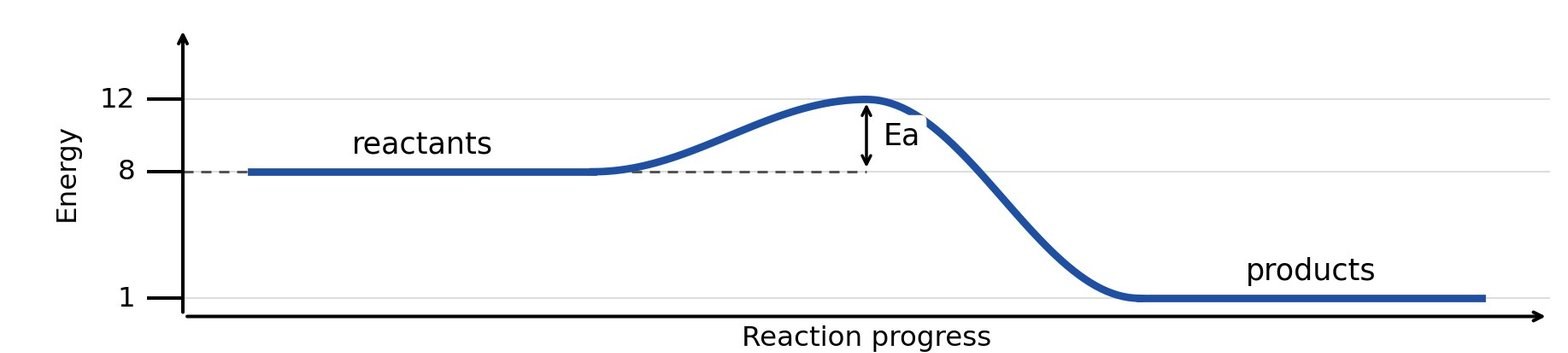
The diagram shows the energy profile for a reaction. The reactants are at energy 8 and the products are at 1. Is the reaction exothermic or endothermic?
A endothermic, energy is taken in B exothermic, energy is given out C endothermic, energy is given out D exothermic, energy is taken in
What looks wrong with Question 10?
Send anonymously
Cancel
11
In the combustion of methane, the energy needed to break the bonds is 1000 kJ and the energy released when new bonds form is 1200 kJ. What is the overall energy change?
A 1200 kJ B 200 kJ C -1000 kJ D -200 kJ
What looks wrong with Question 11?
Send anonymously
Cancel
12
Why does a hand warmer feel hot?
A energy is stored in the chemicals B energy is destroyed by the reaction C energy is taken in from the surroundings D it transfers energy out
What looks wrong with Question 12?
Send anonymously
Cancel
13
In a reaction, the energy needed to break bonds is 800 kJ and the energy released making bonds is 1000 kJ. What is the overall energy change?
A 200 kJ B -200 kJ C -800 kJ D 1000 kJ
What looks wrong with Question 13?
Send anonymously
Cancel
14
What are the reactants in a hydrogen fuel cell?
A hydrogen and nitrogen B hydrogen and oxygen C oxygen and nitrogen D hydrogen and carbon dioxide
What looks wrong with Question 14?
Send anonymously
Cancel
15
What decides the voltage of a chemical cell?
A the metals used B the colour of the metals C the temperature of the room D the size of the cell
What looks wrong with Question 15?
Send anonymously
Cancel
16
In a reaction, the energy needed to break bonds is 1000 kJ and the energy released making bonds is 600 kJ. Is the reaction exothermic or endothermic?
A exothermic, more energy is given out B endothermic, more energy is given out C endothermic, more energy is taken in D exothermic, more energy is taken in
What looks wrong with Question 16?
Send anonymously
Cancel
17
What does the peak of a reaction profile show?
A the activation energy B the energy of the products C the energy given out D the overall energy change
What looks wrong with Question 17?
Send anonymously
Cancel
18
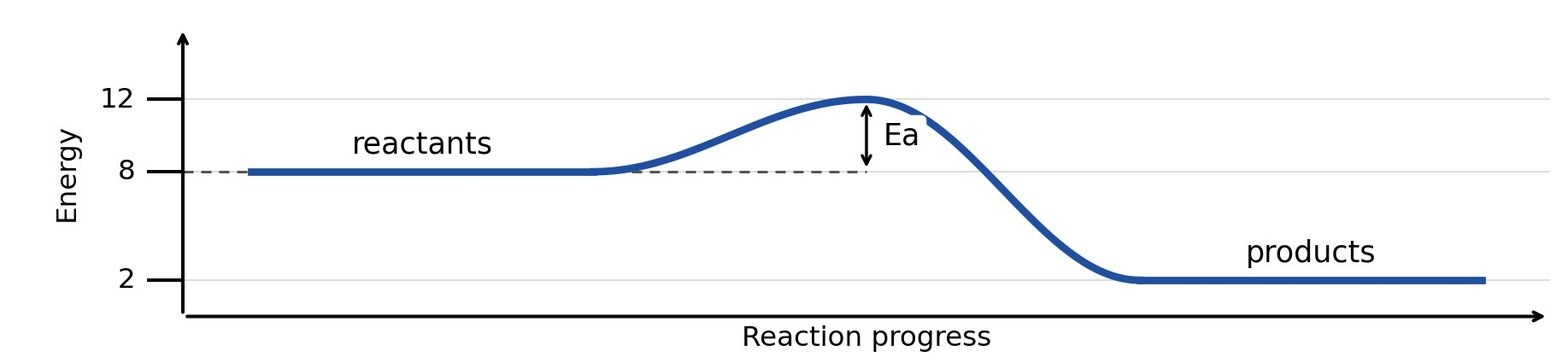
The diagram shows the energy profile for a reaction. The reactants are at energy 8, the peak is at 12 and the products are at 2. What is the activation energy?
A 6 B 4 C 20 D 10
What looks wrong with Question 18?
Send anonymously
Cancel
19
A student heats 100 g of water. Its temperature rises by 5 degrees Celsius. The specific heat capacity of water is 4.2 joules per gram per degree Celsius. How much energy is transferred to the water in kilojoules?
A 2.1 kJ B 21 kJ C 0.21 kJ D 4.2 kJ
What looks wrong with Question 19?
Send anonymously
Cancel
20
In the combustion of methane, the energy needed to break the bonds is 800 kJ and the energy released when new bonds form is 1200 kJ. What is the overall energy change?
A -800 kJ B -400 kJ C 1200 kJ D 400 kJ
What looks wrong with Question 20?
Send anonymously
Cancel
21
What is the temperature change in an exothermic reaction?
A it rises B it becomes zero C it stays the same D it falls
What looks wrong with Question 21?
Send anonymously
Cancel
22
In a reaction, the energy needed to break bonds is 1200 kJ and the energy released making bonds is 1400 kJ. What is the overall energy change?
A 1400 kJ B 200 kJ C -200 kJ D -1200 kJ
What looks wrong with Question 22?
Send anonymously
Cancel
23
Why are hydrogen fuel cells not yet used in most cars?
A hydrogen is hard to store safely B hydrogen fuel cells are too heavy C fuel cells make too much electricity D few places sell hydrogen fuel
What looks wrong with Question 23?
Send anonymously
Cancel
24
In a reaction, the energy needed to break bonds is 1500 kJ and the energy released making bonds is 1100 kJ. Is the reaction exothermic or endothermic?
A exothermic, more energy is given out B endothermic, more energy is taken in C endothermic, more energy is given out D exothermic, more energy is taken in
What looks wrong with Question 24?
Send anonymously
Cancel
25
On a reaction profile, what is the difference between the reactants and the products?
A the overall energy change B the rate of the reaction over time C the temperature change D the activation energy
What looks wrong with Question 25?
Send anonymously
Cancel