1
A sandwich is eaten. Which enzyme digests the starch in the bread?
England GCSE Chemistry OCR Gateway Foundation · Unit 5 · 25 questions
This practice test was made by AI and there may be mistakes. If a question or answer looks wrong, use the Flag a mistake button so it can be fixed.
A sandwich is eaten. Which enzyme digests the starch in the bread?
A wristwatch ticks every second. How many ticks in a minute?
A thermometer shows a patient's temperature is 39 degrees Celsius. Is this above or below normal body temperature?
A cup of coffee is left for an hour. What happens to its temperature?
A chocolate cake is baked. Is baking a chemical change?
A cheese pizza contains cheese made from milk. What is milk rich in?
In a second experiment, 30 cm cubed of gas are made in 30 seconds. What is the rate of the reaction?
A student heats 200 g of water. Its temperature rises by 5 degrees Celsius. The specific heat capacity of water is 4.2 joules per gram per degree Celsius. How much energy is transferred to the water in kilojoules?
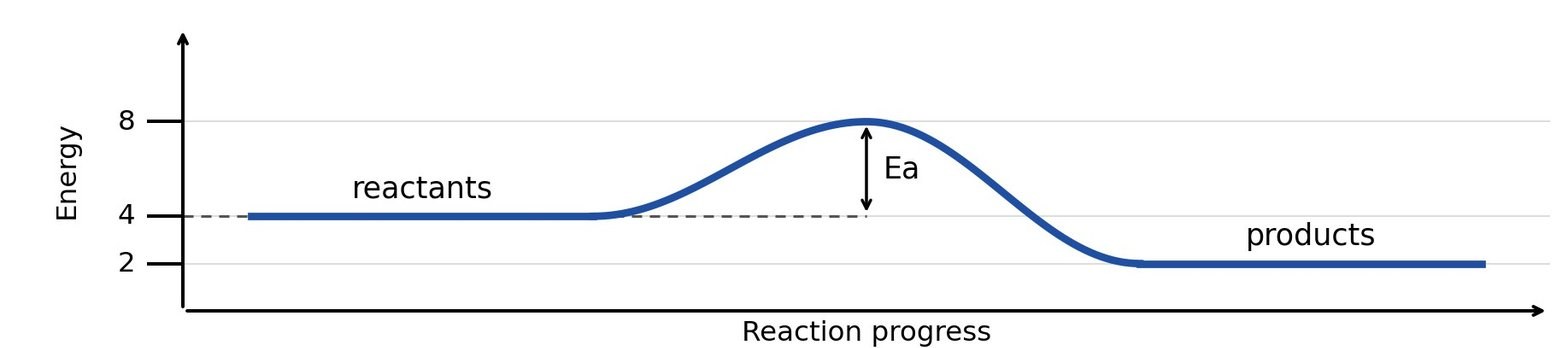
The diagram shows the energy profile for a reaction. The reactants are at energy 4, the peak is at 8 and the products are at 2. What is the activation energy?
In the combustion of methane, the energy needed to break the bonds is 800 kJ and the energy released when new bonds form is 1000 kJ. What is the overall energy change?
A reaction produces 20 cm cubed of gas in 10 seconds. What is the mean rate of reaction?
A reaction should make 200 g of product but only makes 160 g. What is the percentage yield?
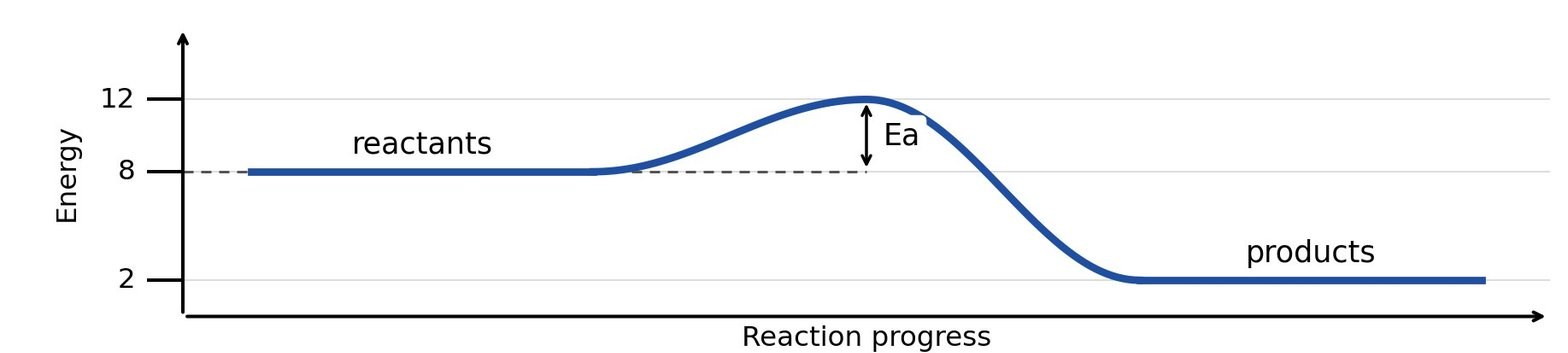
The diagram shows the energy profile for a reaction. The reactants are at energy 8 and the products are at 2. Is the reaction exothermic or endothermic?
What does a temperature change experiment measure?
A reaction makes 2 moles of gas. What volume does the gas occupy at room temperature and pressure?
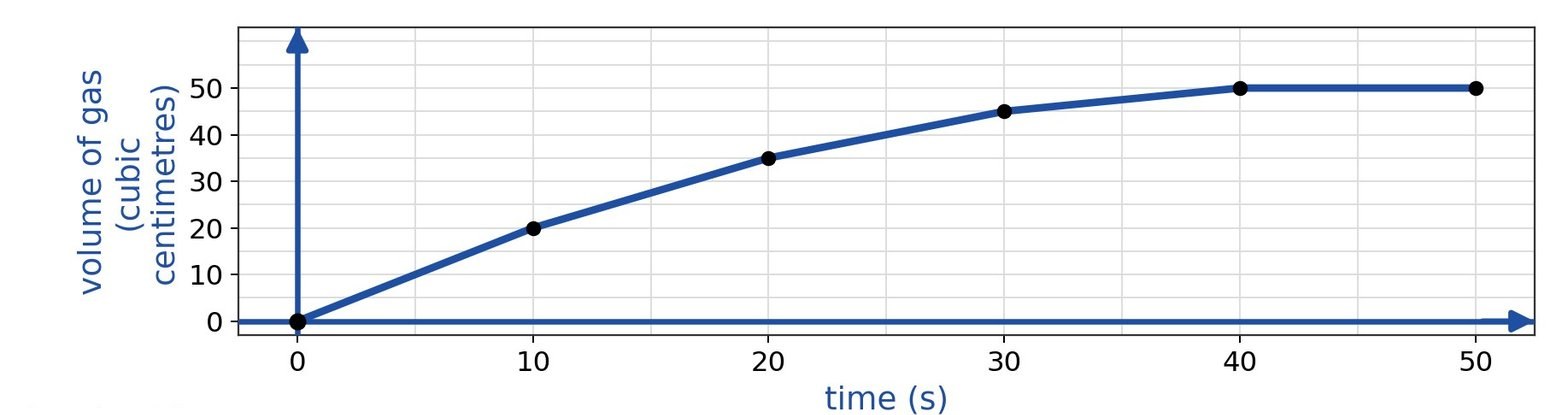
The graph shows the volume of gas made in a reaction. After how many seconds does the reaction finish?
Why does a higher concentration increase the rate?
In an experiment, 60 cubic centimetres of gas are made in 10 seconds. What is the rate of the reaction?
Why is the mass of a reaction flask measured on a balance?
A solution has a concentration of 2 mol per cubic decimetre. How many moles are in 3 cubic decimetres of the solution?
Which of these is exothermic?
In a second experiment, 50 cm cubed of gas are made in 15 seconds. What is the rate of the reaction?
In the combustion of methane, the energy needed to break the bonds is 1000 kJ and the energy released when new bonds form is 1200 kJ. What is the overall energy change?
A reaction produces 40 cm cubed of gas in 20 seconds. What is the mean rate of reaction?
A reaction should make 100 g of product but only makes 80 g. What is the percentage yield?
Your score: 0 / 25