1
Glass marbles are shaken in a tray. What does this model?
A particles disappearing completely B particles gaining energy C particles freezing into place D particles bonding together
What looks wrong with Question 1?
Send anonymously
Cancel
2
A hot air balloon cools down. What happens?
A it stays still B it bursts C it rises faster D it sinks
What looks wrong with Question 2?
Send anonymously
Cancel
3
A chocolate cake is baked. Is baking a chemical change?
A sometimes B no C never D yes
What looks wrong with Question 3?
Send anonymously
Cancel
4
Lemons taste sour. What does sour taste show?
A an acid is present B an alkali is present C a salt is present D a metal is present
What looks wrong with Question 4?
Send anonymously
Cancel
5
A thermometer shows a patient's temperature is 39 degrees Celsius. Is this above or below normal body temperature?
A exactly normal B below normal C impossible to tell D above normal
What looks wrong with Question 5?
Send anonymously
Cancel
6
A forest is cut down. What happens to the carbon stored in the trees?
A it turns to oxygen B it disappears C it is released D it is stored forever
What looks wrong with Question 6?
Send anonymously
Cancel
7
Why do isotopes of the same element have the same chemical properties?
A they have the same mass number B they have the same number of electrons C they have the same number of neutrons in the nucleus D they have the same density always
What looks wrong with Question 7?
Send anonymously
Cancel
8
What type of bonding is in diamond?
A intermolecular forces B ionic C covalent D metallic
What looks wrong with Question 8?
Send anonymously
Cancel
9
The maximum possible mass of product is 20 g. A student makes 16 g. What is the percentage yield?
A 80% B 70% C 160% D 90%
What looks wrong with Question 9?
Send anonymously
Cancel
10
What does a more reactive metal do to the oxide of a less reactive metal?
A it gives oxygen to the oxide B it turns it into a gas C it takes the oxygen away D it does nothing at all
What looks wrong with Question 10?
Send anonymously
Cancel
11
A student heats 200 g of water. Its temperature rises by 5 degrees Celsius. The specific heat capacity of water is 4.2 joules per gram per degree Celsius. How much energy is transferred to the water in kilojoules?
A 8.4 kJ B 0.42 kJ C 42 kJ D 4.2 kJ
What looks wrong with Question 11?
Send anonymously
Cancel
12
Oxygen is 21 percent of the air. How much oxygen is there in 100 litres of air?
A 31 L B 21 L C 42 L D 11 L
What looks wrong with Question 12?
Send anonymously
Cancel
13
A thermometer measures temperature in degrees Celsius. What is the freezing point of water on this scale?
A 10 B 0 C 100 D 32
What looks wrong with Question 13?
Send anonymously
Cancel
14
What does adding carbon to iron do?
A it makes it melt more easily B it makes it conduct less heat C it makes it softer and weaker D it makes it harder
What looks wrong with Question 14?
Send anonymously
Cancel
15
Will iron displace copper from its salt solution?
A yes B only with a catalyst C no D only when heated
What looks wrong with Question 15?
Send anonymously
Cancel
16
What is a reversible reaction?
A a reaction that needs a catalyst B a reaction that makes two products C a reaction that never finishes D a reaction that can go both ways
What looks wrong with Question 16?
Send anonymously
Cancel
17
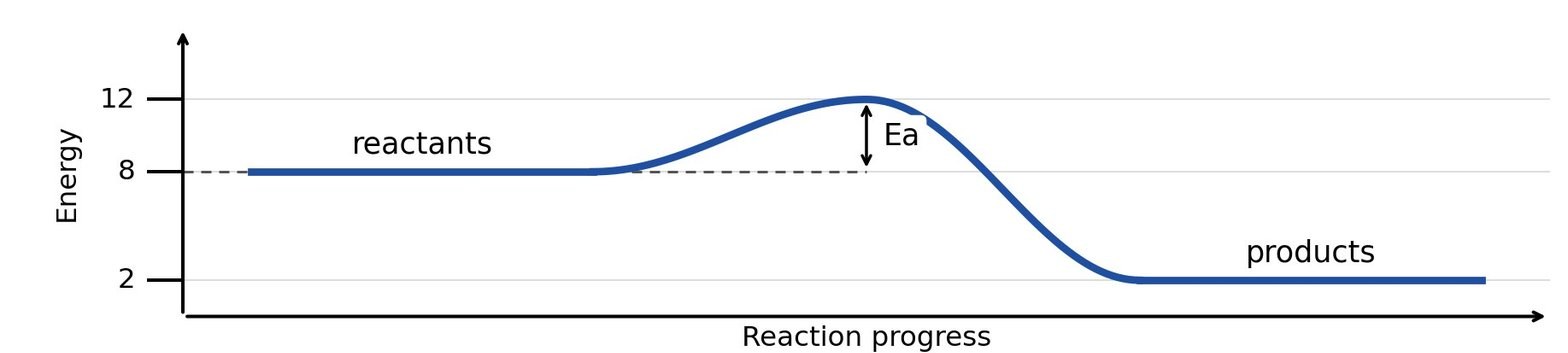
The diagram shows the energy profile for a reaction. The reactants are at energy 8 and the products are at 2. Is the reaction exothermic or endothermic?
A endothermic, energy is given out B exothermic, energy is taken in C exothermic, energy is given out D endothermic, energy is taken in
What looks wrong with Question 17?
Send anonymously
Cancel
18
Nitrogen is 78 percent of the air. How much nitrogen is there in 100 litres of air?
A 156 L B 88 L C 68 L D 78 L
What looks wrong with Question 18?
Send anonymously
Cancel
19
An atom has 17 protons and 6 neutrons. What is its mass number?
A 23 B 17 C 25 D 6
What looks wrong with Question 19?
Send anonymously
Cancel
20
The diagram shows a water molecule. How many lone pairs of electrons does the oxygen atom have?
A 4 B 2 C 3 D 1
What looks wrong with Question 20?
Send anonymously
Cancel
21
What do acids produce in water?
A oxygen B chloride ions C hydrogen ions D hydroxide ions
What looks wrong with Question 21?
Send anonymously
Cancel
22
A metal is added to a salt solution and no reaction happens. What does that tell you?
A the salt is not soluble B the metal is less reactive than the metal in the salt C the metal is a gas D the metal is more reactive than the metal in the salt
What looks wrong with Question 22?
Send anonymously
Cancel
23
In an experiment, 60 cubic centimetres of gas are made in 10 seconds. What is the rate of the reaction?
A 12 cm³/s B 600 cm³/s C 3 cm³/s D 6 cm³/s
What looks wrong with Question 23?
Send anonymously
Cancel
24
A factory emits 50 tonnes of carbon dioxide per day. How much does it emit in one week?
A 700 tonnes B 360 tonnes C 350 tonnes D 340 tonnes
What looks wrong with Question 24?
Send anonymously
Cancel
25
What is the electronic structure of oxygen (atomic number 8)?
A 2,6 B 2,7 C 2,8 D 2,4
What looks wrong with Question 25?
Send anonymously
Cancel
26
In a chromatogram, a spot moves 2 cm and the solvent moves 10 cm. What is the Rf value?
A 0.2 B 0.35 C 0.3 D 0.4
What looks wrong with Question 26?
Send anonymously
Cancel
27
What gas is made at the anode when brine is electrolysed?
A hydrogen B oxygen C nitrogen D chlorine
What looks wrong with Question 27?
Send anonymously
Cancel
28
How can you tell that carbon dioxide is made in a reaction?
A limewater turns cloudy B a squeaky pop is heard C a yellow flame is seen D a glowing splint relights
What looks wrong with Question 28?
Send anonymously
Cancel
29
In the combustion of methane, the energy needed to break the bonds is 1000 kJ and the energy released when new bonds form is 1200 kJ. What is the overall energy change?
A -200 kJ B -1000 kJ C 200 kJ D 1200 kJ
What looks wrong with Question 29?
Send anonymously
Cancel
30
A cup of coffee is hot. How is energy transferred to the air?
A by conduction and convection B by condensation on the cold cup C by radiation only, from the surface D by evaporation only, from the top
What looks wrong with Question 30?
Send anonymously
Cancel
31
An atom of oxygen gains 2 electrons. What is the charge on the ion formed?
A 0 B -2 C +2 D -1
What looks wrong with Question 31?
Send anonymously
Cancel
32
How many spots does a pure substance give on a chromatogram?
A one spot B two spots side by side C three spots in a row D no spots at all
What looks wrong with Question 32?
Send anonymously
Cancel
33
A chocolate cake rises in the oven. What makes it rise?
A the flour melts B a gas is made C the egg evaporates D the sugar freezes
What looks wrong with Question 33?
Send anonymously
Cancel
34
What gas is made when magnesium reacts with dilute acid?
A oxygen B carbon dioxide C hydrogen D chlorine
What looks wrong with Question 34?
Send anonymously
Cancel
35
What does a steep graph of gas volume against time show?
A a slow rate of reaction B a reaction that has finished C a fast rate of reaction D a reaction with no gas made
What looks wrong with Question 35?
Send anonymously
Cancel
36
Why is stainless steel used for cutlery?
A it is magnetic and light B it is very soft to shape C it is very cheap to make D it does not rust
What looks wrong with Question 36?
Send anonymously
Cancel
37
An atom has 8 protons and 10 neutrons. What is its mass number?
A 20 B 18 C 10 D 8
What looks wrong with Question 37?
Send anonymously
Cancel
A solid blocks of carbon atoms B flat sheets of carbon one atom thick C molecules of carbon in hollow shapes D long chains of carbon atoms in a row
What looks wrong with Question 38?
Send anonymously
Cancel
39
What decides the voltage of a chemical cell?
A the colour of the metals B the temperature of the room C the metals used D the size of the cell
What looks wrong with Question 39?
Send anonymously
Cancel
40
A cup of coffee is left for an hour. What happens to its temperature?
A it falls to room temperature B it falls to zero degrees C it rises above room temperature D it stays the same all day
What looks wrong with Question 40?
Send anonymously
Cancel
41
A solution has a concentration of 2 mol per cubic decimetre. How many moles are in 2 cubic decimetres of the solution?
A 3 mol B 5 mol C 4 mol D 8 mol
What looks wrong with Question 41?
Send anonymously
Cancel
42
What is one piece of evidence for climate change?
A the Moon is getting closer B global temperatures are rising C volcanoes are erupting more D the Sun is getting brighter each year
What looks wrong with Question 42?
Send anonymously
Cancel
43
What was Thomson's plum pudding model?
A a cloud of electrons with no centre B a small nucleus with shells around it C a tiny solid ball that cannot be divided at all D a ball of positive charge with electrons in it
What looks wrong with Question 43?
Send anonymously
Cancel
44
In a chromatogram, a spot moves 4 cm and the solvent moves 12 cm. What is the Rf value?
A 0.67 B 0.33 C 0.48 D 0.43
What looks wrong with Question 44?
Send anonymously
Cancel
45
What forms at the cathode during the electrolysis of copper sulfate solution?
A lead B bromine C copper D hydrogen
What looks wrong with Question 45?
Send anonymously
Cancel
46
Lemons contain citric acid. What is the pH of lemon juice likely to be?
A 14 B 12 C 2 D 7
What looks wrong with Question 46?
Send anonymously
Cancel
47
In a second experiment, 50 cm cubed of gas are made in 30 seconds. What is the rate of the reaction?
A 1.6667 cm³/s B 3.1667 cm³/s C 2.1667 cm³/s D 1.1667 cm³/s
What looks wrong with Question 47?
Send anonymously
Cancel
48
A forest absorbs carbon dioxide. Which process does this?
A combustion of the wood B decomposition in the soil C respiration in the trees D photosynthesis
What looks wrong with Question 48?
Send anonymously
Cancel
49
Which element has the electronic structure 2,8,1?
A chlorine, which has seven outer electrons B magnesium, which has two outer electrons C argon, which has a full outer shell D sodium
What looks wrong with Question 49?
Send anonymously
Cancel
50
Glass marbles are used to model atoms. What is a limitation of the model?
A marbles are much bigger than atoms B marbles cannot be counted accurately at all C marbles are the wrong colour for atoms D marbles are too small to see properly
What looks wrong with Question 50?
Send anonymously
Cancel