1
A castle built of limestone is damaged by acid rain. Which gas causes acid rain?
A carbon dioxide
B nitrogen
C sulfur dioxide
D oxygen
What looks wrong with Question 1?
Send anonymously
Cancel
2
Lemons taste sour. What does sour taste show?
A an acid is present
B a salt is present
C a metal is present
D an alkali is present
What looks wrong with Question 2?
Send anonymously
Cancel
3
A school lunch tray holds a meal. Why do we need food?
A to feel full after eating
B for energy and growth
C for fun only, not for health
D to stay awake at night
What looks wrong with Question 3?
Send anonymously
Cancel
4
A chocolate cake is baked. Is baking a chemical change?
A never
B no
C yes
D sometimes
What looks wrong with Question 4?
Send anonymously
Cancel
5
Paintbrushes are used with paint. What is paint an example of?
A a formulation
B a pure substance
C a compound
D an element
What looks wrong with Question 5?
Send anonymously
Cancel
6
Silver coins are made of the element silver. What is the chemical symbol for silver?
A Si
B S
C Sv
D Ag
What looks wrong with Question 6?
Send anonymously
Cancel
7
A solution has a hydrogen ion concentration of 10⁻³mol per cubic decimetre. What is its pH?
A 5
B 3
C 4
D 2
What looks wrong with Question 7?
Send anonymously
Cancel
8
A solution has a concentration of 2 mol per cubic decimetre. How many moles are in 2 cubic decimetres of the solution?
A 8 mol
B 3 mol
C 5 mol
D 4 mol
What looks wrong with Question 8?
Send anonymously
Cancel
9
A student heats 50 g of water. Its temperature rises by 10 degrees Celsius. The specific heat capacity of water is 4.2 joules per gram per degree Celsius. How much energy is transferred to the water in kilojoules?
A 0.21 kJ
B 21 kJ
C 4.2 kJ
D 2.1 kJ
What looks wrong with Question 9?
Send anonymously
Cancel
10
How many moles are there in 80 g of a substance with a relative formula mass of 20 ?
A 8
B 2
C 12
D 4
What looks wrong with Question 10?
Send anonymously
Cancel
11
How can the rate of a reaction be measured using a gas syringe?
A by counting the bubbles
B by weighing the gas syringe
C by timing the gas collected
D by measuring the temperature
What looks wrong with Question 11?
Send anonymously
Cancel
12
In a reaction, 10 g of A reacts with 6 g of B. What mass of product is made?
A 6 g
B 4 g
C 10 g
D 16 g
What looks wrong with Question 12?
Send anonymously
Cancel
13
What is the relative formula mass of calcium oxide, CaO?
A 52
B 112
C 56
D 64
What looks wrong with Question 13?
Send anonymously
Cancel
14
A reaction produces 60 cm cubed of gas in 10 seconds. What is the mean rate of reaction?
A 6 cm³/s
B 12 cm³/s
C 5.5 cm³/s
D 6.5 cm³/s
What looks wrong with Question 14?
Send anonymously
Cancel
15
Why does a higher concentration increase the rate?
A collisions happen more often
B the activation energy falls a lot
C particles get bigger
D particles move faster
What looks wrong with Question 15?
Send anonymously
Cancel
16
In an experiment, 40 cubic centimetres of gas are made in 10 seconds. What is the rate of the reaction?
A 8 cm³/s
B 4 cm³/s
C 400 cm³/s
D 2 cm³/s
What looks wrong with Question 16?
Send anonymously
Cancel
17
A reaction should make 200 g of product but only makes 160 g. What is the percentage yield?
A 160%
B 90%
C 70%
D 80%
What looks wrong with Question 17?
Send anonymously
Cancel
18
A reaction makes 30 g of useful product from 50 g of reactants in total. What is the atom economy?
A 30%
B 60%
C 120%
D 180%
What looks wrong with Question 18?
Send anonymously
Cancel
19
How many moles are there in 24 g of a substance with a relative formula mass of 40?
A 0.3
B 1.8
C 1.2
D 0.6
What looks wrong with Question 19?
Send anonymously
Cancel
20
A reaction makes 1 moles of gas. What volume does the gas occupy at room temperature and pressure?
A 12 dm³
B 36 dm³
C 24 dm³
D 48 dm³
What looks wrong with Question 20?
Send anonymously
Cancel
21
Which acid makes a sulfate salt?
A hydrochloric acid
B ethanoic acid
C sulfuric acid
D nitric acid
What looks wrong with Question 21?
Send anonymously
Cancel
22
What do NPK fertilisers contain?
A nitrogen, potassium and sulfur
B nitrogen, phosphorus and calcium together
C phosphorus, potassium and iron
D nitrogen, phosphorus and potassium
What looks wrong with Question 22?
Send anonymously
Cancel
23
What is the mass of 5 moles of a substance with a relative formula mass of 20?
A 200 g
B 110 g
C 100 g
D 50 g
What looks wrong with Question 23?
Send anonymously
Cancel
24
What happens to equilibrium if the temperature rises?
A it moves to take in heat
B the reaction stops
C it moves to give out heat
D it stays in the same place
What looks wrong with Question 24?
Send anonymously
Cancel
25
The graph shows the volume of gas made in a reaction. After how many seconds does the reaction finish?
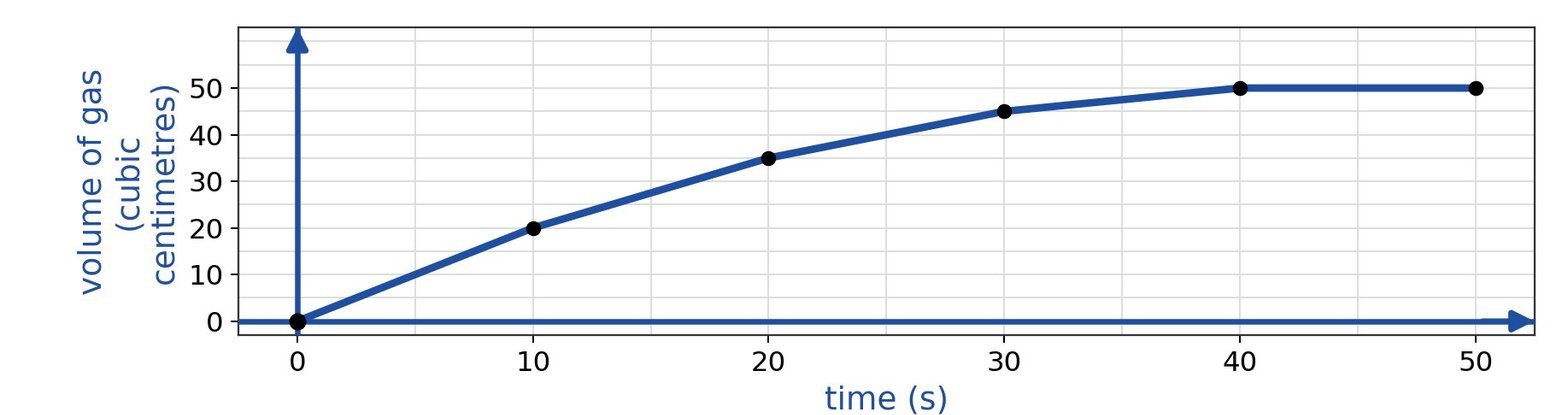
A 40
B 20
C 30
D 50
What looks wrong with Question 25?
Send anonymously
Cancel