1
A cup of coffee is left for an hour. What happens to its temperature?
A it rises above room temperature B it falls to room temperature C it falls to zero degrees D it stays the same all day
What looks wrong with Question 1?
Send anonymously
Cancel
2
An ice cream cone melts in the Sun. What is happening to the particles in the ice cream?
A they get smaller B they gain energy and move more C they lose energy and slow down a lot D they stop moving
What looks wrong with Question 2?
Send anonymously
Cancel
3
How do humans increase carbon dioxide?
A by recycling waste B by planting trees C by using solar power to make electricity D by burning fossil fuels
What looks wrong with Question 3?
Send anonymously
Cancel
4
How do scientists know carbon dioxide levels are rising?
A they measure the air B they weigh the oceans C they measure the sunlight D they count the trees
What looks wrong with Question 4?
Send anonymously
Cancel
5
Oxygen is 21 percent of the air. How much oxygen is there in 500 litres of air?
A 210 L B 115 L C 95 L D 105 L
What looks wrong with Question 5?
Send anonymously
Cancel
6
A river provides drinking water. Why must the water be treated before drinking?
A to add minerals for health B to make it taste better for drinking C to heat it up for use D to remove harmful substances
What looks wrong with Question 6?
Send anonymously
Cancel
7
A swimming pool is filled with water. What is the density of water?
A about 1 kilogram per cubic metre B about 100 kilograms per cubic metre, roughly C about 10 kilograms per cubic metre D about 1000 kilograms per cubic metre
What looks wrong with Question 7?
Send anonymously
Cancel
8
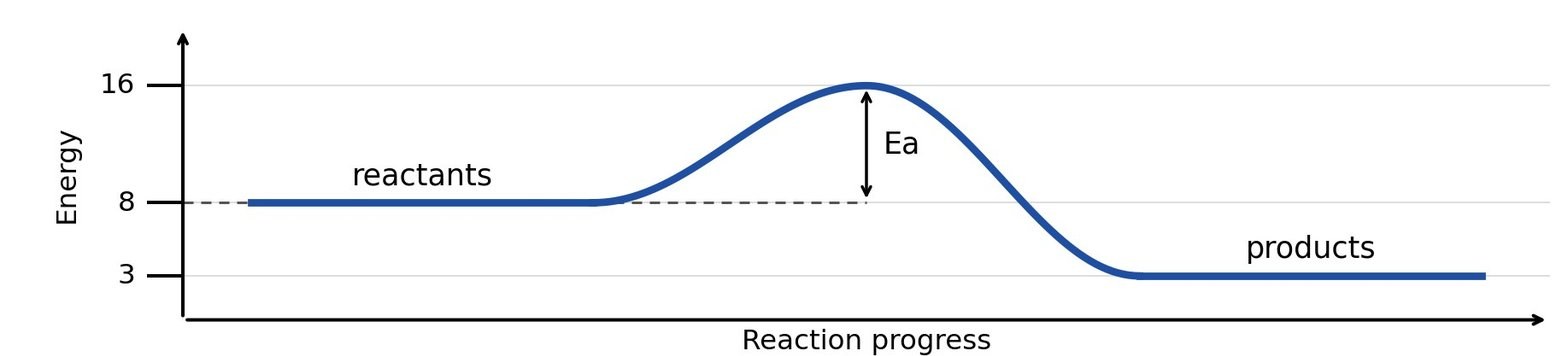
The diagram shows the energy profile for a reaction. The reactants are at energy 8, the peak is at 16 and the products are at 3. What is the activation energy?
A 13 B 24 C 5 D 8
What looks wrong with Question 8?
Send anonymously
Cancel
9
What did volcanoes release into the early atmosphere?
A oxygen and nitrogen gases from the air B argon and helium gases from deep down C nitrogen and oxygen gases from the air D water vapour and carbon dioxide
What looks wrong with Question 9?
Send anonymously
Cancel
10
What is the first step in treating water?
A adding fluoride B chlorination C filtration D boiling
What looks wrong with Question 10?
Send anonymously
Cancel