1
A cup of coffee cools down. Energy is transferred to the surroundings. What type of change is this?
A a reversible reaction B a neutralisation C an energy transfer D a chemical change
What looks wrong with Question 1?
Send anonymously
Cancel
2
Lemons taste sour. What does sour taste show?
A an alkali is present B an acid is present C a salt is present D a metal is present
What looks wrong with Question 2?
Send anonymously
Cancel
3
A thermometer shows a patient's temperature is 39 degrees Celsius. Is this above or below normal body temperature?
A below normal B above normal C impossible to tell D exactly normal
What looks wrong with Question 3?
Send anonymously
Cancel
4
A river flows to the sea. What is this part of?
A the water cycle B the carbon cycle C the rock cycle D the nitrogen cycle
What looks wrong with Question 4?
Send anonymously
Cancel
5
A castle built of limestone is damaged by acid rain. Which gas causes acid rain?
A carbon dioxide B oxygen C sulfur dioxide D nitrogen
What looks wrong with Question 5?
Send anonymously
Cancel
6
A school lunch tray holds a meal with milk. Which nutrient is milk rich in?
A fibre B iron C calcium D vitamin C
What looks wrong with Question 6?
Send anonymously
Cancel
7
What is the main gas in the air today?
A argon B carbon dioxide C oxygen D nitrogen
What looks wrong with Question 7?
Send anonymously
Cancel
8
Which of these is a simple covalent molecule?
A NaCl B MgO C CaCl₂ D CO₂
What looks wrong with Question 8?
Send anonymously
Cancel
9
What is the formula of ethene?
A C₃H₆ B CH₄ C C₂H₄ D C₂H₆
What looks wrong with Question 9?
Send anonymously
Cancel
10
Why do different dyes have different Rf values?
A they are all the same colour B they have the same solubility in the solvent C they move at the same speed D they dissolve differently in the solvent
What looks wrong with Question 10?
Send anonymously
Cancel
11
Why is an indicator used in a titration?
A to show the end B to cool the mixture C to colour the acid D to heat the mixture
What looks wrong with Question 11?
Send anonymously
Cancel
12
A reaction makes 3 moles of gas. What volume does the gas occupy at room temperature and pressure?
A 60 dm³ B 84 dm³ C 72 dm³ D 144 dm³
What looks wrong with Question 12?
Send anonymously
Cancel
13
A swimming pool holds water. Why does a person float in the pool?
A their density is close to water B the water pushes them down C they are heavier than water and sink D they are made of air
What looks wrong with Question 13?
Send anonymously
Cancel
14
What is the charge on a chloride ion?
A Cl²⁻ B Cl⁻ C Cl⁺ D Cl
What looks wrong with Question 14?
Send anonymously
Cancel
15
What is condensation polymerisation?
A polymers break into small molecules B monomers burn to make a polymer C monomers join with nothing lost at all ever D monomers join and lose a small molecule
What looks wrong with Question 15?
Send anonymously
Cancel
16
An alloy is 75 percent copper. How much copper is in 400 kg of the alloy?
A 325 kg B 275 kg C 600 kg D 300 kg
What looks wrong with Question 16?
Send anonymously
Cancel
17
What is seen when sodium hydroxide is added to aluminium chloride solution?
A a brown precipitate forms at once B a white precipitate C a blue precipitate forms at once D a green precipitate forms at once
What looks wrong with Question 17?
Send anonymously
Cancel
18
A student heats 200 g of water. Its temperature rises by 5 degrees Celsius. The specific heat capacity of water is 4.2 joules per gram per degree Celsius. How much energy is transferred to the water in kilojoules?
A 0.42 kJ B 42 kJ C 8.4 kJ D 4.2 kJ
What looks wrong with Question 18?
Send anonymously
Cancel
19
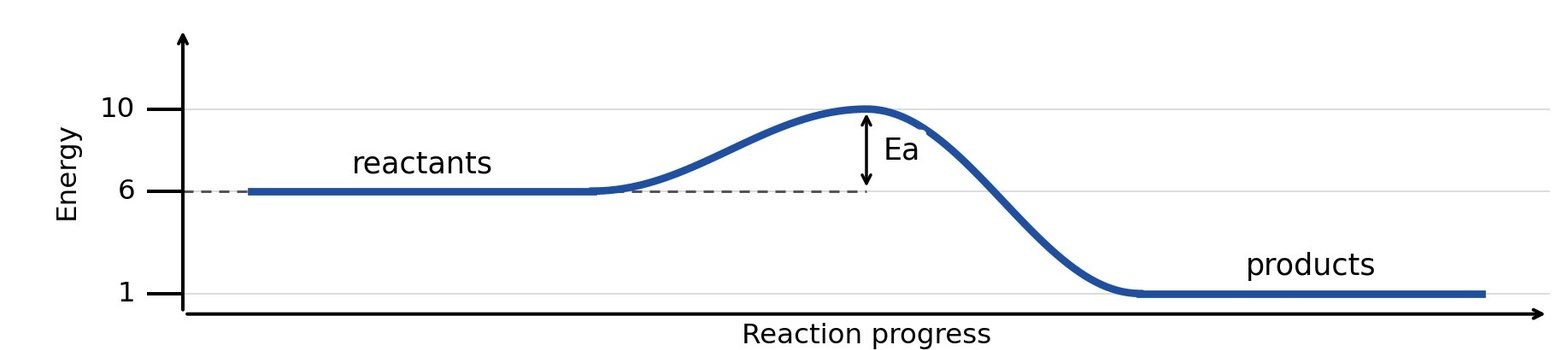
The diagram shows the energy profile for a reaction. The reactants are at energy 6 and the products are at 1. Is the reaction exothermic or endothermic?
A exothermic, energy is taken in B endothermic, energy is given out C exothermic, energy is given out D endothermic, energy is taken in
What looks wrong with Question 19?
Send anonymously
Cancel
20
The diagram shows an ammonia molecule. How many covalent bonds does the nitrogen atom form?
A 4 B 3 C 1 D 2
What looks wrong with Question 20?
Send anonymously
Cancel
21
What is made when ethanoic acid reacts with a carbonate?
A a salt and oxygen gas only in the test B a salt and hydrogen gas only in the test C water and hydrogen gas only in the test D a salt, water and carbon dioxide
What looks wrong with Question 21?
Send anonymously
Cancel
22
In a chromatogram, a spot moves 3 cm and the solvent moves 8 cm. What is the Rf value?
A 0.75 B 0.38 C 0.53 D 0.47
What looks wrong with Question 22?
Send anonymously
Cancel
23
How can you test for hydrogen gas?
A a lighted splint pops B limewater turns cloudy C a glowing splint relights D a damp litmus paper
What looks wrong with Question 23?
Send anonymously
Cancel
24
A reaction should make 100 g of product but only makes 90 g. What is the percentage yield?
A 90% B 180% C 100% D 80%
What looks wrong with Question 24?
Send anonymously
Cancel
25
A factory emits 10 tonnes of carbon dioxide per day. How much does it emit in one week?
A 70 tonnes B 60 tonnes C 80 tonnes D 140 tonnes
What looks wrong with Question 25?
Send anonymously
Cancel
26
The diagram shows a water molecule. How many lone pairs of electrons does the oxygen atom have?
A 4 B 2 C 1 D 3
What looks wrong with Question 26?
Send anonymously
Cancel
27
What is made at the negative electrode in aluminium extraction?
A oxygen gas from the air B carbon dioxide gas C cryolite from the mixture D aluminium
What looks wrong with Question 27?
Send anonymously
Cancel
28
What is chromatography used for in the food industry?
A making food taste better B checking dyes in food C heating food more quickly D keeping food cold longer
What looks wrong with Question 28?
Send anonymously
Cancel
29
What is the filtrate in filtration?
A the filter paper B the liquid collected C the funnel D the solid left behind
What looks wrong with Question 29?
Send anonymously
Cancel
30
Which acid makes a sulfate salt?
A ethanoic acid B nitric acid C hydrochloric acid D sulfuric acid
What looks wrong with Question 30?
Send anonymously
Cancel
31
In the combustion of methane, the energy needed to break the bonds is 1000 kJ and the energy released when new bonds form is 1400 kJ. What is the overall energy change?
A -400 kJ B -1000 kJ C 400 kJ D 1400 kJ
What looks wrong with Question 31?
Send anonymously
Cancel
32
An atom of sodium loses 1 electron. What is the charge on the ion formed?
A 0 B +2 C +1 D -1
What looks wrong with Question 32?
Send anonymously
Cancel
33
What is the overall equation for a hydrogen fuel cell?
A oxygen plus water makes hydrogen B hydrogen plus nitrogen makes ammonia C hydrogen plus oxygen makes water D hydrogen plus oxygen makes carbon dioxide
What looks wrong with Question 33?
Send anonymously
Cancel
34
Which stage of a life cycle assessment covers digging up raw materials?
A use B disposal C extraction D manufacture
What looks wrong with Question 34?
Send anonymously
Cancel
35
What colour flame does sodium give?
A yellow B red C blue D bright green
What looks wrong with Question 35?
Send anonymously
Cancel
36
A solution has 10 g of salt in 2 cubic decimetres of water. What is its concentration?
A 5 g/dm³ B 12 g/dm³ C 2 g/dm³ D 20 g/dm³
What looks wrong with Question 36?
Send anonymously
Cancel
37
In the combustion of methane, the energy needed to break the bonds is 1000 kJ and the energy released when new bonds form is 1200 kJ. What is the overall energy change?
A -1000 kJ B -200 kJ C 200 kJ D 1200 kJ
What looks wrong with Question 37?
Send anonymously
Cancel
38
What is the electronic structure of magnesium (atomic number 12)?
A 2,8,2 B 2,8,8 C 2,8,1 D 2,7,3
What looks wrong with Question 38?
Send anonymously
Cancel
39
An alkane has 6 carbon atoms. How many hydrogen atoms does one molecule have?
A 12 B 14 C 16 D 10
What looks wrong with Question 39?
Send anonymously
Cancel
40
In chromatography, what is the stationary phase?
A the solvent B the spots C the ruler D the paper
What looks wrong with Question 40?
Send anonymously
Cancel
41
What colour flame does potassium give in a flame test?
A green B lilac C yellow D brick red
What looks wrong with Question 41?
Send anonymously
Cancel
42
How many moles are there in 20 g of a substance with a relative formula mass of 20 ?
A 2 B 0.5 C 1 D 3
What looks wrong with Question 42?
Send anonymously
Cancel
43
How do scientists know carbon dioxide levels are rising?
A they measure the air B they weigh the oceans C they measure the sunlight D they count the trees
What looks wrong with Question 43?
Send anonymously
Cancel
44
What did Mendeleev predict about the gaps in his table?
A the gaps would stay empty for ever B new groups would appear in the gaps one day C elements would be found to fill them D the table would need to be remade
What looks wrong with Question 44?
Send anonymously
Cancel
45
A river provides drinking water. Why must the water be treated before drinking?
A to heat it up for use B to make it taste better for drinking C to add minerals for health D to remove harmful substances
What looks wrong with Question 45?
Send anonymously
Cancel
46
In a chromatogram, a spot moves 2 cm and the solvent moves 10 cm. What is the Rf value?
A 0.3 B 0.2 C 0.35 D 0.4
What looks wrong with Question 46?
Send anonymously
Cancel
47
Silver coins are made of a metal. Which property do metals have?
A they dissolve in water B they do not conduct electricity at all C they conduct electricity D they are brittle
What looks wrong with Question 47?
Send anonymously
Cancel
48
How many moles of gas occupy 96 cubic decimetres at room temperature and pressure?
A 3 B 4 C 5 D 8
What looks wrong with Question 48?
Send anonymously
Cancel
49
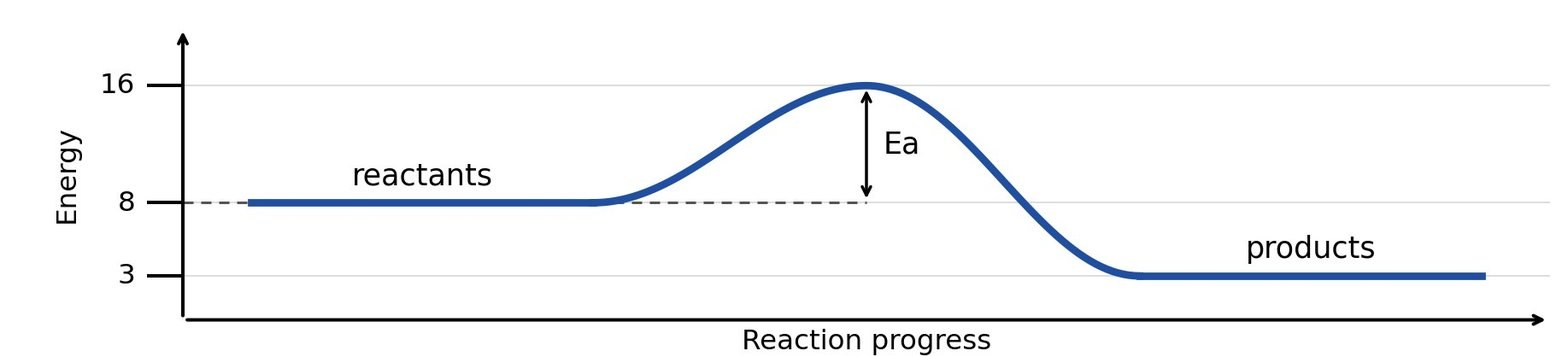
The diagram shows the energy profile for a reaction. The reactants are at energy 8, the peak is at 16 and the products are at 3. What is the activation energy?
A 13 B 24 C 5 D 8
What looks wrong with Question 49?
Send anonymously
Cancel
50
Which group contains the alkali metals?
A Group 1 B Group 2 C Group 7 D Group 0
What looks wrong with Question 50?
Send anonymously
Cancel