1
Hens' eggs have a large yolk. The yolk is one very large cell. Which part of the cell is the yolk?
2
Potatoes left in salty water go soft. Why?
3
A thermometer is placed in hot water. What happens to the liquid inside the thermometer?
4
Glass marbles are used to model atoms. What is a limitation of the model?
5
A sunflower leaf cell contains chloroplasts. What is the job of the chloroplasts?
6
A peach contains a stone. What is inside the stone?
7
A plant cell in pure water becomes turgid. What does turgid mean?
8
Why does oxygen diffuse from the lungs into the blood?
9
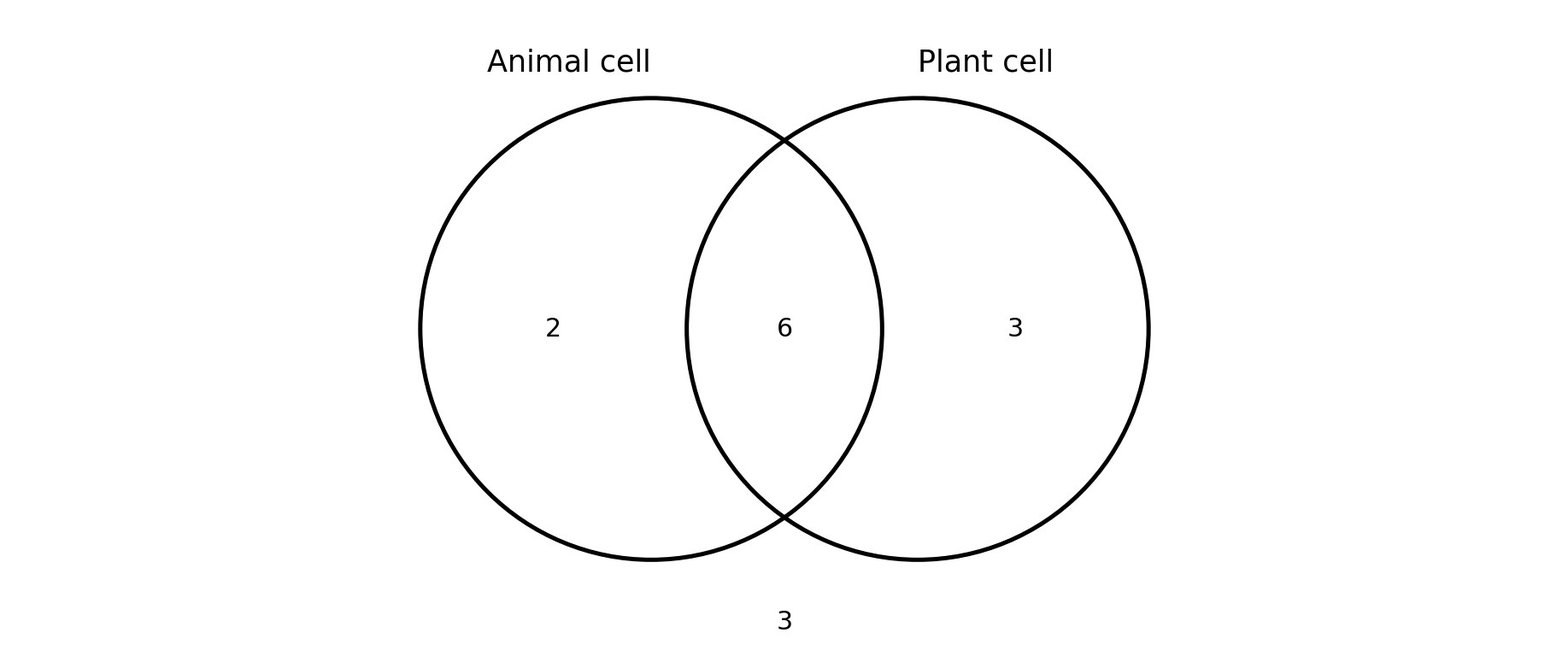
The Venn diagram shows features of animal cells and plant cells. How many features are found in both types of cell?
10
Which structure is found in a bacterial cell but not in an animal cell?
11
A cell is 12 mm long in a photograph. Its real length is 0.03 mm. What is the magnification?
12
A cell is 36 mm long in a photograph. Its real length is 60 micrometres. What is the magnification?
13
What is a risk of using stem cells from another person?
14
Which part of a cell is where most of the chemical reactions happen?
15
A piece of potato weighs 4 g. After soaking in pure water it weighs 4.6 g. What is the percentage increase in mass?
16
Which part of a light microscope holds the slide?
17
During mitosis, how many daughter cells are produced from one cell?
18
In osmosis, water moves from where to where?
19
Which of these uses active transport?
20
Which of these is found in a plant cell but not in an animal cell?
21
A cell is 30 mm long in a photograph. Its real length is 0.2 mm. What is the magnification?
22
A cell is 12 mm long in a photograph. Its real length is 60 micrometres. What is the magnification?
23
Before a cell divides by mitosis, what happens to its chromosomes?
24
Which cell contains chloroplasts?
25
A cell is 18 mm long in a photograph. Its real length is 0.06 mm. What is the magnification?