1
Red apples are cut and left in the air. They turn brown because an enzyme in the apple reacts with oxygen. What would slow this browning down?
2
A school lunch tray holds a meal. Why do we need food?
3
A thermometer is placed in hot water. What happens to the liquid inside the thermometer?
4
A sunflower leaf cell contains chloroplasts. What is the job of the chloroplasts?
5
Glass marbles in a tray are used as a model for particles in a solid. What do the marbles show?
6
A peach is a fruit. Which part of the flower does it develop from?
7
In osmosis, water moves from where to where?
8
Photosynthesis produces oxygen at a rate of 5 cm cubed per minute. How much oxygen is produced in 10 minutes?
9
A sandwich contains bread, cheese and lettuce. Which enzyme starts breaking down the bread in the mouth?
10
A cell of real length 0.01 mm is viewed at a magnification of 400 times. How long is the image of the cell?
11
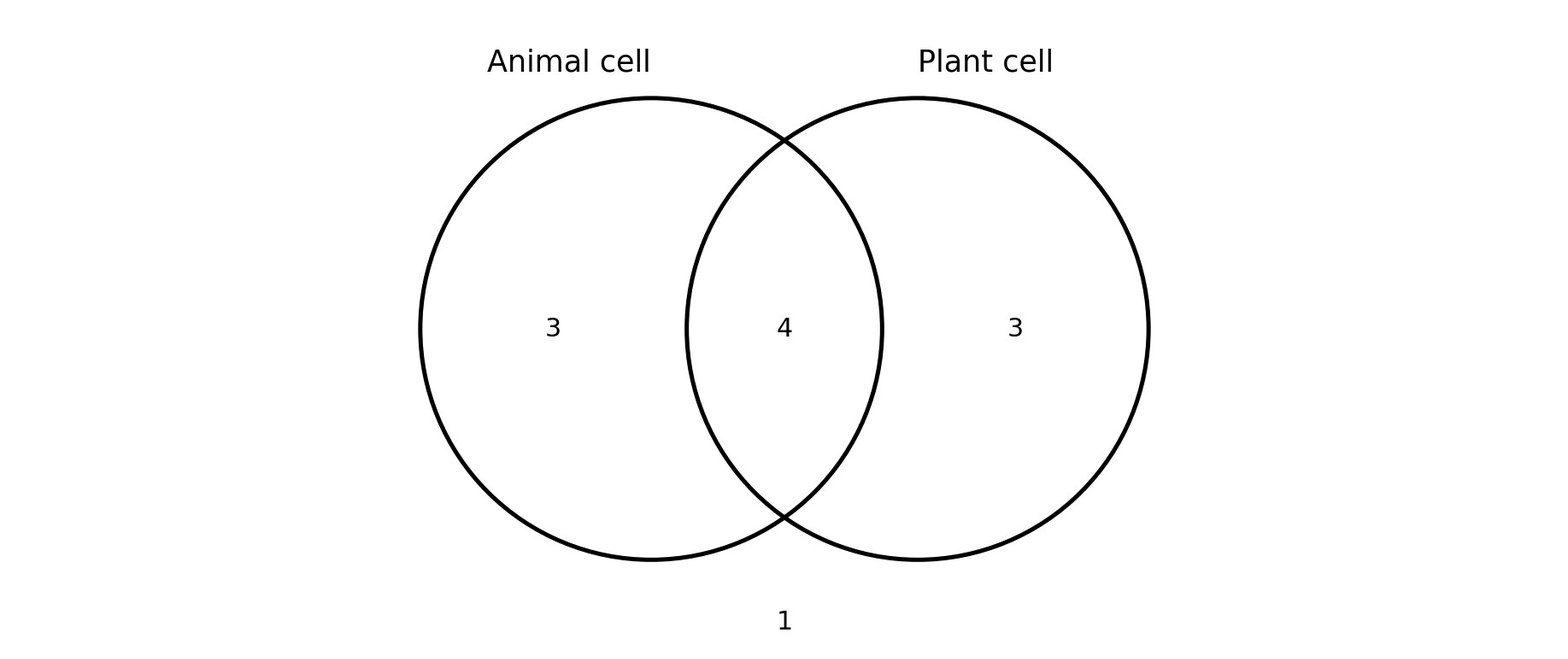
The Venn diagram shows features of animal cells and plant cells. How many features are found in both types of cell?
12
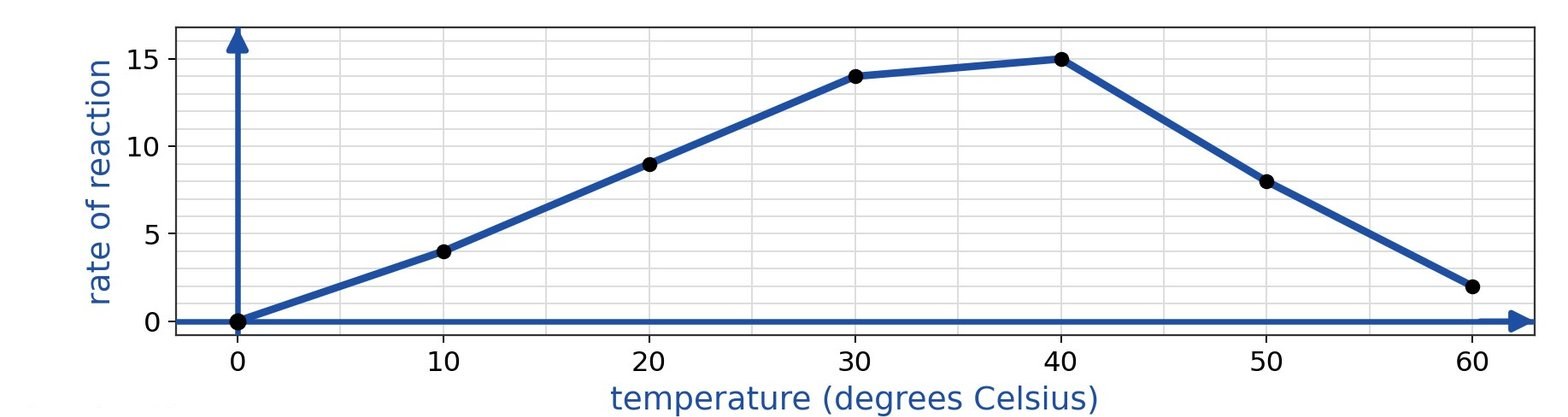
The graph shows the rate of an enzyme reaction at different temperatures. At which temperature is the rate highest?
14
Which part of a plant cell gives the cell strength and support?
15
A food contains 100 kJ of energy per 100 g. How much energy is in 200 g of the food?
16
What is the basal metabolic rate?
17
Which test shows that a food contains protein?
18
Potatoes left in salty water go soft. Why?
19
What is glucose converted into for storage in animals?
20
Amylase breaks starch down into which substance?
21
A piece of potato weighs 5 g. After soaking in pure water it weighs 5.5 g. What is the percentage increase in mass?
22
How should a biological drawing of a cell be made?
23
An enzyme reaction is fastest at 40 degrees Celsius. At 60 degrees Celsius the rate is much lower. Why?
24
Hens' eggs have a large yolk. The yolk is one very large cell. Which part of the cell is the yolk?
25
A cell is 30 mm long in a photograph. Its real length is 0.15 mm. What is the magnification?