1
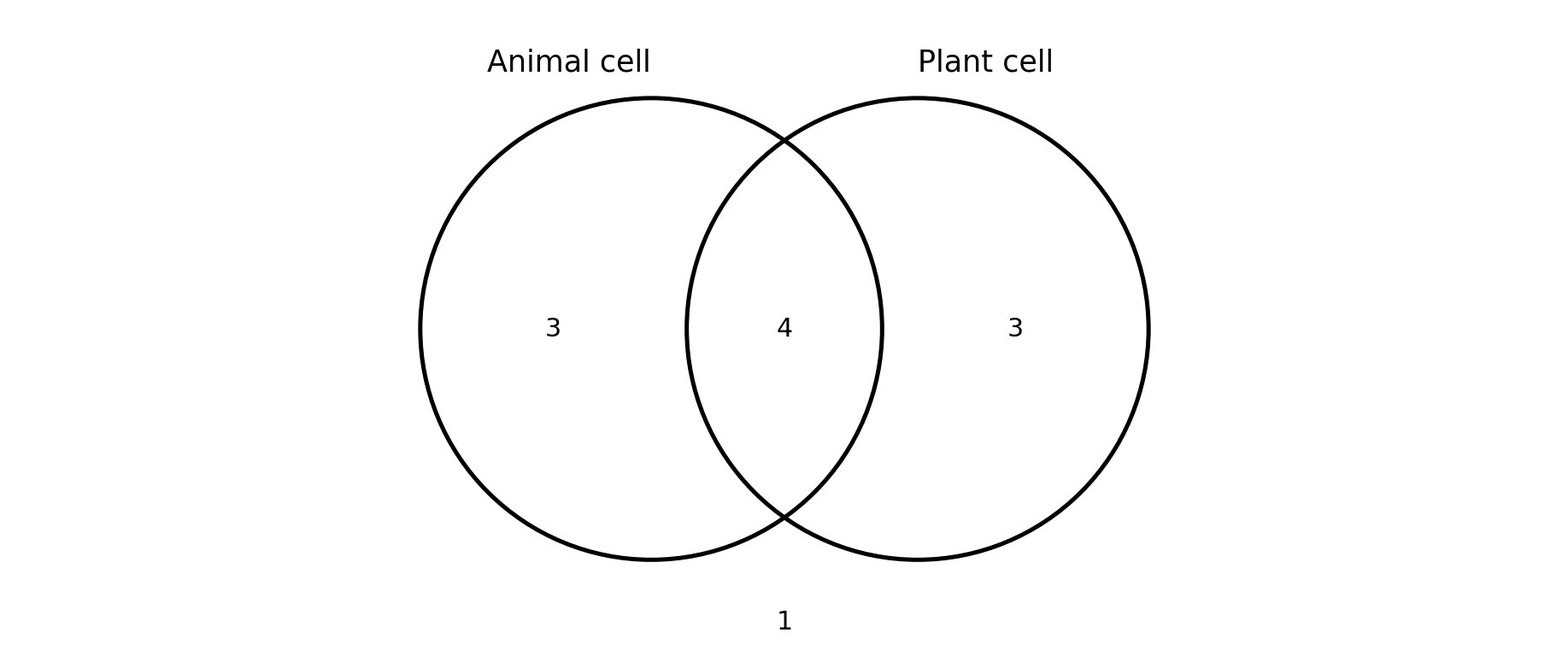
The Venn diagram shows features of animal cells and plant cells. How many features are found in both types of cell?
A 4 B 6 C 5 D 3
What looks wrong with Question 1?
Send anonymously
Cancel
2
What happens when a cell differentiates?
A it grows larger and larger B it moves to a new place C it becomes specialised D it divides into two identical cells
What looks wrong with Question 2?
Send anonymously
Cancel
3
Which bases pair together in DNA?
A A pairs with G, C pairs with T B A pairs with T, C pairs with G C A pairs with C, T pairs with G D A pairs with A, T pairs with T
What looks wrong with Question 3?
Send anonymously
Cancel
4
Where did the nucleus for Dolly come from?
A from an embryo cell B from an egg cell C from a sperm cell D from an adult cell
What looks wrong with Question 4?
Send anonymously
Cancel
5
Which disease is now prevented by the MMR vaccine?
A tuberculosis B malaria C measles D athlete's foot
What looks wrong with Question 5?
Send anonymously
Cancel
A water uptake by roots B water loss from leaves C photosynthesis in leaves D sugar transport in phloem
What looks wrong with Question 6?
Send anonymously
Cancel
A a sugar stored in the liver B a hormone that controls water C a salt lost in sweat D waste from protein breakdown
What looks wrong with Question 7?
Send anonymously
Cancel
8
A heart beats 80 times per minute. Each beat pumps 70 mL of blood. Calculate the cardiac output in mL per minute.
A 5700 B 2800 C 11200 D 5600
What looks wrong with Question 8?
Send anonymously
Cancel
9
What do decomposers return to the soil?
A nutrients B water C oxygen D carbon dioxide
What looks wrong with Question 9?
Send anonymously
Cancel
10
An atom has 11 protons. How many electrons does the neutral atom have?
A 13 B 12 C 11 D 10
What looks wrong with Question 10?
Send anonymously
Cancel
11
How many atoms of oxygen are there in one molecule of water?
A 3 B 0 C 2 D 1
What looks wrong with Question 11?
Send anonymously
Cancel
12
How are insoluble salts made?
A by precipitation B by distillation C by filtration D by evaporation of the solvent
What looks wrong with Question 12?
Send anonymously
Cancel
13
Why is a catalyst used in the Haber process?
A to use up the nitrogen faster B to shift the equilibrium towards ammonia C to raise the temperature of the reaction D to speed the reaction up
What looks wrong with Question 13?
Send anonymously
Cancel
14
What happens to reactivity down Group 1?
A it stays the same for all three metals B it increases then decreases again C it increases D it decreases as the atoms get larger
What looks wrong with Question 14?
Send anonymously
Cancel
15
A reaction should make 200 g of product but only makes 100 g. What is the percentage yield?
A 40% B 60% C 50% D 100%
What looks wrong with Question 15?
Send anonymously
Cancel
16
Which gases are greenhouse gases?
A oxygen and nitrogen in the air B carbon dioxide and methane C oxygen and water vapour only D nitrogen and argon
What looks wrong with Question 16?
Send anonymously
Cancel
17
What is the SI unit of mass?
A metre, the unit of length B kilogram C joule, the unit of energy D newton, the unit of force
What looks wrong with Question 17?
Send anonymously
Cancel
18
An object speeds up from 10 m/s to 20 m/s in 10 seconds. What is its acceleration?
A 2 m/s² B 0.5 m/s² C 10 m/s² D 1 m/s²
What looks wrong with Question 18?
Send anonymously
Cancel
19
What is kinetic energy?
A energy of movement B energy of heat C energy of position D energy of light
What looks wrong with Question 19?
Send anonymously
Cancel
20
A wave travels at 20 m/s with a wavelength of 10 m. What is its frequency?
A 200 Hz B 4 Hz C 2 Hz D 1 Hz
What looks wrong with Question 20?
Send anonymously
Cancel
21
What do all electromagnetic waves travel at in a vacuum?
A zero speed B the speed of sound C different speeds D the speed of light
What looks wrong with Question 21?
Send anonymously
Cancel
22
In alpha decay, what happens to the atomic number of the nucleus?
A it stays the same B it falls by 4 C it falls by 2 D it rises by 2
What looks wrong with Question 22?
Send anonymously
Cancel
23
A machine transfers 1000 J of energy in 50 s. Calculate the power in W.
A 10 B 40 C 20 D 200
What looks wrong with Question 23?
Send anonymously
Cancel
24
A door is hard to push open near its hinges. Why?
A the hinges push back harder B the door is heavier near the hinges C the handle is too far away D the moment is small
What looks wrong with Question 24?
Send anonymously
Cancel
25
A component has a potential difference of 12 V across it and a current of 2 A through it. What is its resistance?
A 6 ohms B 3 ohms C 24 ohms D 12 ohms
What looks wrong with Question 25?
Send anonymously
Cancel
26
What happens to an electromagnet when the current is switched off?
A it attracts more strongly than before B it becomes a permanent magnet C it stays magnetic for ever after D it loses its magnetism
What looks wrong with Question 26?
Send anonymously
Cancel
27
A transformer has 200 turns on the primary coil and 50 turns on the secondary coil. What is the turns ratio?
A 3 B 8 C 5 D 4
What looks wrong with Question 27?
Send anonymously
Cancel
28
How much energy is needed to heat 2 kg of a substance with a specific heat capacity of 4200 J per kg per degree Celsius by 10 degrees Celsius?
A 8400 J B 168000 J C 84000 J D 42000 J
What looks wrong with Question 28?
Send anonymously
Cancel
29
A spring has a spring constant of 10 N/m. It is stretched by 0.2 m. Calculate the force in N.
A 17 B 2 C 1 D 4
What looks wrong with Question 29?
Send anonymously
Cancel
30
Photosynthesis produces oxygen at a rate of 5 cm cubed per minute. How much oxygen is produced in 10 minutes?
A 50 cm³ B 60 cm³ C 40 cm³ D 100 cm³
What looks wrong with Question 30?
Send anonymously
Cancel
31
A brown dog is vaccinated. What does the vaccine contain?
A a dead or weakened pathogen B white blood cells C an antibiotic D a live dangerous pathogen that causes disease
What looks wrong with Question 31?
Send anonymously
Cancel
32
A brown dog is bitten by a tick. Ticks can spread disease. How is the disease spread?
A through water B by touch C by a vector D through the air
What looks wrong with Question 32?
Send anonymously
Cancel
33
Rabbits in a population show different fur colours. What is this called?
A variation B selection C mutation D evolution
What looks wrong with Question 33?
Send anonymously
Cancel
34
What is antibiotic resistance?
A people become allergic to antibiotics B bacteria evolve to survive antibiotics C bacteria are killed too slowly D antibiotics stop working in cold weather
What looks wrong with Question 34?
Send anonymously
Cancel
35
A sandwich contains bread and cheese. Where does digestion begin?
A in the stomach B in the mouth C in the large intestine D in the small intestine
What looks wrong with Question 35?
Send anonymously
Cancel
36
Eggs contain protein. Which part of the egg is mostly protein?
A the yolk B the air sac C the shell D the white
What looks wrong with Question 36?
Send anonymously
Cancel
37
A school lunch tray holds a meal. Why do we need food?
A to feel full after eating B for energy and growth C to stay awake at night D for fun only, not for health
What looks wrong with Question 37?
Send anonymously
Cancel
38
A honeybee visits a flower to collect nectar. What does it carry between flowers?
A leaves B pollen C seeds D water
What looks wrong with Question 38?
Send anonymously
Cancel
39
Silver coins are made of a metal. Which property do metals have?
A they conduct electricity B they do not conduct electricity at all C they dissolve in water D they are brittle
What looks wrong with Question 39?
Send anonymously
Cancel
40
Paintbrushes are used with paint. What is paint an example of?
A a compound B a pure substance C an element D a formulation
What looks wrong with Question 40?
Send anonymously
Cancel
41
A castle wall is made of stone. What type of rock is limestone?
A sedimentary B metamorphic C volcanic D igneous
What looks wrong with Question 41?
Send anonymously
Cancel
42
Silver coins are made of the element silver. What is the chemical symbol for silver?
A S B Si C Sv D Ag
What looks wrong with Question 42?
Send anonymously
Cancel
43
Glass marbles are used to model atoms. What is a limitation of the model?
A marbles are much bigger than atoms B marbles cannot be counted accurately at all C marbles are too small to see properly D marbles are the wrong colour for atoms
What looks wrong with Question 43?
Send anonymously
Cancel
44
A thermometer shows a patient's temperature is 39 degrees Celsius. Is this above or below normal body temperature?
A impossible to tell B above normal C exactly normal D below normal
What looks wrong with Question 44?
Send anonymously
Cancel
45
A river provides drinking water. Why must the water be treated before drinking?
A to add minerals for health B to make it taste better for drinking C to remove harmful substances D to heat it up for use
What looks wrong with Question 45?
Send anonymously
Cancel
46
A wristwatch is used to time a race. What is speed calculated from?
A distance and time B distance only, not time C time only, not distance D mass and time together
What looks wrong with Question 46?
Send anonymously
Cancel
47
A bicycle is ridden uphill. Which energy store increases?
A kinetic energy of motion B elastic potential energy C thermal energy from friction D gravitational potential
What looks wrong with Question 47?
Send anonymously
Cancel
48
A bicycle rolls down a hill. What happens to its gravitational potential energy?
A it becomes chemical energy stored in the bike B it decreases as kinetic energy increases C it stays the same D it increases
What looks wrong with Question 48?
Send anonymously
Cancel
49
A wristwatch ticks every second. How many ticks in a minute?
A 12 B 30 C 60 D 100
What looks wrong with Question 49?
Send anonymously
Cancel
50
A set square is used to measure an angle of reflection. What is the angle of incidence equal to?
A double the angle of reflection B the angle of reflection C half the angle of reflection D zero
What looks wrong with Question 50?
Send anonymously
Cancel