1
Hens' eggs have a large yolk. The yolk is one very large cell. Which part of the cell is the yolk?
2
Potatoes left in salty water go soft. Why?
3
A thermometer shows a patient's temperature is 39 degrees Celsius. Is this above or below normal body temperature?
4
Glass marbles are shaken in a tray. What does this model?
5
A peach contains a stone. What is inside the stone?
6
A sunflower leaf cell contains chloroplasts. What is the job of the chloroplasts?
7
A plant cell in pure water becomes turgid. What does turgid mean?
8
A pondweed plant releases 12 bubbles of oxygen in 3 minutes. How many bubbles does it release per minute?
9
A person breathes 20 times per minute. How many breaths is that in one hour?
10
A cell is 24 mm long in a photograph. Its real length is 0.2 mm. What is the magnification?
11
Which part of a light microscope holds the slide?
12
Which structure is found in a bacterial cell but not in an animal cell?
13
One glucose molecule releases 30 molecules of ATP in respiration. How many ATP molecules are released from 3 glucose molecules?
14
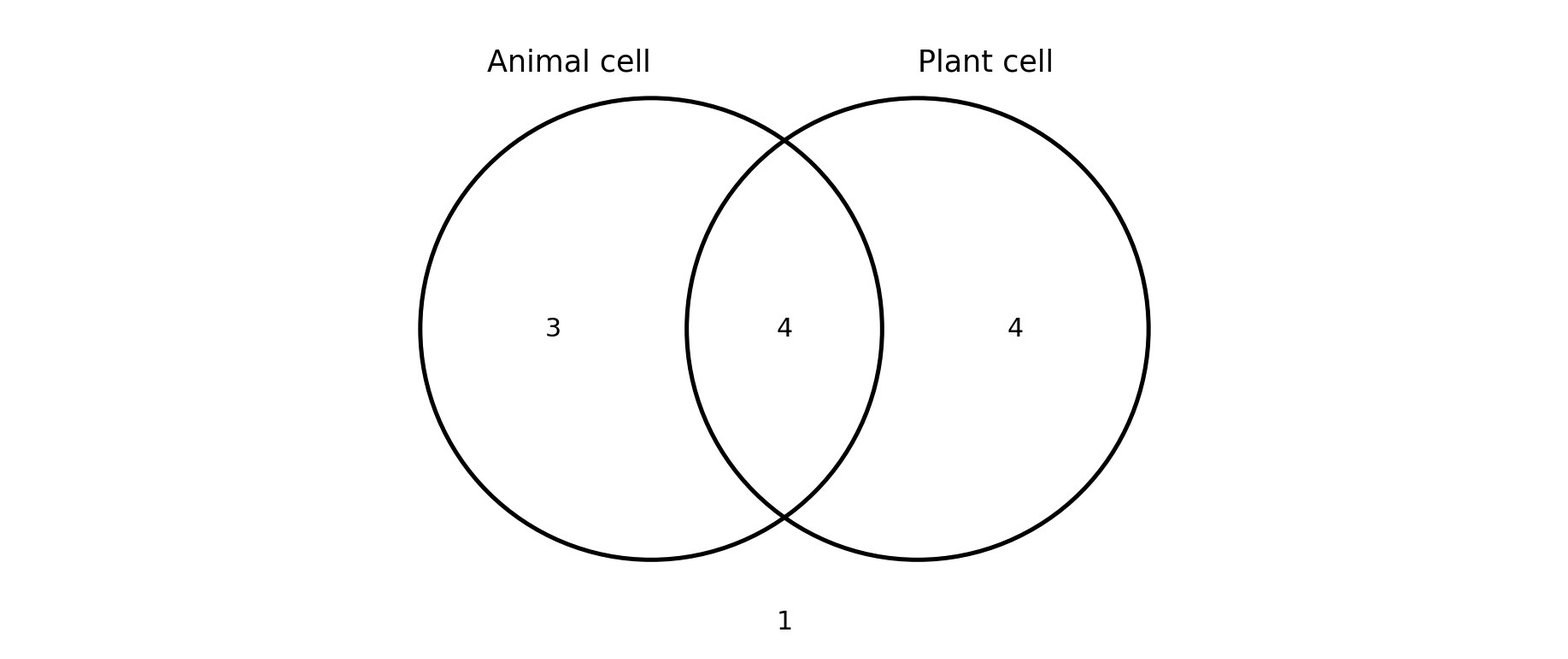
The Venn diagram shows features of animal cells and plant cells. How many features are found in both types of cell?
15
A forest absorbs carbon dioxide from the air. Which process is responsible?
16
What happens to an animal cell placed in pure water?
17
A cell image is 12 mm long and the magnification is 400 times. What is the real length of the cell?
18
What happens to excess amino acids in the body?
19
Why can plant cells keep differentiating throughout life, but most animal cells cannot?
20
A cell of real length 0.01 mm is viewed at a magnification of 100 times. How long is the image of the cell?
21
What happens to heart rate during exercise?
22
What is the word equation for aerobic respiration?
23
A piece of potato weighs 4 g. After soaking in pure water it weighs 4.4 g. What is the percentage increase in mass?
24
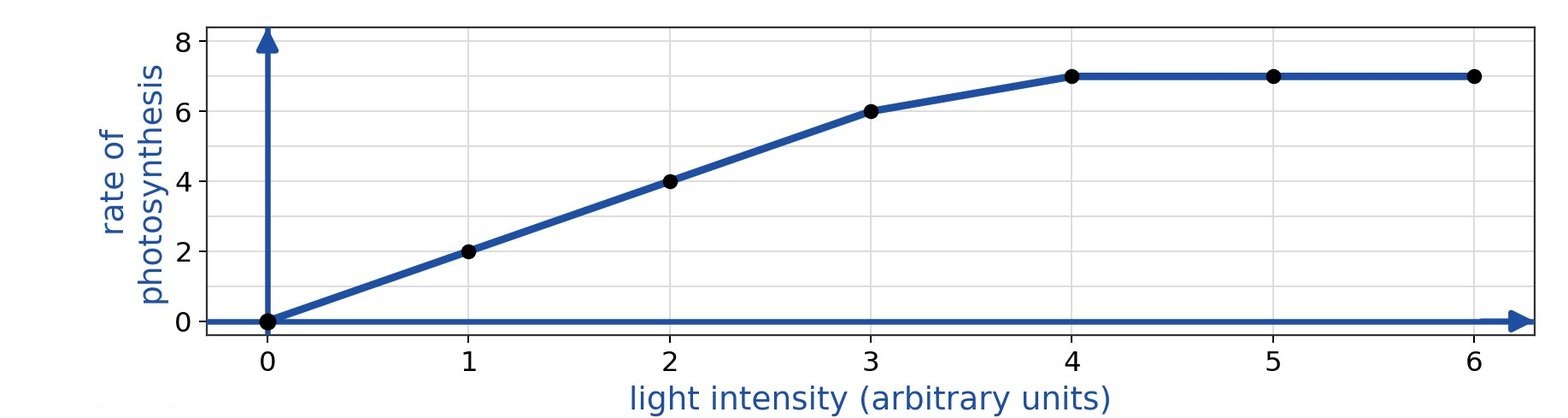
The graph shows the rate of photosynthesis at different light intensities. At which light intensity does the rate first reach its maximum?
25
What does agar provide for bacteria in a culture?