1
A chocolate cake rises in the oven. What makes it rise?
A the egg evaporates B the flour melts C a gas is made D the sugar freezes
What looks wrong with Question 1?
Send anonymously
Cancel
2
A sandwich is eaten. Which enzyme digests the starch in the bread?
A pepsin B amylase C protease D lipase
What looks wrong with Question 2?
Send anonymously
Cancel
3
A cup of coffee is hot. How is energy transferred to the air?
A by evaporation only, from the top B by radiation only, from the surface C by conduction and convection D by condensation on the cold cup
What looks wrong with Question 3?
Send anonymously
Cancel
4
A thermometer is placed in hot water. What happens to the liquid inside the thermometer?
A it contracts B it freezes C it evaporates D it expands
What looks wrong with Question 4?
Send anonymously
Cancel
5
A cheese pizza is cooked in an oven. How is energy transferred in the oven?
A by radiation and convection B by condensation on the oven walls C by evaporation from the cheese D by conduction only, through the tray
What looks wrong with Question 5?
Send anonymously
Cancel
6
A wristwatch ticks every second. How many ticks in a minute?
A 60 B 12 C 100 D 30
What looks wrong with Question 6?
Send anonymously
Cancel
7
In an experiment, 20 cubic centimetres of gas are made in 10 seconds. What is the rate of the reaction?
A 4 cm³/s B 200 cm³/s C 2 cm³/s D 1 cm³/s
What looks wrong with Question 7?
Send anonymously
Cancel
8
Which of these is exothermic?
A burning a fuel B melting ice C photosynthesis D dissolving ammonium nitrate
What looks wrong with Question 8?
Send anonymously
Cancel
9
A reaction makes 2 moles of gas. What volume does the gas occupy at room temperature and pressure?
A 96 dm³ B 60 dm³ C 36 dm³ D 48 dm³
What looks wrong with Question 9?
Send anonymously
Cancel
10
Why is the mass of a reaction flask measured on a balance?
A the flask gets heavier as it reacts B the mass shows the pH change C gas escaping makes the mass fall D the balance shows the temperature
What looks wrong with Question 10?
Send anonymously
Cancel
11
What must particles have to react when they collide?
A the right colour B enough energy C the same mass D a catalyst with them
What looks wrong with Question 11?
Send anonymously
Cancel
12
In a second experiment, 50 cm cubed of gas are made in 30 seconds. What is the rate of the reaction?
A 1.1667 cm³/s B 1.6667 cm³/s C 3.1667 cm³/s D 2.1667 cm³/s
What looks wrong with Question 12?
Send anonymously
Cancel
13
A student heats 100 g of water. Its temperature rises by 5 degrees Celsius. The specific heat capacity of water is 4.2 joules per gram per degree Celsius. How much energy is transferred to the water in kilojoules?
A 2.1 kJ B 4.2 kJ C 21 kJ D 0.21 kJ
What looks wrong with Question 13?
Send anonymously
Cancel
14
In the combustion of methane, the energy needed to break the bonds is 800 kJ and the energy released when new bonds form is 1200 kJ. What is the overall energy change?
A 1200 kJ B -800 kJ C -400 kJ D 400 kJ
What looks wrong with Question 14?
Send anonymously
Cancel
15
A reaction should make 200 g of product but only makes 100 g. What is the percentage yield?
A 100% B 60% C 50% D 40%
What looks wrong with Question 15?
Send anonymously
Cancel
16
A solution has a concentration of 2 mol per cubic decimetre. How many moles are in 2 cubic decimetres of the solution?
A 4 mol B 3 mol C 8 mol D 5 mol
What looks wrong with Question 16?
Send anonymously
Cancel
17
On a reaction profile, what is the difference between the reactants and the products?
A the overall energy change B the temperature change C the activation energy D the rate of the reaction over time
What looks wrong with Question 17?
Send anonymously
Cancel
18
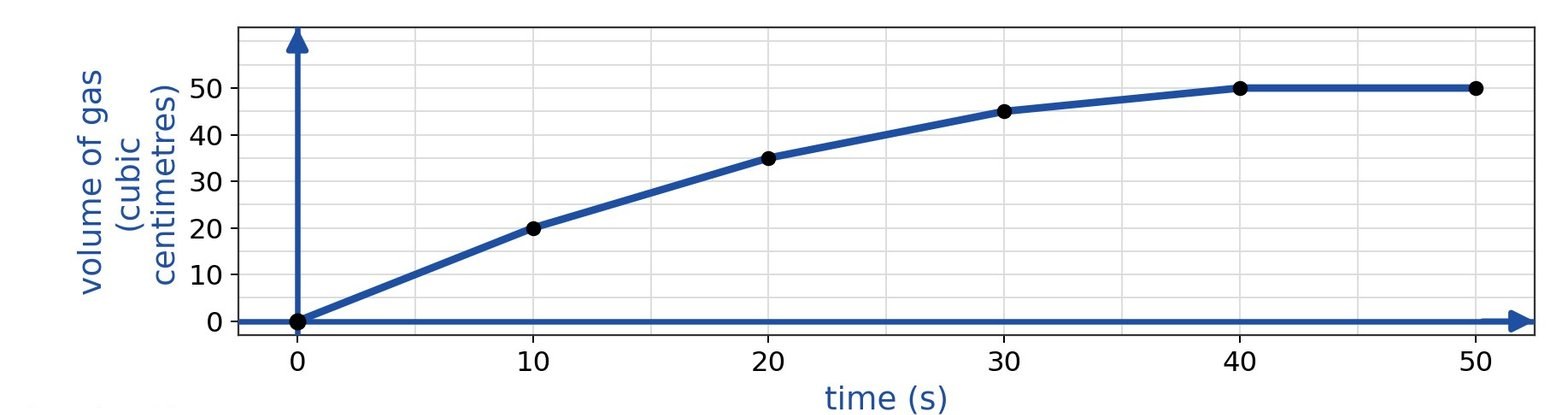
The graph shows the volume of gas made in a reaction. After how many seconds does the reaction finish?
A 30 B 50 C 40 D 20
What looks wrong with Question 18?
Send anonymously
Cancel
19
A reaction produces 20 cm cubed of gas in 10 seconds. What is the mean rate of reaction?
A 1.5 cm³/s B 2.5 cm³/s C 4 cm³/s D 2 cm³/s
What looks wrong with Question 19?
Send anonymously
Cancel
20
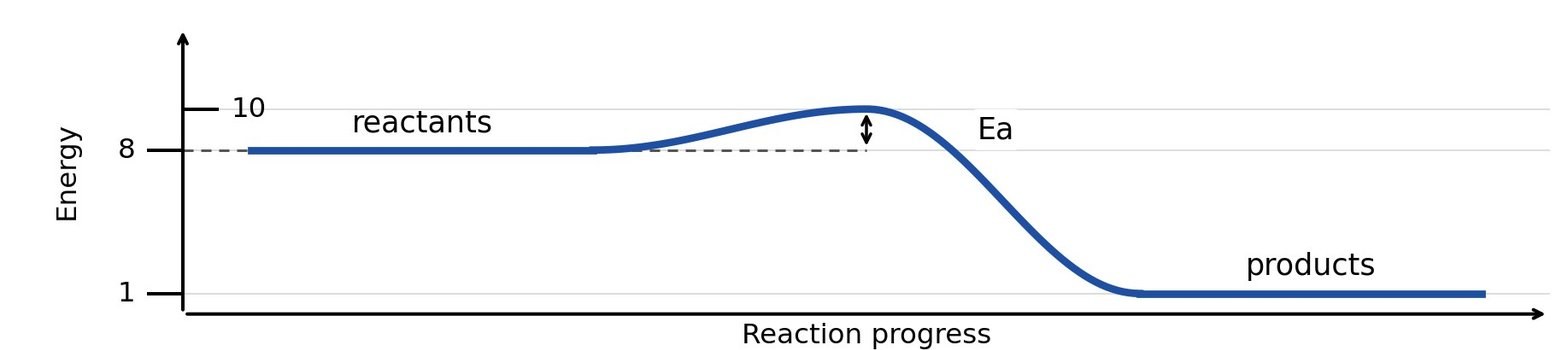
The diagram shows the energy profile for a reaction. The reactants are at energy 8 and the products are at 1. Is the reaction exothermic or endothermic?
A endothermic, energy is taken in B exothermic, energy is taken in C endothermic, energy is given out D exothermic, energy is given out
What looks wrong with Question 20?
Send anonymously
Cancel
21
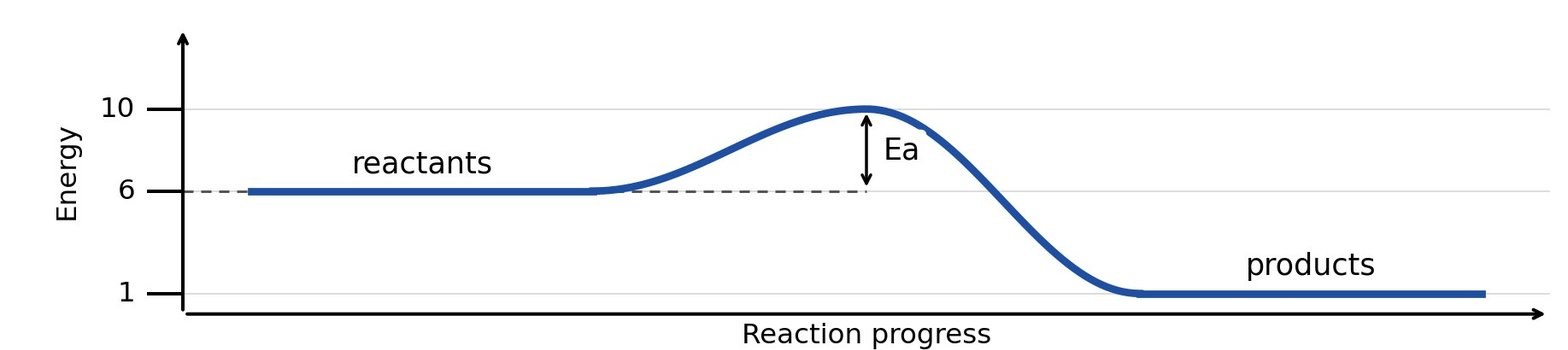
The diagram shows the energy profile for a reaction. The reactants are at energy 6, the peak is at 10 and the products are at 1. What is the activation energy?
A 5 B 9 C 16 D 4
What looks wrong with Question 21?
Send anonymously
Cancel
22
In an experiment, 60 cubic centimetres of gas are made in 30 seconds. What is the rate of the reaction?
A 4 cm³/s B 1 cm³/s C 1800 cm³/s D 2 cm³/s
What looks wrong with Question 22?
Send anonymously
Cancel
23
Which of these is endothermic?
A neutralisation B photosynthesis C burning a fuel D respiration
What looks wrong with Question 23?
Send anonymously
Cancel
24
A reaction makes 3 moles of gas. What volume does the gas occupy at room temperature and pressure?
A 144 dm³ B 60 dm³ C 72 dm³ D 84 dm³
What looks wrong with Question 24?
Send anonymously
Cancel
25
In the disappearing cross experiment, what is timed?
A how long the cross takes to appear B how long the cross takes to vanish C how long the acid takes to boil D how long the mixture takes to cool down
What looks wrong with Question 25?
Send anonymously
Cancel