1
Glass marbles are shaken in a tray. What does this model?
2
A forest absorbs carbon dioxide from the air. Which process is responsible?
3
Hens' eggs have a large yolk. The yolk is one very large cell. Which part of the cell is the yolk?
4
A thermometer is placed in hot water. What happens to the liquid inside the thermometer?
5
A sunflower is left in bright light. Its leaves photosynthesise faster than in dim light. What else would increase the rate?
6
A peach contains a stone. What is inside the stone?
7
What is produced by anaerobic respiration in muscle cells?
8
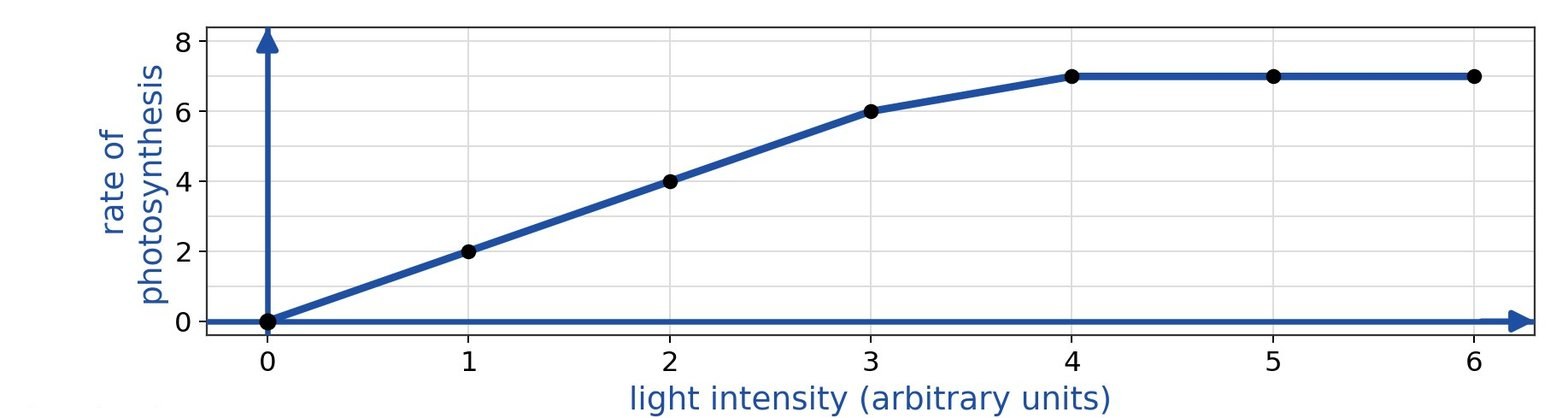
The graph shows the rate of photosynthesis at different light intensities. At which light intensity does the rate first reach its maximum?
9
A cell is 36 mm long in a photograph. Its real length is 30 micrometres. What is the magnification?
10
Strips cut from potatoes are left in salt water overnight. What happens to the strips?
11
A pondweed plant releases 30 bubbles of oxygen in 3 minutes. How many bubbles does it release per minute?
12
During mitosis, how many daughter cells are produced from one cell?
13
A cell is 9 mm long in a photograph. Its real length is 0.03 mm. What is the magnification?
14
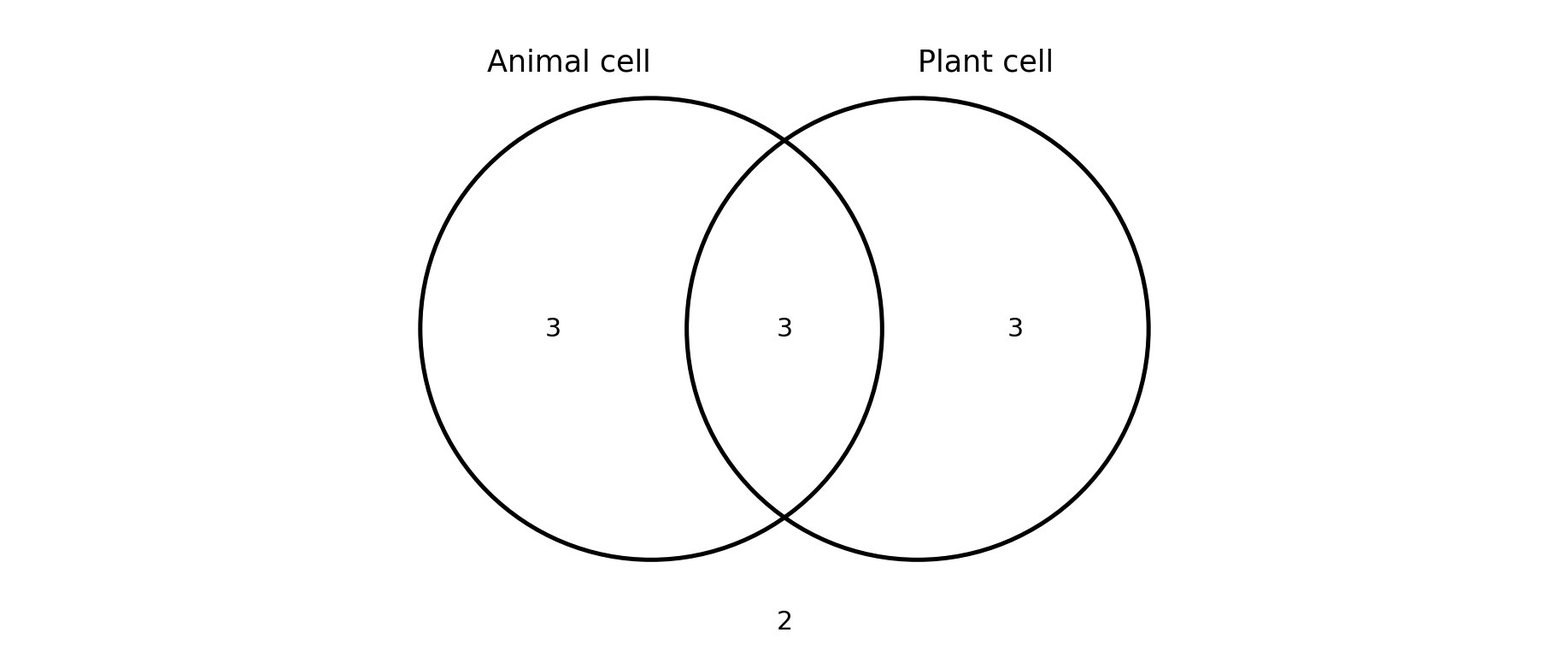
The Venn diagram shows features of animal cells and plant cells. How many features are found in both types of cell?
15
One glucose molecule releases 30 molecules of ATP in respiration. How many ATP molecules are released from 5 glucose molecules?
17
Why are cultures grown near a Bunsen burner flame?
18
A person breathes 15 times per minute. How many breaths is that in one hour?
19
A piece of potato weighs 4 g. After soaking in pure water it weighs 4.5 g. What is the percentage increase in mass?
20
Which of these is a use of glucose in a plant?
21
Which part of a cell controls all the activities of the cell?
22
A microscope has an eyepiece lens of 10 times and an objective lens of 40 times. What is the total magnification?
23
What is glucose used to make in cell walls?
24
Which of these is found in both animal cells and plant cells?