1
A castle wall is made of stone. What type of rock is limestone?
England GCSE Combined Science OCR Twenty First Century Foundation · Unit 12 · 25 questions
This practice test was made by AI and there may be mistakes. If a question or answer looks wrong, use the Flag a mistake button so it can be fixed.
A castle wall is made of stone. What type of rock is limestone?
Silver coins are made of a metal. Which property do metals have?
Lemons taste sour. What does sour taste show?
A school lunch tray holds a meal. Why do we need food?
Paintbrushes are used with paint. What is paint an example of?
A chocolate cake is made from flour, sugar and eggs. Which ingredient provides protein?
A reaction makes 30 g of useful product from 50 g of reactants in total. What is the atom economy?
The maximum possible mass of product is 40 g. A student makes 32 g. What is the percentage yield?
A solution has a hydrogen ion concentration of 10⁻⁷mol per cubic decimetre. What is its pH?
In a second experiment, 50 cm cubed of gas are made in 30 seconds. What is the rate of the reaction?
How can the rate of a reaction be measured using a gas syringe?
A reaction makes 3 moles of gas. What volume does the gas occupy at room temperature and pressure?
How many moles are there in 40 g of a substance with a relative formula mass of 20 ?
What is the relative formula mass of calcium oxide, CaO?
A reaction produces 20 cm cubed of gas in 20 seconds. What is the mean rate of reaction?
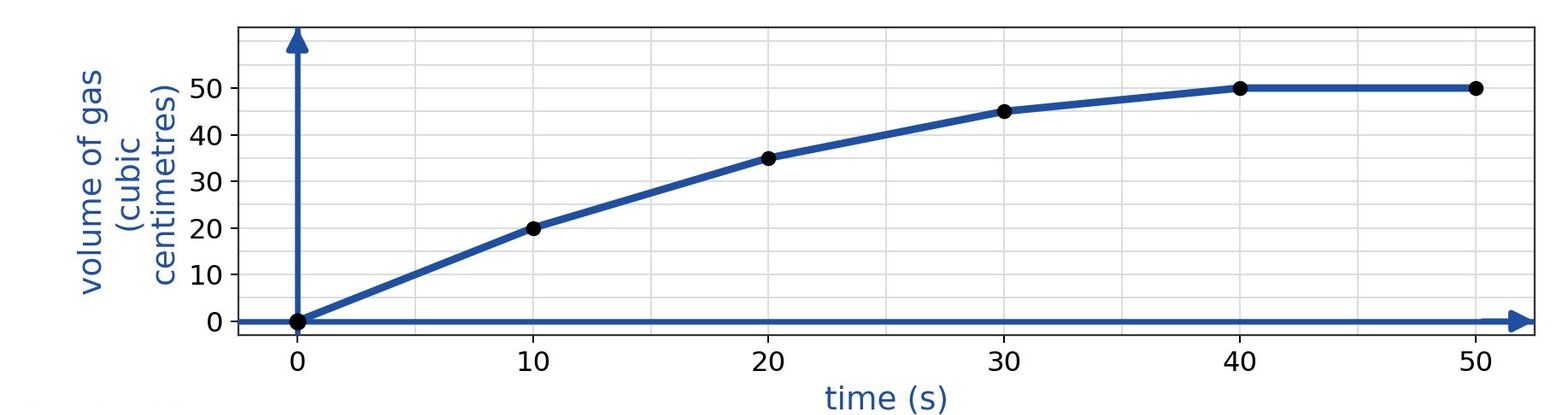
The graph shows the volume of gas made in a reaction. After how many seconds does the reaction finish?
How many moles are there in 24 g of a substance with a relative formula mass of 16?
A reaction should make 100 g of product but only makes 80 g. What is the percentage yield?
A student heats 50 g of water. Its temperature rises by 10 degrees Celsius. The specific heat capacity of water is 4.2 joules per gram per degree Celsius. How much energy is transferred to the water in kilojoules?
In an experiment, 20 cubic centimetres of gas are made in 30 seconds. What is the rate of the reaction?
What must particles have to react when they collide?
What is the relative formula mass of methane, CH₄?
What is the mass of 5 moles of a substance with a relative formula mass of 16?
A solution has a concentration of 1 mol per cubic decimetre. How many moles are in 3 cubic decimetres of the solution?
A reaction makes 20 g of useful product from 40 g of reactants in total. What is the atom economy?
Your score: 0 / 25