1
A forest absorbs carbon dioxide from the air. Which process is responsible?
A respiration B combustion C decomposition in the soil D photosynthesis
What looks wrong with Question 1?
Send anonymously
Cancel
2
Seabirds on a rocky island eat fish. If the fish population falls, what happens to the seabirds?
A they eat more fish B they move to the sea C their numbers fall D their numbers rise
What looks wrong with Question 2?
Send anonymously
Cancel
3
Red apples contain vitamin C. What is vitamin C needed for?
A making red blood cells B good eyesight at night C healthy skin and gums D strong bones and teeth
What looks wrong with Question 3?
Send anonymously
Cancel
4
A peach contains a stone. What is inside the stone?
A a leaf B a root C a seed D a flower
What looks wrong with Question 4?
Send anonymously
Cancel
5
A sunflower grows taller over the summer. Where does most of the extra mass come from?
A carbon dioxide from the air B water absorbed from the soil C sunlight captured by the leaves D minerals absorbed from the soil
What looks wrong with Question 5?
Send anonymously
Cancel
6
A honeybee is an insect. How many legs does it have?
A 6 B 10 C 8 D 4
What looks wrong with Question 6?
Send anonymously
Cancel
7
What is glucose made into for storage in a plant?
A protein B chlorophyll C cellulose D starch
What looks wrong with Question 7?
Send anonymously
Cancel
8
A pondweed plant releases 18 bubbles of oxygen in 2 minutes. How many bubbles does it release per minute?
A 9 B 18 C 10 D 8
What looks wrong with Question 8?
Send anonymously
Cancel
9
A quadrat of area 20 square metres contains on average 4 daisies. Estimate the number of daisies in a field of 200 square metres.
A 80 B 400 C 40 D 20
What looks wrong with Question 9?
Send anonymously
Cancel
10
A field has 5000 kg of grass. If 5 percent of the energy passes to the rabbits, how much grass biomass supports the rabbits?
A 250 kg B 125 kg C 500 kg D 2500 kg
What looks wrong with Question 10?
Send anonymously
Cancel
11
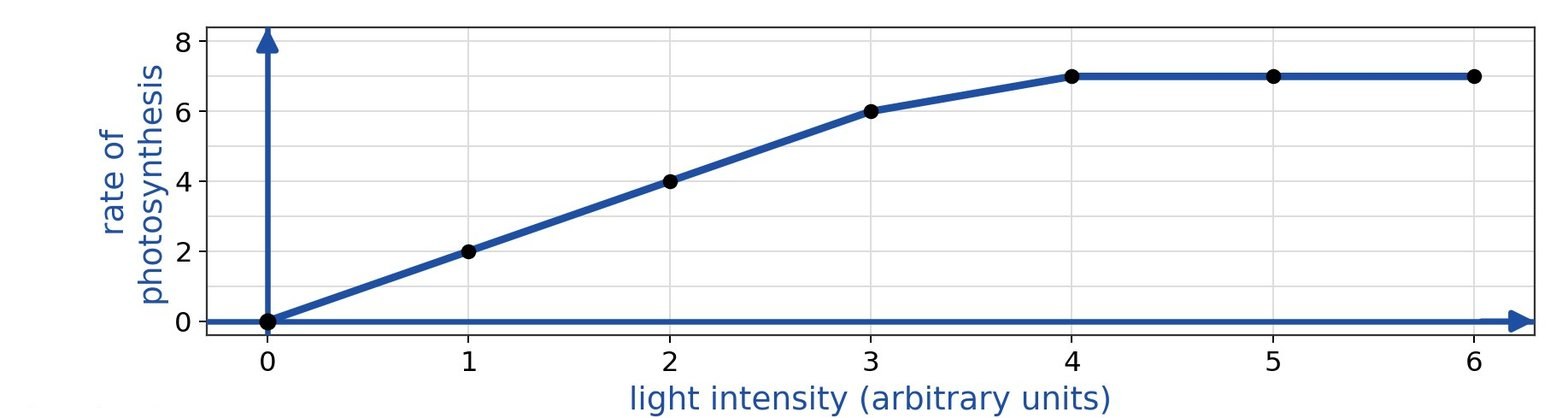
The graph shows the rate of photosynthesis at different light intensities. At which light intensity does the rate first reach its maximum?
A 3 B 2 C 6 D 4
What looks wrong with Question 11?
Send anonymously
Cancel
12
Where is carbon stored long term?
A in living organisms only B in fossil fuels C in rain water D in the air as oxygen
What looks wrong with Question 12?
Send anonymously
Cancel
13
Producers in a food chain hold 100000 kJ of energy. About 10 percent passes to the primary consumers. How much energy reaches them?
A 100000 kJ B 5000 kJ C 20000 kJ D 10000 kJ
What looks wrong with Question 13?
Send anonymously
Cancel
14
Why are quadrats placed at random?
A to cover the whole area B to find the rarest plants C to avoid bias D to save time in the field
What looks wrong with Question 14?
Send anonymously
Cancel
15
What shape is a pyramid of biomass?
A a circle B the same width all the way up C wide at the bottom, narrow at the top D narrow at the bottom, wide at the top
What looks wrong with Question 15?
Send anonymously
Cancel
16
Producers in a food chain have a biomass of 2000 kg. About 10 per cent of biomass passes to the next level. What is the biomass of the primary consumers?
A 400 B 20 C 2000 D 200
What looks wrong with Question 16?
Send anonymously
Cancel
17
What happens to excess amino acids in the body?
A they are turned into glucose B they are stored as glycogen C they are breathed out D they become urea
What looks wrong with Question 17?
Send anonymously
Cancel
18
Why is decay important in an ecosystem?
A it makes the soil warmer B it recycles nutrients C it stops plants growing D it removes carbon dioxide
What looks wrong with Question 18?
Send anonymously
Cancel
19
What is the water cycle driven by?
A wind only B energy from the soil C energy from the Sun D gravity only
What looks wrong with Question 19?
Send anonymously
Cancel
20
Which of these is a use of glucose in a plant?
A transpiration B photosynthesis C pollination D respiration
What looks wrong with Question 20?
Send anonymously
Cancel
21
A pondweed plant releases 24 bubbles of oxygen in 3 minutes. How many bubbles does it release per minute?
A 16 B 7 C 9 D 8
What looks wrong with Question 21?
Send anonymously
Cancel
22
What is one effect of global warming?
A all deserts become wetter B sea levels rise C the air holds less water D more ice forms at the poles
What looks wrong with Question 22?
Send anonymously
Cancel
23
Producers in a food chain hold 10000 kJ of energy. About 10 percent passes to the primary consumers. How much energy reaches them?
A 2000 kJ B 10000 kJ C 500 kJ D 1000 kJ
What looks wrong with Question 23?
Send anonymously
Cancel
24
What is a quadrat used for?
A to measure the height of trees B to count every plant exactly C to estimate a population D to catch small animals
What looks wrong with Question 24?
Send anonymously
Cancel
25
Producers in a food chain have a biomass of 10000 kg. About 10 per cent of biomass passes to the next level. What is the biomass of the primary consumers?
A 1000 B 2000 C 10000 D 100
What looks wrong with Question 25?
Send anonymously
Cancel