1
A castle wall is made of stone. What type of rock is limestone?
2
A school lunch tray holds a meal. Why do we need food?
3
Paintbrushes are used with paint. What is paint an example of?
4
Silver coins are made of the element silver. What is the chemical symbol for silver?
5
A chocolate cake is made from flour, sugar and eggs. Which ingredient provides protein?
6
Lemons contain citric acid. What is the pH of lemon juice likely to be?
7
A solution has a hydrogen ion concentration of 10⁻¹mol per cubic decimetre. What is its pH?
8
Which factor increases the rate of a reaction?
9
In an experiment, 60 cubic centimetres of gas are made in 10 seconds. What is the rate of the reaction?
10
Why does a larger surface area increase the rate?
11
Why is iron used as the catalyst in the Haber process?
12
A reaction should make 200 g of product but only makes 180 g. What is the percentage yield?
13
Which acid makes a sulfate salt?
14
The maximum possible mass of product is 100 g. A student makes 90 g. What is the percentage yield?
15
If the pressure rises, which side does equilibrium move to?
16
How many moles of gas occupy 48 cubic decimetres at room temperature and pressure?
17
What is the relative formula mass of hydrogen chloride, HCl?
18
How many moles are there in 8 g of a substance with a relative formula mass of 40?
19
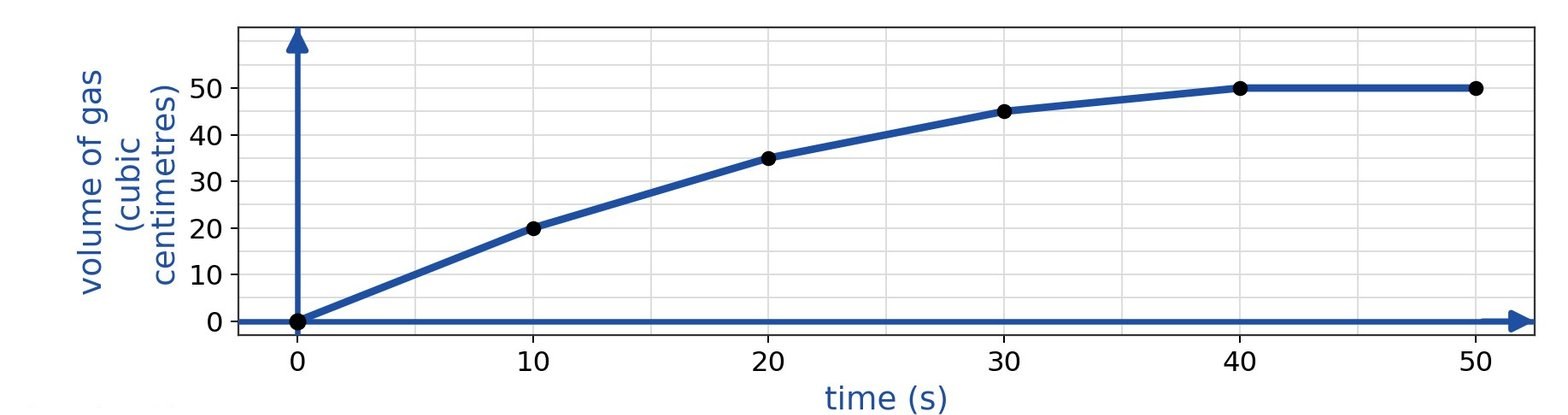
The graph shows the volume of gas made in a reaction. After how many seconds does the reaction finish?
20
What is the mass of 3 moles of a substance with a relative formula mass of 16?
21
What is neutralisation?
22
What happens to the reactant that is not limiting?
23
What does a steep graph of gas volume against time show?
24
A reaction produces 20 cm cubed of gas in 10 seconds. What is the mean rate of reaction?
25
In a second experiment, 50 cm cubed of gas are made in 30 seconds. What is the rate of the reaction?