1
Seabirds are affected by plastic pollution. How does plastic harm them?
A it keeps them warm B it makes them stronger and healthier C they eat it by mistake D it helps them fly
What looks wrong with Question 1?
Send anonymously
Cancel
2
A honeybee is an insect. How many legs does it have?
A 4 B 8 C 10 D 6
What looks wrong with Question 2?
Send anonymously
Cancel
3
Red apples are cut and left in air. Why do they turn brown?
A they ferment into alcohol B enzymes react with oxygen C they freeze in the cold D they dry out in the air
What looks wrong with Question 3?
Send anonymously
Cancel
4
A peach contains a stone. What is inside the stone?
A a flower B a leaf C a root D a seed
What looks wrong with Question 4?
Send anonymously
Cancel
5
A forest absorbs carbon dioxide from the air. Which process is responsible?
A decomposition in the soil B respiration C combustion D photosynthesis
What looks wrong with Question 5?
Send anonymously
Cancel
6
A sunflower is left in bright light. Its leaves photosynthesise faster than in dim light. What else would increase the rate?
A less water in the soil B a lower temperature C more carbon dioxide in the air D less chlorophyll in the leaves of the plant
What looks wrong with Question 6?
Send anonymously
Cancel
7
Why are quadrats placed at random?
A to cover the whole area B to avoid bias C to save time in the field D to find the rarest plants
What looks wrong with Question 7?
Send anonymously
Cancel
A a population B all the organisms in an area C where an organism lives D a food web
What looks wrong with Question 8?
Send anonymously
Cancel
9
A field has 2000 kg of grass. If 5 percent of the energy passes to the rabbits, how much grass biomass supports the rabbits?
A 200 kg B 50 kg C 1000 kg D 100 kg
What looks wrong with Question 9?
Send anonymously
Cancel
10
What is one effect of global warming?
A sea levels rise B all deserts become wetter C more ice forms at the poles D the air holds less water
What looks wrong with Question 10?
Send anonymously
Cancel
11
How is carbon dioxide returned to the air?
A by photosynthesis B by decomposition only C by feeding D by respiration
What looks wrong with Question 11?
Send anonymously
Cancel
12
A pondweed plant releases 30 bubbles of oxygen in 6 minutes. How many bubbles does it release per minute?
A 6 B 4 C 10 D 5
What looks wrong with Question 12?
Send anonymously
Cancel
A bacteria and fungi B animals that eat dead plants C worms and insects only D green plants and algae
What looks wrong with Question 13?
Send anonymously
Cancel
14
What is a genetically modified crop?
A a crop grown without any fertiliser B a crop grown in a greenhouse C a crop with a useful new gene D a crop that needs no water
What looks wrong with Question 14?
Send anonymously
Cancel
15
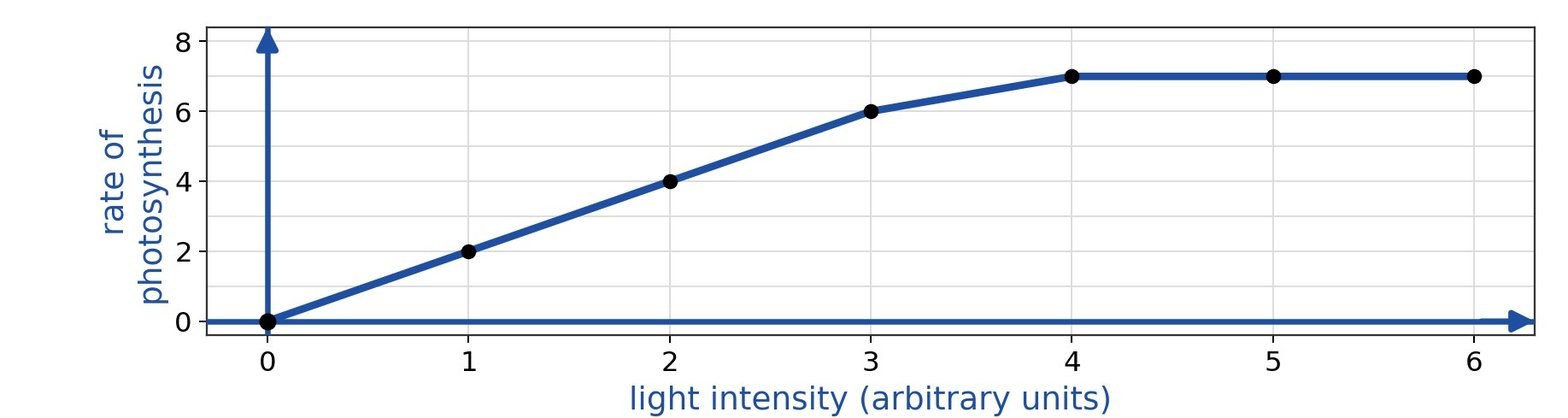
The graph shows the rate of photosynthesis at different light intensities. At which light intensity does the rate first reach its maximum?
A 2 B 6 C 4 D 3
What looks wrong with Question 15?
Send anonymously
Cancel
16
What is glucose made into for storage in a plant?
A starch B cellulose C protein D chlorophyll
What looks wrong with Question 16?
Send anonymously
Cancel
17
Producers in a food chain hold 100000 kJ of energy. About 10 percent passes to the primary consumers. How much energy reaches them?
A 100000 kJ B 10000 kJ C 5000 kJ D 20000 kJ
What looks wrong with Question 17?
Send anonymously
Cancel
A the breakdown of food in the gut only B the release of energy in respiration C all the chemical reactions in the body D the building of proteins only
What looks wrong with Question 18?
Send anonymously
Cancel
19
Producers in a food chain have a biomass of 2000 kg. About 10 per cent of biomass passes to the next level. What is the biomass of the primary consumers?
A 400 B 2000 C 20 D 200
What looks wrong with Question 19?
Send anonymously
Cancel
20
A quadrat of area 20 square metres contains on average 8 daisies. Estimate the number of daisies in a field of 200 square metres.
A 800 B 160 C 80 D 40
What looks wrong with Question 20?
Send anonymously
Cancel
21
Quadrat counts of daisies are 4, 6 and 5. What is the mean count?
A 5 B 4 C 6 D 15
What looks wrong with Question 21?
Send anonymously
Cancel
22
A field has 5000 kg of grass. If 10 percent of the energy passes to the rabbits, how much grass biomass supports the rabbits?
A 1000 kg B 250 kg C 5000 kg D 500 kg
What looks wrong with Question 22?
Send anonymously
Cancel
23
What is evaporation in the water cycle?
A water evaporating from seas B water running off the land into rivers C water freezing on mountains D rain falling on the sea
What looks wrong with Question 23?
Send anonymously
Cancel
24
A pondweed plant releases 24 bubbles of oxygen in 4 minutes. How many bubbles does it release per minute?
A 6 B 5 C 7 D 12
What looks wrong with Question 24?
Send anonymously
Cancel
25
What makes a good compost heap?
A warm, moist and airy B cold, dry and sealed C wet, cold and airless D dry, warm and sealed
What looks wrong with Question 25?
Send anonymously
Cancel