1
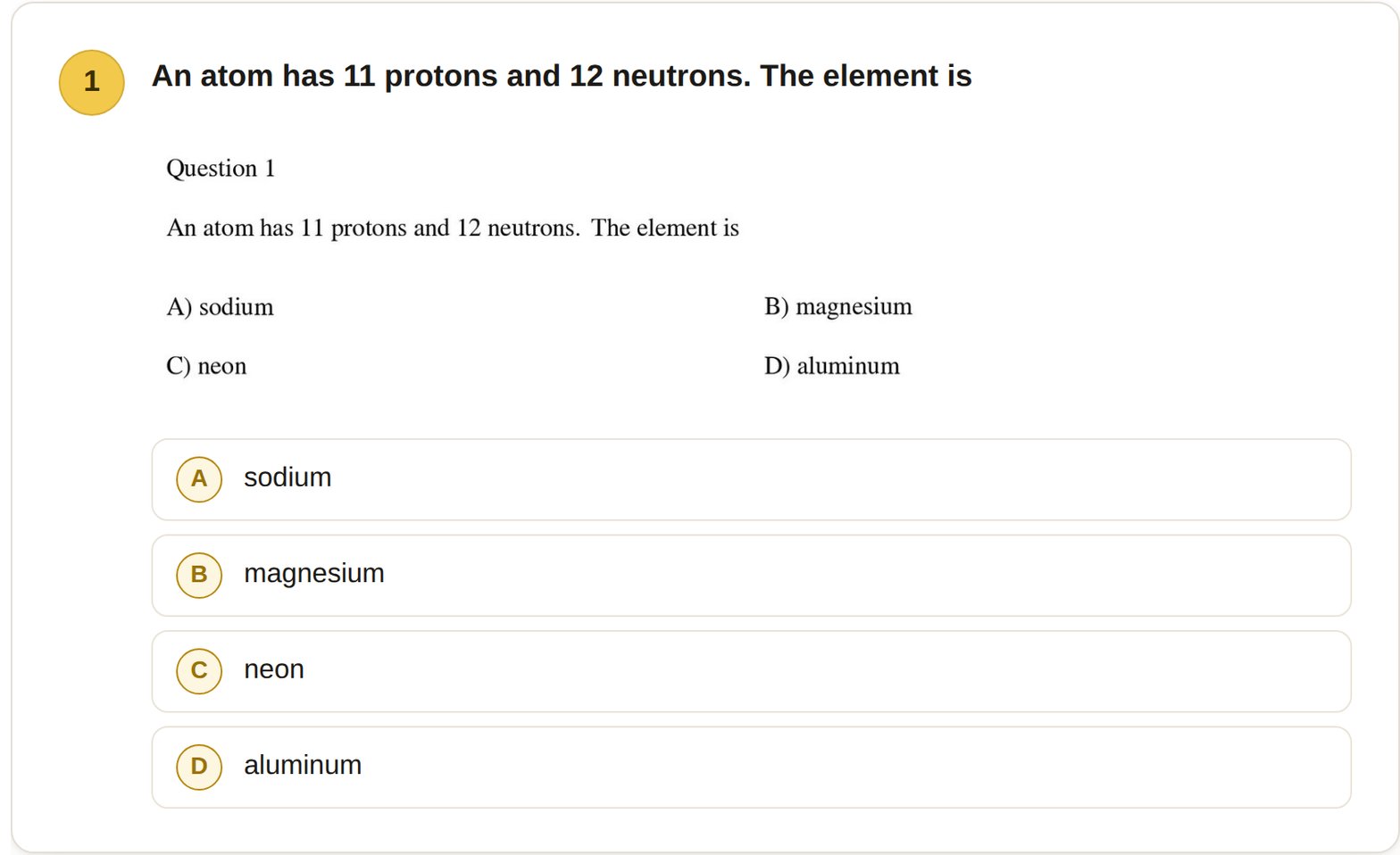
An atom has 11 protons and 12 neutrons. The element is
Final Exam - Practice Test | Minnesota Chemistry · Final Exam · 50 questions
This practice test was made by AI and there may be mistakes. If a question or answer looks wrong, use the Flag a mistake button to let Brett know so he can fix it.
An atom has 11 protons and 12 neutrons. The element is
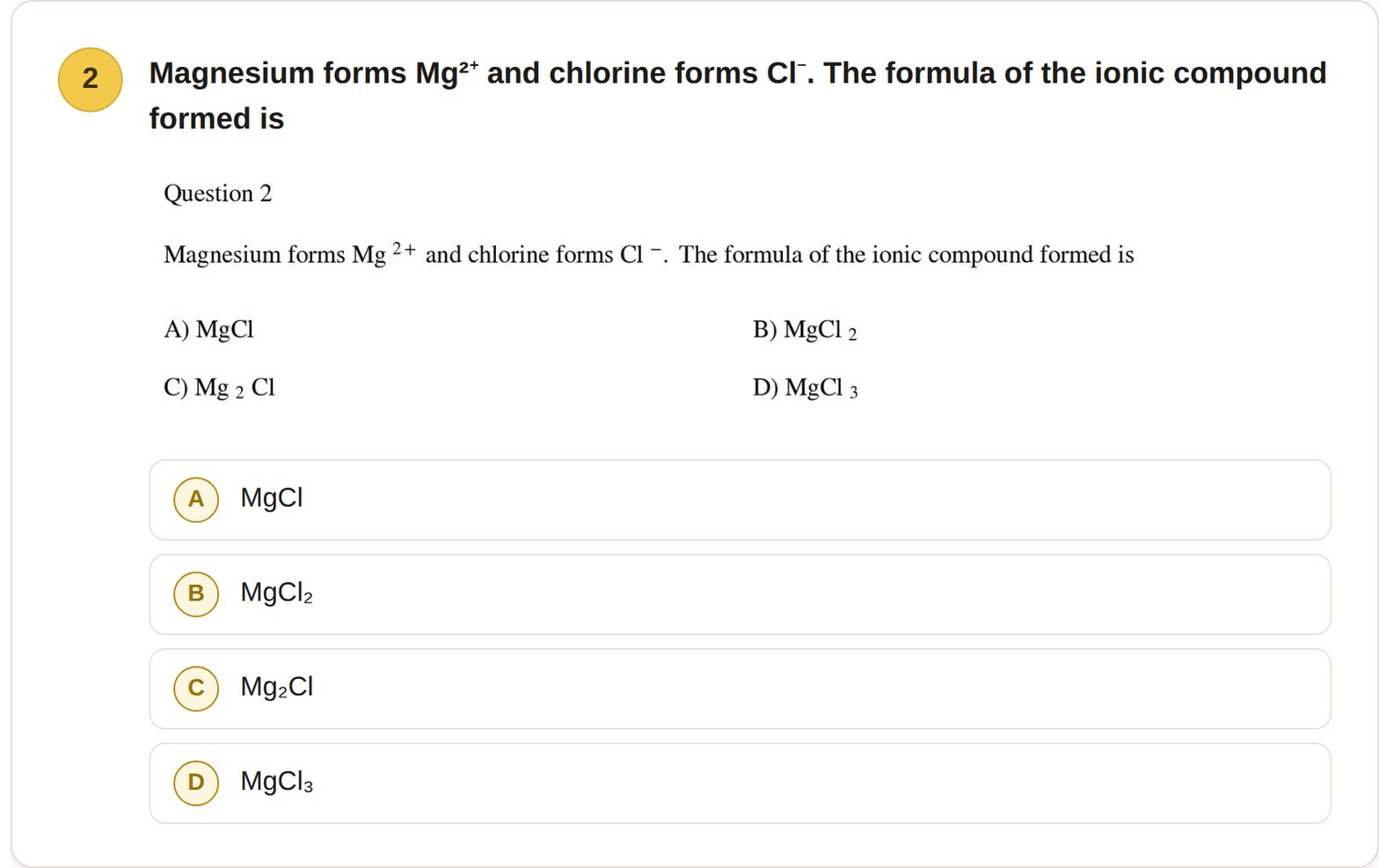
Magnesium forms Mg²⁺ and chlorine forms Cl⁻. The formula of the ionic compound formed is
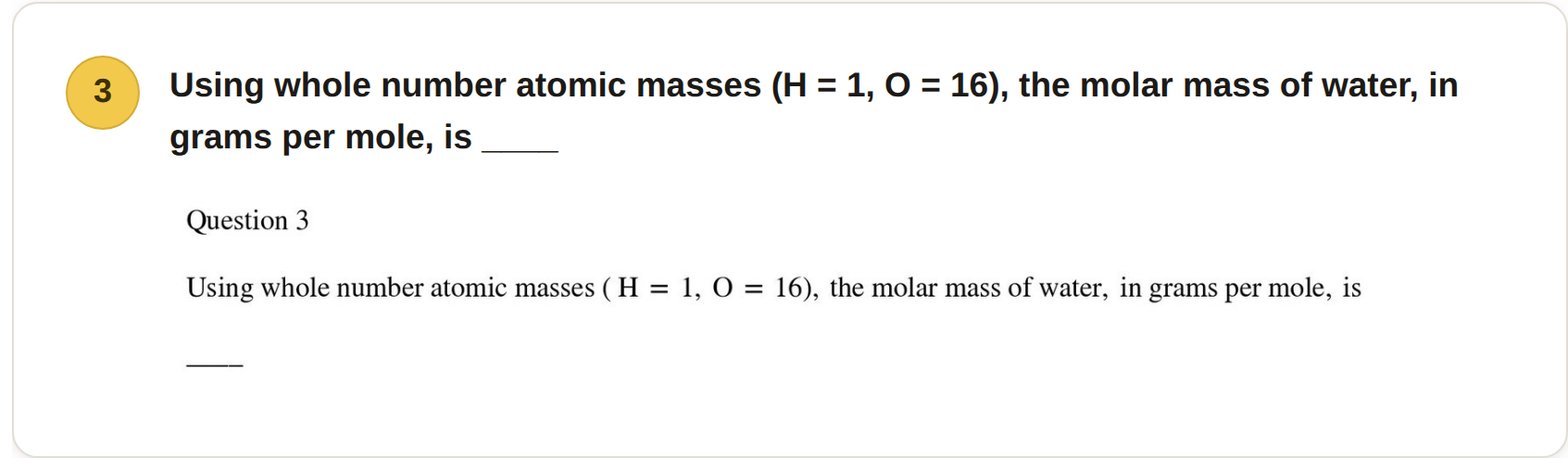
Using whole number atomic masses (H = 1, O = 16), the molar mass of water, in grams per mole, is ____
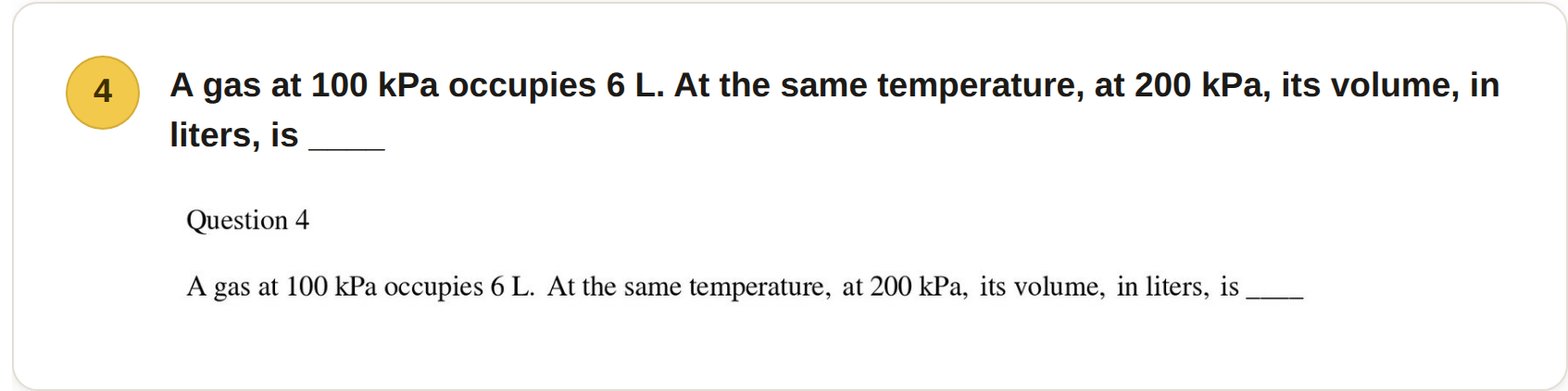
A gas at 100 kPa occupies 6 L. At the same temperature, at 200 kPa, its volume, in liters, is ____
A neutral atom has 8 protons. The number of electrons it has is
Carbon dioxide has a central carbon atom bonded to two oxygen atoms and no lone pairs. The shape of the molecule is
Molarity is defined as moles of solute per
A gas at 100 kPa and 300 K is heated to 600 K at constant volume. Its new pressure, in kilopascals, is ____
The element in group 2 and period 4 is
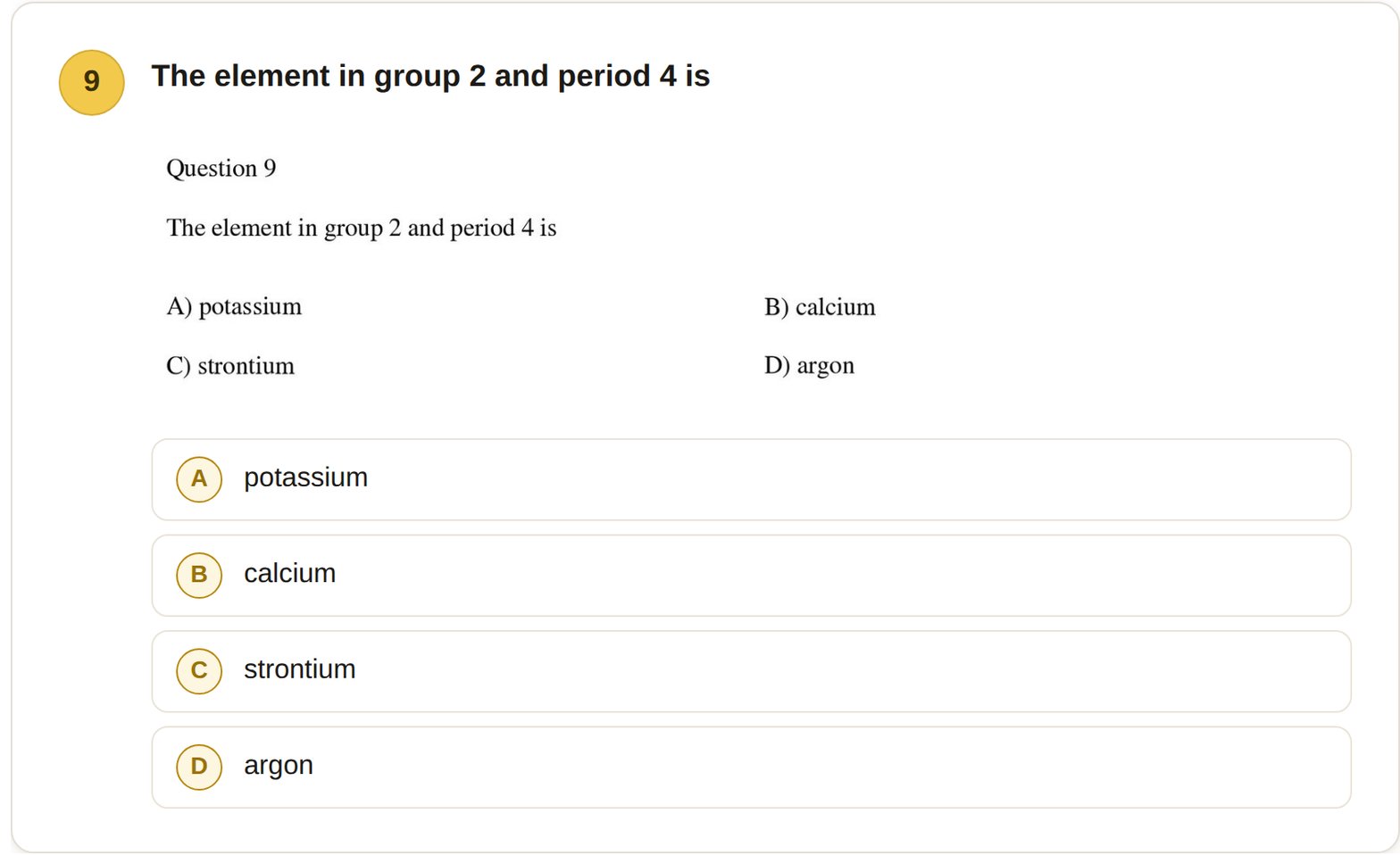
Which of these molecules can form hydrogen bonds with other molecules of the same kind
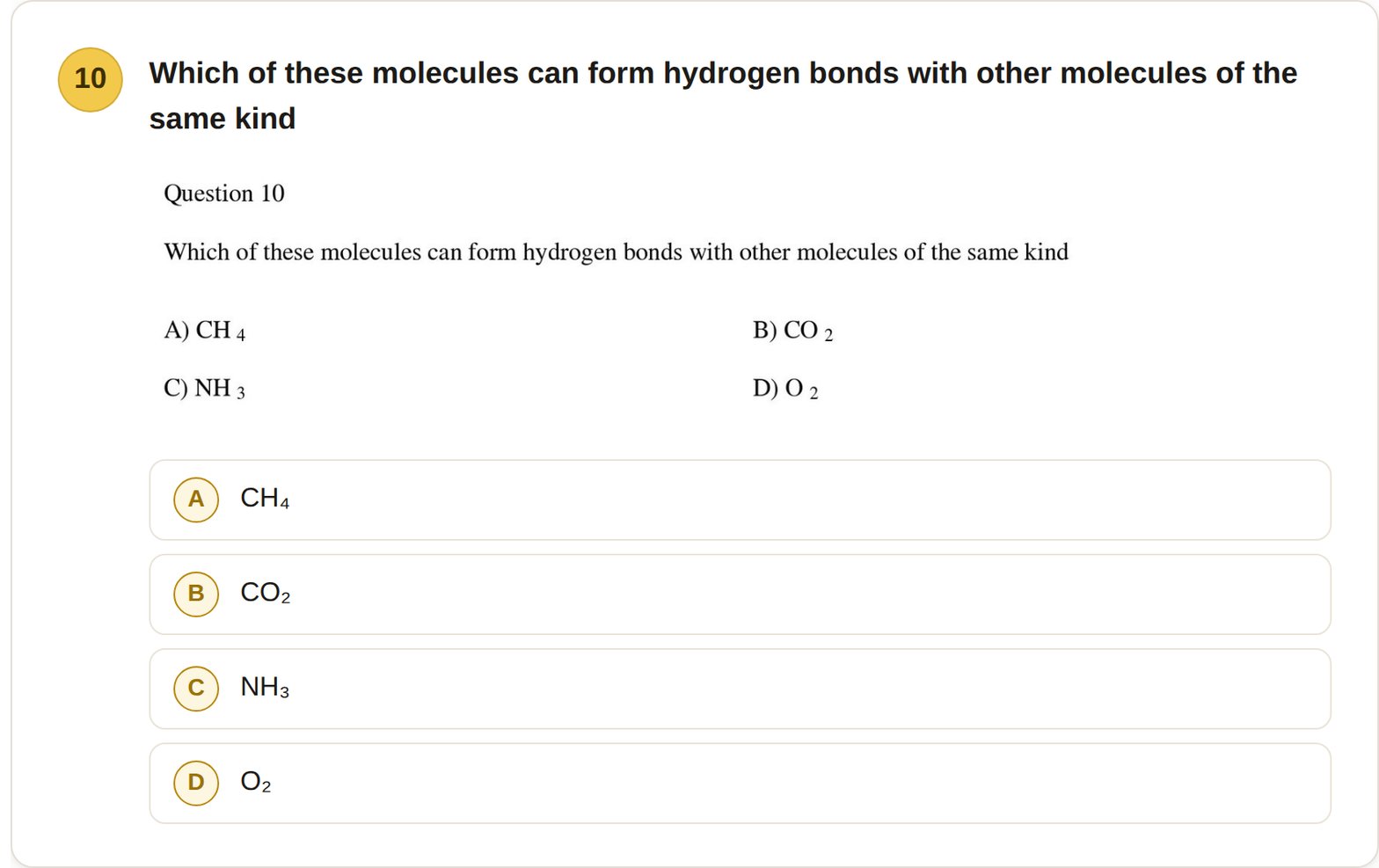
In a chemical reaction, the reactant that runs out first is the
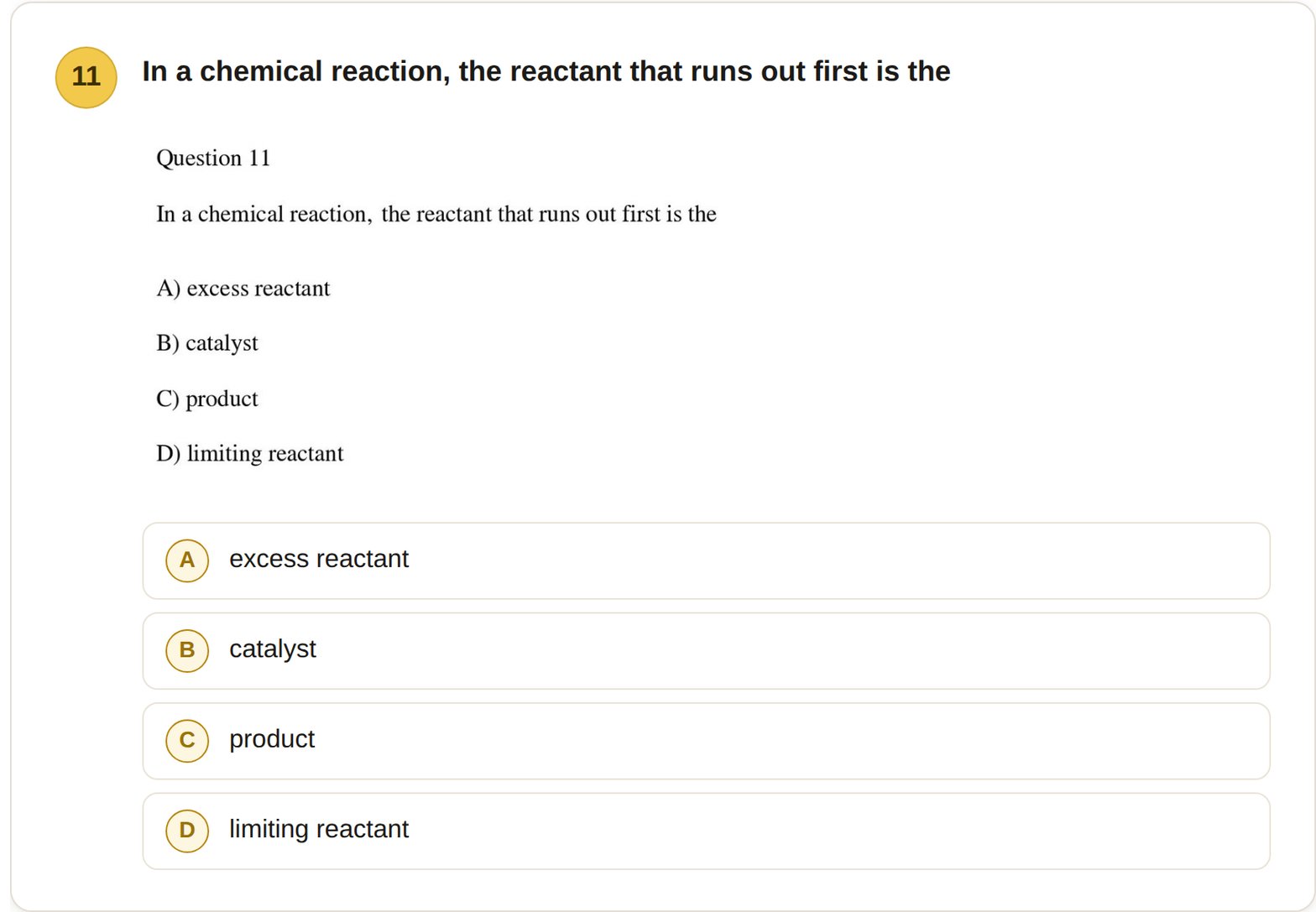
At standard temperature and pressure, the volume, in liters, of 2 mol of gas is ____
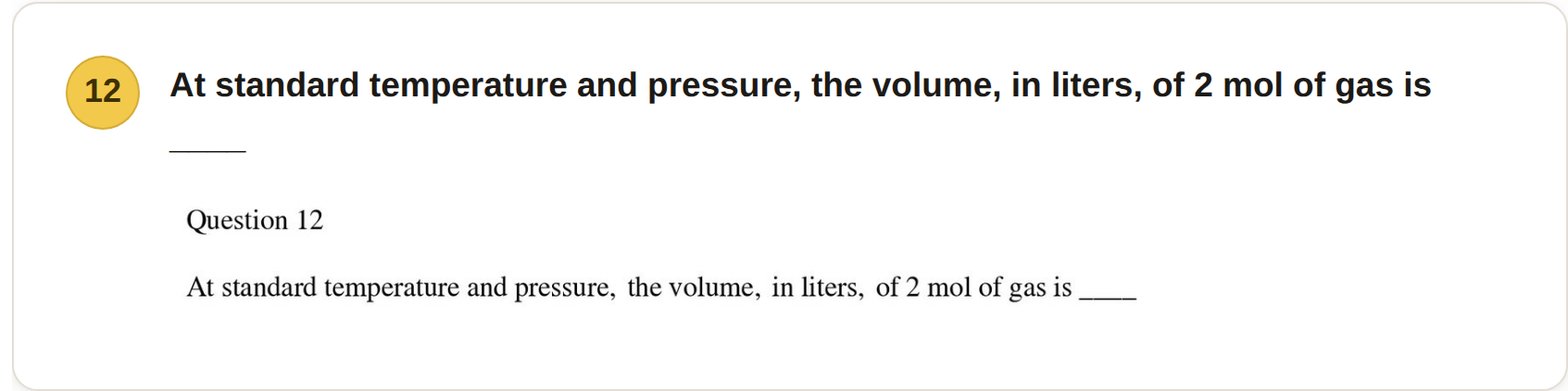
Going across a period from left to right, ionization energy generally
The reaction CaCO₃ → CaO + CO₂ is a
Which solution is more concentrated
Using c = 4.2 J per gram per degree Celsius, the heat, in joules, absorbed by 100 g of water warmed by 10 degrees Celsius is ____
In the Bohr model of the atom, electrons are described as
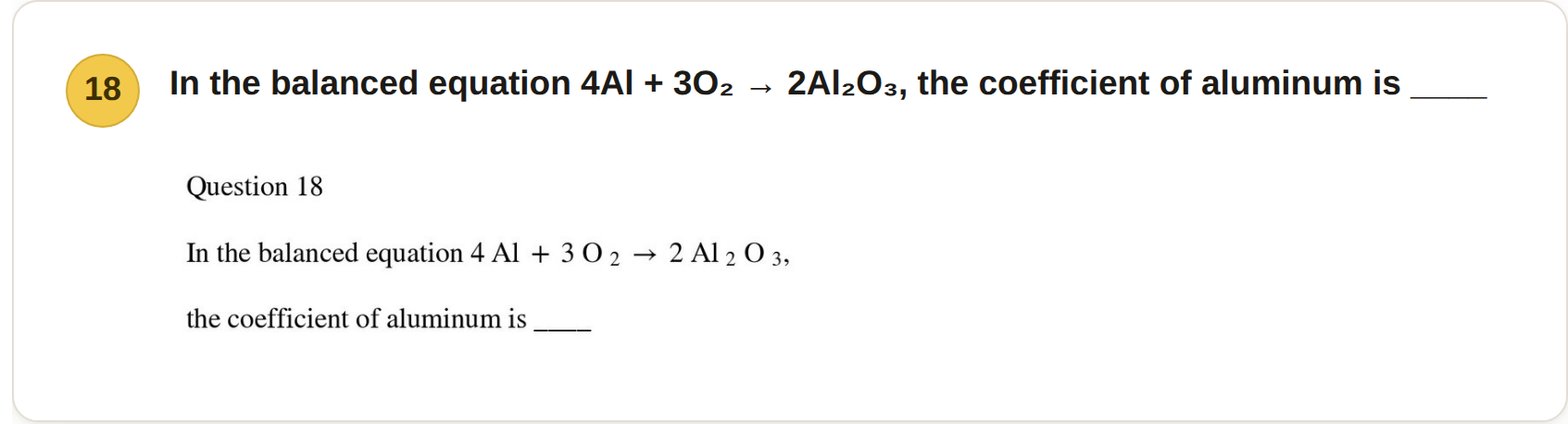
In the balanced equation 4Al + 3O₂ → 2Al₂O₃, the coefficient of aluminum is ____
The percent by mass of oxygen in carbon dioxide, to one decimal place, is ____
At equilibrium, the forward and reverse reaction rates are
Which of these is a heterogeneous mixture
Metallic bonding is best described as
A compound contains 12 g of carbon (1 mol) and 2 g of hydrogen (2 mol). The number of hydrogen atoms per carbon atom in its empirical formula is ____
Entropy increases when a solid
Going down a group, electronegativity generally
In a water molecule, the oxygen atom has this many lone pairs of electrons
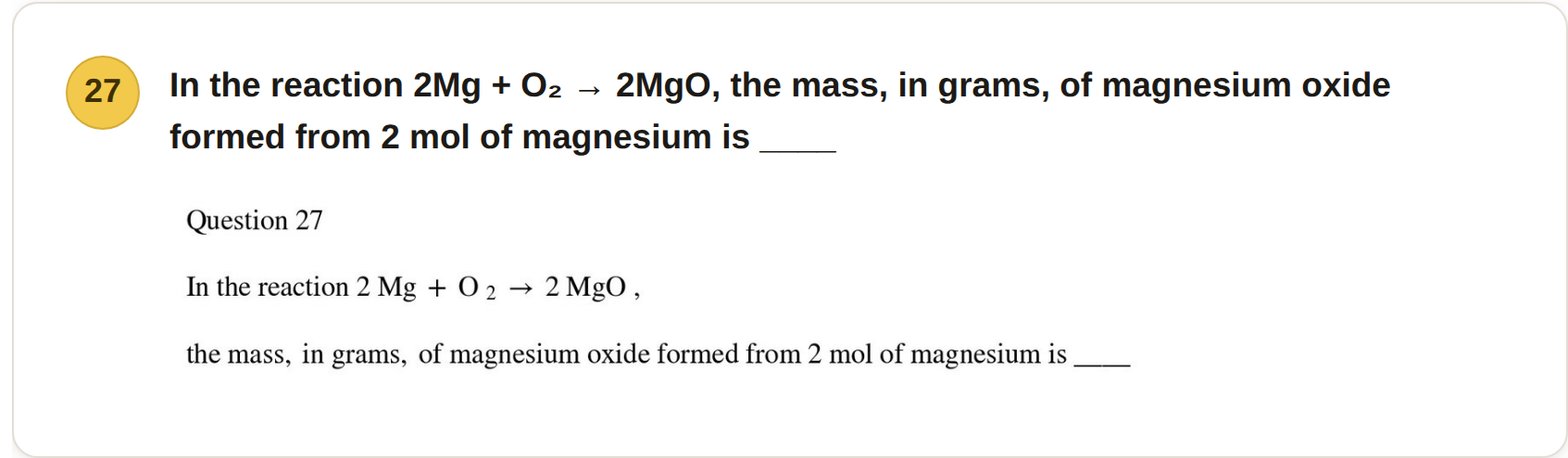
In the reaction 2Mg + O₂ → 2MgO, the mass, in grams, of magnesium oxide formed from 2 mol of magnesium is ____
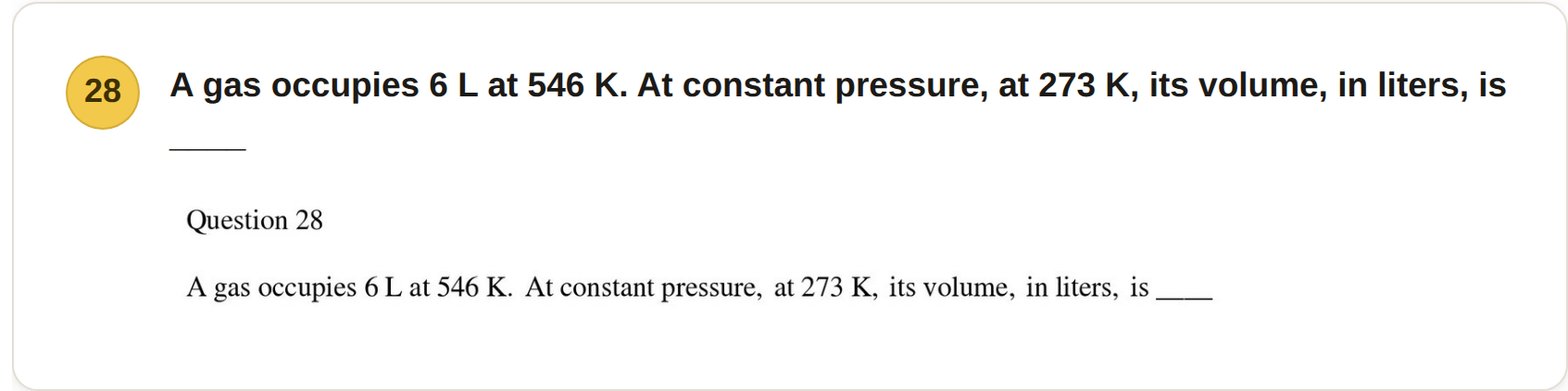
A gas occupies 6 L at 546 K. At constant pressure, at 273 K, its volume, in liters, is ____
Which particles are found in the nucleus of an atom
The strongest intermolecular force among these substances is found in
Using atomic masses (Na = 23, Cl = 35.5), the molar mass of sodium chloride, in grams per mole, is ____
Gas pressure is caused by gas particles
Sulfur has atomic number 16. The number of electrons in S²⁻ is ____
The total number of atoms in one formula unit of Ca(OH)₂ is ____
The concentration of a solution increases when
A gas occupies 4 L at 273 K. At constant pressure, at 546 K, its volume, in liters, is ____
Iron-56 has atomic number 26. The number of neutrons in iron-56 is ____
In the balanced equation H₂ + Cl₂ → 2HCl, the coefficient of hydrogen chloride is ____
A balanced chemical equation conserves
Hess law states that the total enthalpy change of a reaction is
A sample has mass 120 g and density 3 g per cubic centimeter. Its volume, in cubic centimeters, is ____
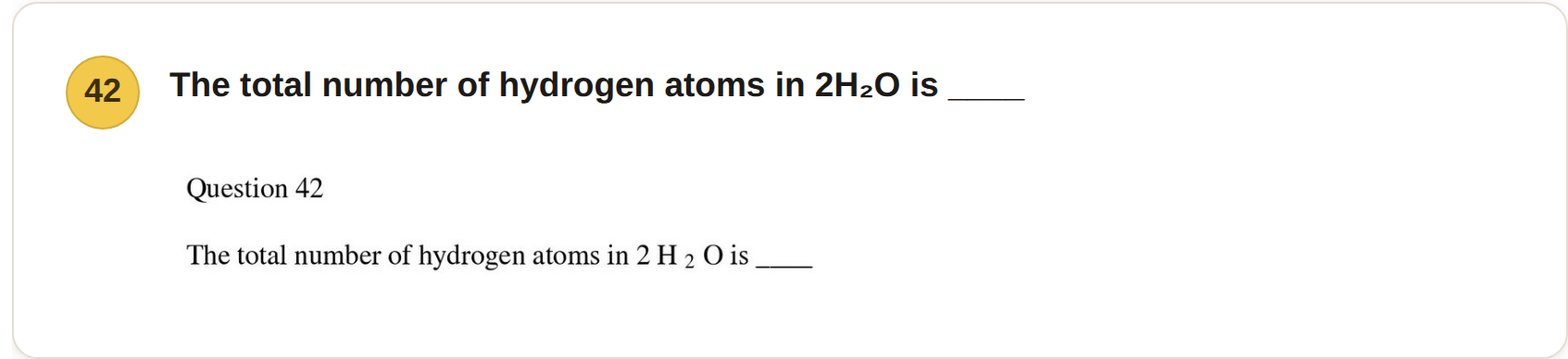
The total number of hydrogen atoms in 2H₂O is ____
In the reaction CaCO₃ → CaO + CO₂, the mass, in grams, of calcium oxide formed from 1 mol of calcium carbonate is ____
Removing a product from a system at equilibrium shifts equilibrium toward the
Using whole number atomic masses (C = 12, O = 16), the molar mass of carbon dioxide, in grams per mole, is ____
In the balanced equation 4Fe + 3O₂ → 2Fe₂O₃, the coefficient of iron is ____
A percent yield of 80% means the actual yield is
A gas at 100 kPa occupies 12 L at 300 K. At 200 kPa and 600 K, its volume, in liters, is ____
An atom has mass number 27 and 14 neutrons. The number of protons in the atom is ____
The total number of ions in two formula units of NaCl is ____
Your score: 0 / 50